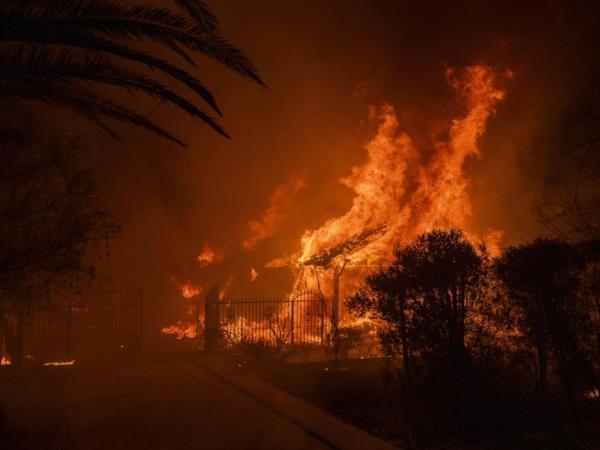
As of Thursday, the Eaton Fire is 55% contained and the Palisades Fire is 22% contained, according to Cal Fire. But what exactly does “containment” mean?
The National Wildfire Coordinating Group defines containment as the status of a wildfire suppression action signifying that a control line has been completed around the fire, and any associated spot fires, which can reasonably be expected to stop the fire’s spread.
The key to containment lies in establishing a control line, a barrier around the fire created by removing vegetation and fuel. Firefighters achieve this by digging trenches or conducting controlled burns to eliminate potential fuel sources, as explained by the Western Fire Chiefs Association.


Additionally, a “firebreak” serves as a natural or constructed barrier that can act as a control line, such as a wide highway or the ocean.
The primary objective of containment efforts is not to extinguish the fire entirely but to prevent its further growth. It's crucial to note that even when a fire is 100% contained, it may continue to burn. For instance, the Mendocino Complex Fire, which started on July 27, 2018, was fully contained on September 18 of the same year. However, hot spots within the containment area continued to smolder for several months until the fire was completely extinguished on January 4, 2019.
Containment is a critical milestone in wildfire management, indicating that the fire's spread is under control. It underscores the ongoing efforts of firefighters to establish barriers and prevent the fire from expanding further, ultimately safeguarding lives and property.