Closing summary
And, on that note, we will be closing the blog for today.
-
Ukraine’s military has confirmed it hit the Taneko oil refinery in Russia’s Tatarstan region overnight (12:08) as part of its campaign to raise the Russian cost of continuing the war against Ukraine (10:08, 12:08).
-
13 people were reported dead with 39 injured after strikes on Nizhnekamsk in Russia’s Tatarstan region, including seven Uzbek citizens (14:54, 16:12).
-
Russia criticised the strike as a “terrorist attack” and opened a criminal investigation (11:08).
In other news,
-
Danish prime minister Mette Frederiksen and Italian prime minister Giorgia Meloni released a statement vowing to protect Europe’s “Christian cultural heritage,” ramping up their rhetoric on irregular migration (11:43).
-
Several European countries continued to battle the impact of extreme temperatures and droughts affecting key rivers, including the Rhine, the Danube, and the Vistula (14:27), as the UK and France brace for the fifth heatwave of the summer (15:43).
-
Estonia’s ruling coalition lost its majority after two MPs leaving their parties (15:52).
If you have any tips, comments or suggestions, email me at jakub.krupa@theguardian.com.
I am also on Bluesky at @jakubkrupa.bsky.social and on X at @jakubkrupa.
Russia developing its Starlink-like system 'faster than expected,' top Ukrainian official says
Separately, it is emerging that Russia is rolling out its own version of the Starlink satellite internet system faster than expected and plans to have nearly 300 satellites in orbit by 2027, according to a Ukrainian intelligence official quoted by Reuters.
SpaceX’s Starlink network, which operates in Ukraine but not Russia, has given Kyiv a major advantage in drone operations and battlefield communications.
Russian forces had been using grey-market Starlink terminals in Ukraine until Kyiv successfully lobbied SpaceX to disable them earlier this year, one of several factors that shifted battlefield momentum in Ukraine’s favour.
In an interview with Ukrainian media outlet RBC-Ukraine, Maj Gen Vadym Skibitskyi said Russia currently has 16 satellites in its Rassvet system.
“They have already begun launching it much faster than originally planned,” said Skibitskyi, who is the deputy head of Ukraine’s GUR military intelligence service.
“Once Russia deploys a full satellite constellation, the system will operate like Starlink. Discussions are already underway on how to counter it,” he said.
Nine victims of oil refinery strike were at hostel
We are now getting a bit more details from Russia about the attack on oil refinery in Tatarstan.
Nine out of 13 victims of the drone attack on Russia’s Nizhnekamsk on Monday were in a hostel at the time of the strike, Russian news agency RIA reported, citing the press office of the head of the region.
Seven Uzbek citizens were killed in the attack in Russia, the Uzbek consulate in Kazan said earlier, Reuters said (14:54).
Estonia's government loses majority
There also some political news from the Baltics, where Estonia’s governing coalition lost its majority today, after two MPs left their parties.
The move leaves the government with 50 seats in the 101-seat parliament.
Prime minister Kristen Michal acknowledged the impact of the resignations, saying his administration will need to “seek compromises” to function.
He said his government will “hold the line so that Estonia is securely defended, our prosperity turns to growth, nature remains clean, and our vision is future-oriented,” public broadcaster EER reported.
The next parliamentary election needs to be held by March 2027.
UK, France brace for fifth heatwave of the summer
In other continental news, the UK and France are preparing for another – fifth! – heatwave of the summer, with temperatures in high 30s and up to 40C in parts of the two countries.
For the latest on this, you can follow our blog here:
Germany will devote more resource to its anti-drone police unit, the government has said, just days after an explosives-laden unmanned aerial vehicle (UAV) was found in a strategically important airport.
Last week a UAV was defused after it was found near a Ukrainian cargo plane at Leipzig-Halle airport, a key hub for military equipment transports.
AFP reports interior minister Alexander Dobrindt labelled the incident a “hybrid attack scenario” potentially involving a “foreign power”. Berlin now plans to double personnel in the federal police anti-drone unit to 300.
Updated
Seven Uzbek citizens among 13 killed in Ukrainian drone attack on Nizhnekamsk in Tatarstan
AP is quoting Russian authorities who have issued an updated casualty count after the Ukrainian drone strike on the petroleum hub of Nizhnekamsk in Tatarstan. It is now said that it killed 13 people and wounded 75 others.
At the same time Reuters has issued a newsflash the Uzbek consulate has said that seven of those killed were Uzbek citizens.
The Ukrainian military said it hit an oil refinery in Nizhnekamsk, which is about 1,200 kilometers (750 miles) east of the Ukrainian border. The city has a population of about 240,000.
Tatarstan’s head, Rustam Minnikhanov, has declared a day of mourning, and claimed a child was among those killed.
Adding to the list of concerns across Europe over the heatwave and risk of fires, Greece has reported a new fire near Athens.
AFP reports hundreds of crew have been dispatched in a bid to halt it spreading. More than 10,000 hectares of pine forests were left blackened by a blaze that broke out 10 days ago northwest of the capital.
Updated
Drought continues to affect Vistula, Rhine, Danube rivers
In other news, extreme temperatures and droughts in large parts of Europe are causing further disruptions.
Western Europe experienced its warmest June-July period on record, with heat and drought fuelling extreme wildfires across the region, the European Union’s Copernicus Climate Change Service said, as reported by Reuters.
“Climate change is increasingly bringing the kinds of hot and dry conditions that favour large, high-intensity wildfires in southern Europe while extending the fire season northwards,” Laurence Rouil, director of the Copernicus Atmosphere Monitoring Service, said in a statement.
The Vistula, Poland’s longest river, fell on Monday to match its record low in Warsaw, the national meteorological institute IMGW reported.
“We are currently recording a water level of 102 centimetres,” matching a record set on Friday, IMGW hydrologist Dariusz Witkowski told AFP.
Across the border, a German industry group that parts of the Rhine river could soon become unnavigable as water levels drop further due to soaring summer temperatures and low rainfall.
Last week, ING warned that record low water levels in the Rhine could shave 0.3% off Germany’s GDP growth this year (Europe Live).
Meanwhile, Romania said its only working nuclear reactor can operate for a further nine days after it redirected the flow of the drought-hit Danube river to supply the turbines with water, Reuters reported.
Updated
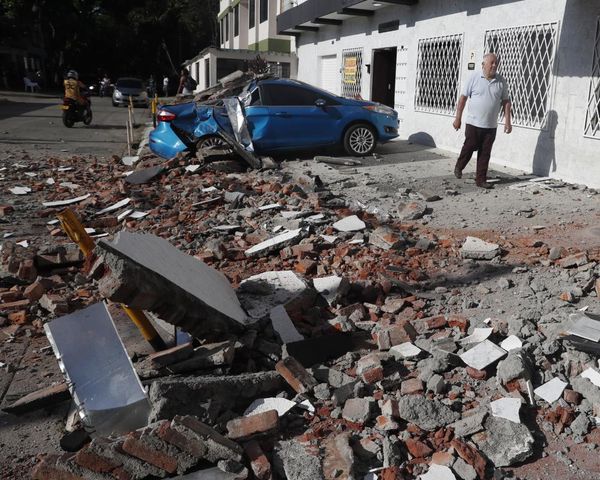
We are now getting some pictures showing the scale of destruction in Kharkiv after a Russian strike on a multi-story residential building there killed five people (10:11).
Drones strike Russian industrial facility in Siberia
A fire broke out at an industrial facility in Russia’s Tyumen region in Siberia after several drones fell on it, Tyumen region governor Alexander Moor said on his Telegram channel.
This is reported by Reuters.
UN Security Council to discuss Ukrainian prisoners of war
Later today, the UN security council will hold a meeting on Ukrainian prisoners of war and civilian detainees held by Russia, Ukraine’s foreign minister Andrii Sybiha said.
“First-hand testimonies will highlight the systematic torture and abuse faced by Ukrainians in Russian captivity, as well as the urgent need for international access, an end to ill-treatment, accountability, and the return of all those unlawfully detained,” he said.
The meeting has been called by Latvia, the UK, and Ukraine.
The World Health Organization chief, Tedros Adhanom Ghebreyesus, said a WHO warehouse stocking medical supplies in the Ukrainian city of Dnipro was destroyed in strikes on Friday.
“I cannot say loudly enough: attacks on health care must stop. Otherwise, people are deprived of life-saving healthcare,” Tedros posted.
“Even wars have rules. One of those is that health must be protected!”
Ukraine's military confirms its strikes on oil refinery in Russia's Tatarstan
Meanwhile, Ukraine’s military has confirmed it hit the Taneko oil refinery in Russia’s Tatarstan region overnight, adding that a fire was recorded at the facility, Reuters reported.
Updated
Frederiksen and Meloni sign joint statement on tackling irregular migration and 'protecting' Europe's 'Christian cultural heritage'
Nordic correspondent
In other news, the Danish prime minister Mette Frederiksen has released an inflammatory joint statement with Italy’s PM Giorgia Meloni vowing to “protect” what they refer to as Europe’s “Christian cultural heritage”.
The statement by the two leaders, released on Facebook with a picture of the two of them smiling side by side, states that they expect people from other countries to “respect European values” and “not impose a way of life on us that we do not want”.
It comes after Frederiksen, leader of the centre left Social Democrats, and Meloni, leader of the far-right Brothers of Italy, only recently joined forces to put pressure on Spain over Ceuta.
“Respect for our laws must go hand in hand with respect for European values,” they wrote in the statement released today. “This applies to illegal migrants, but also to the millions of foreign nationals living legally in our countries and in Europe.”
Signing off “Giorgia and Mette”, they added:
“We both acknowledge Europe’s Christian cultural heritage and wish to protect it. We expect those who come to our countries and wish to make Europe their home to respect European values and not impose upon us a way of life we do not desire.”
Acknowledging their differences, they write: “We know many people wonder about our partnership. We come from very different political backgrounds.”
But they then go on to say that as “the only two female heads of government in the EU” they are “united in our desire to look after Europe. We will not accept uncontrolled migration into Europe.”
Claiming that “no one can deny that illegal migration has had negative consequences for our societies,” they say that they plan to set up “departure centres in third countries” and “other innovative solutions outside Europe”.
As well as a sign of the potential direction of travel among European leaders on attitudes to immigration, their words will also have strong repercussions domestically in Denmark amid rising Islamophobia.
It is also indicative of Frederiksen’s growing embrace of right wing immigration politics – despite leading a recently formed left-leaning coalition – which has proved to be influential across the Nordics and among Labour politicians in the UK.
Updated
Russia criticises 'terrorist' attack on Nizhnekamsk, opens criminal investigation
Responding to the overnight strikes on Nizhnekamsk, Russian investigators said they had opened a criminal case into what they qualified as a terrorist attack, saying in a statement that Ukraine had struck residential areas and that a child was among those civilians killed, Reuters said.
The head of Russia’s Tatarstan region, Rustam Minnikhanov, has declared a period of mourning, Radmir Belyayev, the mayor of Nizhnekamsk, said in a statement on Telegram. The region’s oil refinery, one of Russia’s most technologically advanced, was hit in the attack, Russian media reported.
There was no immediate comment from Ukraine, Reuters reported.
Russian central bank tells banks to provide support to businesses hit by attacks on warehouses
The Russian central bank has advised creditors to support businesses affected by Ukrainian attacks on logistics centres and warehouses, according to a letter from the bank published on Monday and reported by Reuters.
Affected businesses should be able to apply to restructure their loans, the regulator said.
At least 20 warehouses belonging to Russian e-commerce retailer Wildberries have been attacked by Ukraine since 18 July.
Up to 50,000 North Korean soldiers expected to be deployed in Russia, Ukraine says
Up to 50,000 North Korean soldiers will be deployed in Russia, Volodymyr Zelenskyy has said, while calling on South Korea to provide support for Ukraine’s air defence.
It is an increase from the estimated 30,000 announced by the Ukrainian president in July.
Kyiv had found some North Korean missiles in Ukraine’s territory, he said.
“It is absolutely clear that North Korea will continue to build its experience in modern warfare, receive licences from Russia, and receive all kinds of military tools from them.”
Five dead after Russian attack on Ukraine's Kharkiv region
Meanwhile, at least five people died in a Russian strike on Ukraine’s Kharkiv region, regional prosecutor’s office said.
“On 10 August, Russian forces carried out a massive artillery strike on the residential area of the village of Bugaivka in the Chuguiv district. Various houses were destroyed as a result of the enemy attack. Five people were killed,” the prosecutor’s office said in a statement on Telegram, quoted by AFP.
Morning opening: 12 killed, 39 injured as Ukraine steps up attacks on Russian oil refining facilities
A Ukrainian drone attack on the city of Nizhnekamsk in Russia’s Tatarstan region killed 12 people and wounded 39 others, Russian authorities said.
The city, some 1,000 kilometers within Russia, hosts a major oil refinery, with facilities long targeted by Ukrainian army. Ukraine previously hit the facility in June.
Russia said it shot down 456 Ukrainian drones, without specifying how many of them reached their targets.
In his regular nightly address, Ukraine’s president Volodymyr Zelenskyy said on Sunday that continuing strikes on oil refining facilities were directly linked with putting more pressure on Moscow.
“The only reason this is still continuing is Russia’s unwillingness to end this war,” he said.
Agencies said it was one of Kyiv’s most deadly attacks of the full-scale war since 2022.
Elsewhere, I will be keeping an eye on the row between Spain and Italy, after Madrid reintroduced border checks on visitors from Italy in response to Rome imposing similar measures after a mass rush of people from Morocco into Ceuta.
Italy’s authorities were left frustrated by the move, with the country’s foreign minister calling it “completely unacceptable,” as tourists faced border delays.
It’s Monday, 10 August 2026, it’s Jakub Krupa here, and this is Europe Live.
Good morning.