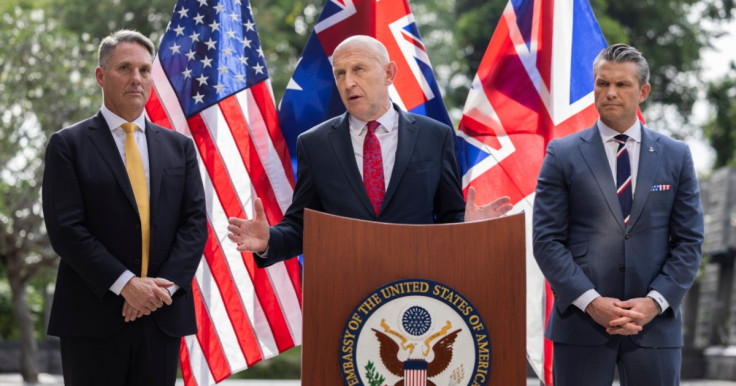
The United Kingdom, United States and Australia have unveiled plans to develop a new generation of underwater drone technology designed to protect critical infrastructure, strengthen military capabilities and enhance security beneath the world's oceans.
The announcement was made during a major defence summit in Singapore, where ministers from the three nations confirmed that the project would become a flagship initiative under the AUKUS security partnership.
The advanced underwater systems are expected to be operational as early as next year, marking one of the first major capability projects to emerge from the alliance's technology-sharing programme.
New Technology Targets Growing Undersea Threats
The planned uncrewed undersea vehicles, commonly known as UUVs, will be equipped with sophisticated sensors, payloads and weapons systems capable of carrying out a wide range of missions.
According to defence officials, the technology will help protect vital seabed infrastructure, including communications cables and energy pipelines that support modern economies and global connectivity.
The drones will also be capable of surveillance, reconnaissance, logistics support and precision strike operations.
UK Defence Secretary John Healey said the new systems would rapidly provide allied forces with advanced battlefield technologies while helping address threats to underwater infrastructure.
New defence deal secured 🇬🇧🇦🇺🇺🇸
— John Healey (@JohnHealey_MP) May 30, 2026
Today, we announced the first ever AUKUS pillar 2 signature project.
Backed by over £150M, our new weapons and sensors for undersea drones will secure the High North and Indo Pacific.
We're full steam ahead on AUKUS. pic.twitter.com/Bs32ROjHnj
The importance of undersea cables has grown significantly in recent years. These networks carry vast amounts of global internet traffic, financial transactions and communications data. Damage to even a small number of cables can disrupt services and create significant economic consequences.
The UK alone is connected through dozens of undersea cables, many of which have become increasingly important to national security and economic stability.
Concerns Rise Over Russian And Chinese Activity
The project comes amid growing international concern about suspected interference with underwater infrastructure in several regions around the world.
British officials have previously raised alarms about Russian naval activity near critical undersea assets in waters surrounding the United Kingdom. London has accused Moscow of conducting covert operations targeting cables and pipelines, claims that Russia has firmly rejected.
Meanwhile, incidents involving damaged cables in the Baltic Sea and waters around Taiwan have intensified fears that strategic infrastructure could become vulnerable during periods of geopolitical tension.
Chinese vessels have also faced scrutiny following reports linking ships to incidents involving damaged undersea communication lines in parts of northern Europe and East Asia.
While investigations into several cases remain ongoing, the events have highlighted the increasing importance of protecting infrastructure hidden beneath the oceans.
Although defence ministers declined to directly link the new AUKUS programme to Russian or Chinese activities, analysts view the initiative as part of a broader effort to strengthen security in strategically important maritime regions.
Officials say the technology will improve deterrence capabilities across the Indo-Pacific, the Atlantic Ocean and northern waters where military competition has become more pronounced.
AUKUS Faces Pressure To Deliver Results
The underwater drone initiative represents the first major signature project under AUKUS Pillar Two, which focuses on advanced technologies such as artificial intelligence, hypersonic weapons and undersea robotics.
The broader AUKUS agreement, established in 2021, was created to deepen defence cooperation between the three nations and expand military technology sharing. It is widely viewed as a strategic response to shifting power dynamics in the Indo-Pacific region.
Despite its ambitious goals, the partnership has faced criticism over the pace of progress. Some observers have questioned whether major projects, particularly the planned nuclear-powered submarine programme, can be delivered on schedule.
Australia's future AUKUS submarines are not expected to enter service until the 2040s, leading to concerns about replacing the country's ageing fleet.
In the interim, British and American nuclear-powered submarines will rotate through Australian bases, while Canberra plans to acquire second-hand vessels from the United States during the 2030s.
However, ministers insisted the programme remains firmly on course. US Defence Secretary Pete Hegseth said submarine rotations through Australia were progressing as planned, while Australian Defence Minister Richard Marles confirmed that key infrastructure projects were advancing rapidly.
With £150 million committed by Britain towards the underwater drone effort, AUKUS leaders are hoping the project will demonstrate that the alliance is moving from promises to practical results.
As competition beneath the oceans intensifies, the three nations are betting that advanced autonomous technology will become a crucial part of future defence and security operations.