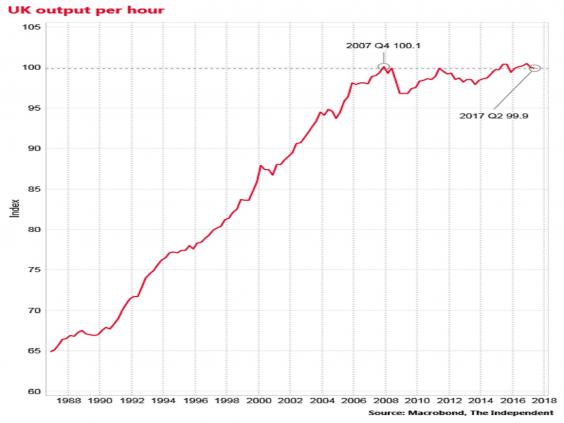
The UK's productivity sank again in the second quarter of 2017, edging Britain closer to a lost decade of productivity growth and increasing the likelihood of the emergence of a new hole in the public finances.
The Office for National Statistics reported on Friday that UK real output per hour worked fell by 0.3 per cent in the three months to June.
This followed an expansion of just 0.1 per cent in the first quarter.
That means the level of UK productivity remains below where it was in the final quarter of 2007, before the financial crisis and recession hit.
Such a prolonged period of productivity stagnation for the UK is unprecedented in modern times and is one of the key drivers of the dismal performance of average wages since the crash.
At the time of the March Budget the Treasury's official watchdog, the Office for Budget Responsibility had forecast that output per hour would grow by 0.5 per cent in the first quarter of 2017 and 0.3 per cent in the second quarter.
Over 2017 as a whole the OBR had projected that the UK economy’s productivity would grow by 1.6 per cent, 1.5 per cent next year and 1.7 per cent in 2019, rising to 1.8 per cent in 2020.
The Treasury expects the OBR to respond to the latest disappointing outturn data to revise down its productivity growth forecasts over the next five years, slashing projected tax revenues and eating deep into the £26bn of headroom that the Chancellor Philip Hammond had been projected to have in 2020-21 against his own fiscal rules.
The ONS also reported on Friday that the output per hour gap between the UK and the average for the rest of the G7 economies was 15.1 per cent in 2016.
Lost decade approaching
Productivity, by this measure, was 25.6 per cent below Germany's and 22.3 per cent below that of France.
Many economists expect Brexit to reduce the UK’s long-term productivity performance by lowering trade flows with our nearest neighbours and also restricting immigration.
The OBR revised down its forecast for UK trend potential productivity growth in the wake of the Brexit vote between 2017 and 2020, reflecting its expectation of less productivity-enhancing business investment due to uncertainty over future trade arrangements and resulting in a £7.2bn hole in the public finances by 2020-21 relative to otherwise.