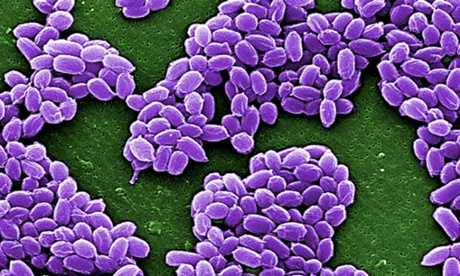
A laboratory in the UK is among a growing list of those accidentally sent samples of live anthrax by the US department of defence in 2007, officials have confirmed.
The UK lab that received the anthrax is run by a private company, which destroyed the deadly pathogens soon after they arrived from the US without ever realising they were live rather than inactivated. It is understood that none of the workers who had contact with the anthrax fell ill.
The Health and Safety Executive refused to name the laboratory where the incident took place, on the grounds that it would pose a security risk if the anthrax research carried out at the facility became public. At the time the pathogen was sent to the lab, private companies ran at least 98 labs in the UK with sufficient containment to handle bugs as dangerous as anthrax.
The company that runs the lab only learned that the anthrax sample was potentially live when the US Department of Defense got in touch about the shipment during their current investigation, the Guardian understands. The HSE said that together with other government agencies, it was “ready to support the company as necessary”.
“We do not believe there is any continuing health risk to staff or to the public. If anyone would have been exposed in 2007, symptoms would have presented shortly after. No such reports of ill health were apparent in the workforce,” the HSE said.
The DoD breaches, which occurred at Dugway Proving Ground – a US military laboratory in Utah – appear to have occurred over several years. The DoD have said their investigation is ongoing, but so far live samples of the pathogen have been found to have been sent to a total of 68 laboratories across the US, Australia, South Korea and now the UK.
Dugway is a facility which produces anthrax – a weaponised version of a naturally occurring deadly bacteria – in industrial quantities. From there, samples of the pathogen are sent to labs across the world for use in testing for detection equipment and treatments.
In theory the samples are “inactivated” by radiation first, but experts told the Guardian that the system may not have been properly calibrated, potentially over an extended period of time.
In a statement, DoD spokesperson Maj Eric Badger said that there were “no suspected or confirmed cases of infection, and no known risk to the general public”.
“Concurrently, DoD is performing a comprehensive review of its laboratory procedures, processes, and protocols associated with inactivating spore-forming anthrax, by order of deputy secretary of defense Bob Work,” Badger added.
A similar breach was revealed in 2014 at the Center for Disease Control in Atlanta, Georgia, when up to 70 staff were thought to have been accidentally exposed to the live toxin because the lab failed to use an approved sterilisation technique. It is not known whether the breaches at Dugway – which appear to be much larger in scope, and happened over a much longer period of time – may have had a similar origin.
“Obviously there’s going to be a lot of discussion and investigation into what went wrong here,” said Stephen Morse, a professor of infectious disease epidemiology at Columbia university in New York, who is an expert in bio-defence. “To me the surprising thing is that it didn’t just happen for a short period of time, it was a problem that went on for a while.”
Richard Ebright, an expert in bio-weapons at Rutgers university, said there was little or no direct danger to the public. Instead, he said, “the major concern is the security breach” of not knowing where the weaponised spores – from even a small amount of which a dangerous amount can be grown – have gone.