Good-bye, and thank you for all your great comments. We’ll be back tomorrow.
Before I go.... The Financial Times is reporting that the IMF’s executive body has been told by its staff that Athens’ reforms don’t go far enough and the fund should not be involved in the troika’s third, €86bn bailout. The paper says:
The International Monetary Fund’s board has been told Athens’ high debt levels and poor record of implementing reforms disqualify Greece from a third IMF bailout of the country, raising new questions over whether the institution will join the EU’s latest financial rescue.
The determination, presented by IMF staff at a two-hour board meeting on Wednesday, means that while IMF staff will participate in bailout negotiations currently under way in Athens, the Fund will not decide whether to agree a new programme for months — potentially into next year.
Closing summary
I’m wrapping back for the day. Here are today’s main events:
- The American, Irish and Spanish economies are powering ahead, the latest GDP figures showed. The Irish economy has grown to €189bn and is now bigger than in the “Celtic Tiger” boom days of 2007, before the credit crunch and global recession struck.
- Greek prime minister Alexis Tsipras has called for an internal ballot (“referendum”) within his divided Syriza party on the bailout conditions on Sunday, although his preference is to hold an emergency party congress in September (after Greece is expected to have sealed its new bailout deal with the troika). In a defiant speech in an old movie theatre in Athens to Syriza’s central committee, he defended the government’s decision to accept the bailout.
- European stock markets have been buoyed by upbeat company results, including from Siemens, Nokia and Deutsche Bank, although concerns over China are evidently still a drag. The pan-European FTSEurofirst 300 is up 0.5%. Germany’s Dax is back in positive territory, up 0.1%, after turning negative, France’s CAC is 0.4% ahead and the FTSE 100 index in London has gained 0.3% to 6649.61.
Updated
Alasdair Cavalla, economist at the Centre for Economics and Business Research, says:
This brings official data closer into step with other indicators, which had not noted a sharp difference between Q1 and Q2. The first-quarter figure was indeed softer due to a ports shutdown, poor performance in the mining sector and unseasonably bad weather, but the Bureau of Economic Analysis admitted that its statistical adjustment process is itself in need of some adjustment. This means that in contrast to the originally reported contraction, the US saw only a mild dip and is continuing to witness solid, but not stellar growth.
Consumers are powering the recovery: the barometer of durable goods, which grows when people are confident enough to make larger purchases, showed a 7.3% jump in Q2 while consumption expenditure grew 2.9% overall. The housing market made a similarly strong contribution mirroring this strong sentiment. Investment shrunk slightly, though that reflects in part the weaknesses in oil and gas pulling down the figure for the broader economy. A surprising outturn came from exports, which are hampered by the strong dollar and generally weaker conditions in overseas markets. These recovered most of the ground lost in Q1, rising by 5.3%.”
Updated
Chris Williamson, chief economist at economic data firm Markit, says:
Updated GDP numbers deliver a double-punch to US economy doom-mongers, painting a reassuringly bright picture of the health of the US economy so far this year and raising the odds of the Fed hiking interest rates in September
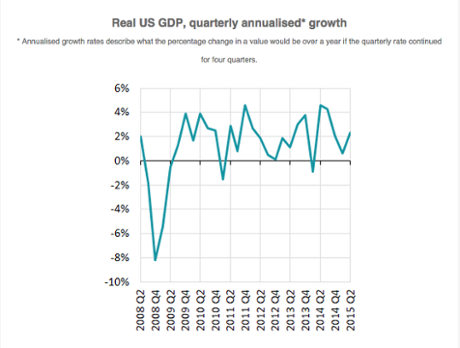
Not only did the economy grow at a robust 2.3% annualised rate in the second quarter, the 0.2% downturn previously seen at the start of the year has been revised away to show growth of 0.6%.
The new data, and the first quarter revisions in particular, remove a worrying sense of doubt about the health of the economy that will have given cautious policymakers a reason to hold back on hiking interest rates for the first time since rates were effectively cut to zero at the height of the global financial crisis.”
NOTABLE US GDP REVISION: Growth between 2011-14 was 2.0% not 2.3%--not a big difference, but helps explain #Fed caution last year #USD
— Ken Odeluga (@TheSquareMile) July 30, 2015
US economy obviously began growing earlier, but their ↓ revisions and UK's ↑ revision last yr making recoveries look increasingly similar.
— Mike Bird (@Birdyword) July 30, 2015
Consumer spending boosted US economic growth in the second quarter, as people used some of the savings made from cheaper gasoline to go shopping. Consumer spending, which accounts for more than two thirds of US economic activity, rose 2.9%, versus 1.8% in the first quarter.
A pick-up in the housing market, exports and government spending also underpinned growth.
US #GDP +2.3% (annualised) in Q2 (+0.6% in Q1): Consumer spending up 2.9%, business investment down 0.6%, Exports +5.3%, Imports +3.5%
— Markit Economics (@MarkitEconomics) July 30, 2015
Decent aggro'd 12:30 GMT data for USD: claims hold near 40Y low; Q2 GDP basically in line; Q1 GDP revised higher; Q2 consumption beats. $DXY
— Christopher Vecchio (@CVecchioFX) July 30, 2015
The eurozone's brief moment in the sun over https://t.co/3TMOvP5IBh
— Mike Bird (@Birdyword) July 30, 2015
Updated
US economy gathers speed, Q1 contraction revised away
The US economy grew at an annualised rate of 2.3% in the second quarter, the Commerce Department said. In the first quarter, GDP rose by 0.6%, rather than shrinking by 0.2% as previously estimated, with bad weather holding back the economy.
Updated
Q2'15 US GDP report due up in <10-mins: +2.5% exp from -0.2% (annualized); Atlanta Fed GDPNow tracking it at +2.4%. pic.twitter.com/i1zntZb3d4
— Christopher Vecchio (@CVecchioFX) July 30, 2015
Returning to Greece, here are the comments made by prime minister Alexis Tsipras to his party this morning, as reported by Reuters. In a defiant speech in an old movie theatre in Athens, he said:
I propose to the central committee to hold an emergency congress to discuss being in power as leftists, our strategy in the face of bailout conditions.
But there is another view, which is respected, that doesn’t accept the government’s analysis and believes there was an alternative available in the early morning hours of 13 July [when he accepted a bailout agreement with Greece’s credits to avoid Grexit].
If this is the case... then I suggest the party hold a referendum on this crucial question.
Updated
In other news, as readers have pointed out, Germany’s FAZ newspaper is reporting that German finance minister Wolfgang Schäuble wants to weaken the European Commission by removing the competition and single market departments.
The paper says he believes the Brussels-based commission can no longer combine its role as ‘guardian’ of the EU treaties - including enforcing anti-trust and internal market rules - with its increasing political activities.
This is what the International Monetary Fund said about Ireland back in March. In its annual assessment, the fund found that the Irish economy was “starting to fire on all cylinders”, although the scars of the crisis were still visible in high unemployment, widespread mortgage arrears and house prices 38% below their peak. Then, the IMF forecast economic growth 0f 3.5% this year, much of it led by exports.
Ireland’s recovery is off to a good start in 2013–14, with some of the adverse legacies from the crisis beginning to heal
However, ING economist Anthony Baert was more cautious. Ireland grew by 6.5% year-on-year in the first quarter. He said:
Although over 6% yearly growth rates were not unusual for Ireland in the pre-crisis years, the current growth spurt still looks like catching-up speed rather than cruising speed. However, this process could still take some time. Despite the strong activity, the labour market is not performing as strong.
Irish economy now bigger than at height of 'Celtic Tiger' boom
At €189bn, the Irish economy is now bigger than at the height of the “Celtic Tiger” boom in 2007, before the financial crisis struck.
Alan McQuaid, chief economist at Merrion Stockbrokers, said:
It is quite clear that Ireland will easily top the eurozone growth league table for the second year running.
Growth is now more likely to be in the 5-6% range for 2015, a positive boost for the government ahead of next year’s general election.”
Updated
Irish economy on track to be fastest-growing EU economy in 2015
We’ve also had Irish GDP figures today. Ireland had a strong start to the year, with economic growth of 1.4% in the first quarter. Growth in 2014 was revised higher to 5.2% from 4.8% – the highest growth rate since 2007 and the best performance in the European Union.
Ireland’s central bank upgraded its forecasts, predicting expansion of more than 4% for 2015 and 2016, which would make the country the best-performing economy in the EU again.
Updated
For the back story, it is worth reading the New Yorker’s excellent profile of the flamboyant former Greek finance minister Yanis Varoufakis, entitled The Greek Warrior.

Tsipras proposes Syriza congress in September
Just to clarify: the Greek prime minister proposed to Syriza’s central committee to hold an emergency party congress in September – after Greece has sealed its new bailout deal with the troika, he hopes. He warned against deepening internal divisions by trying to decide the party’s strategy in a hurry. But he also raised the possibility of holding an internal ballot on Greece’s bailout deal on Sunday.
Tsipras argued that the bailout deal was “not of our choice” but the alternative was bleak: a disorderly default. Exit from the euro without reserves to support a new currency would have led to major devaluation and a return to the IMF, he told his party.
Tsipras offered party 2x choices: membership referendum or special conference - to head off left revolt.
— Paul Mason (@paulmasonnews) July 30, 2015
Updated
... or an internal ballot on the bailout conditions in September. Syriza hardliners however want to vote on the bailout deal as soon as possible.
Updated
Looks like Tsipras may hold a party referendum on the bailout deal on Sunday.
Tsipras calls for Syriza party referendum on Sunday on bailout. Here we go again!
— Jeremy Gaunt (@reutersJeremyG) July 30, 2015
#Tsipras: If some don't think there was no alternative and insist on discussion on their alternative, should be party referendum on Sunday.
— NikiKitsantonis (@NikiKitsantonis) July 30, 2015
Looks like Tsipras is in real trouble w Syriza. Dissenters ask 4 party referendum on the bailout deal. Tsipras might not b able 2 prevent it
— Yannis Koutsomitis (@YanniKouts) July 28, 2015
Updated
Tsipras has defended the Greek government’s deal with creditors, saying it was “not of our choice”. Speaking to his party’s central committee, which runs Syriza, he said Greece faced a dilemma between a difficult compromise and a disorderly default. According to the Kathimerini newspaper, the Greek prime minister said:
If someone believes another government could have brought back a better deal they should say so.
He believes that his government has actually managed to stir up the EU.
We created the first cracks in Europe’s neoliberal hegemony. We have to give a definitive answer on whether a leftist government can exist in a liberal, conservative Europe.
Greek newspaper Kathimerini reports:
#Tsipras to SYRIZA: Grexit would force Greece into devaluation and going back to IMF for support
— Kathimerini English (@ekathimerini) July 30, 2015
#Tsipras to SYRIZA: It's not going to be easy but we don't have choice, for time being at least #greece
— Kathimerini English (@ekathimerini) July 30, 2015
If Tsipras loses his grip on Syriza and the party splits, Greece could be plunged back into turmoil. It struck an 11th hour deal with international lenders earlier this month to keep Athens afloat with a new €86bn aid package – Greece’s third bailout.
But hardliners within the centre-left party rejected the deal and accused Tsipras of betraying Syriza’s anti-austerity roots. The hardline Left Platform faction wants the government to ditch talks with the troika immediately and hold a party congress to determine its line.
In a radio interview on Wednesday, Tsipras said he could be forced to call a snap general election if he loses his parliamentary majority, and suggested an emergency party conference could be held in early September.
Tsipras has opened the Syriza central committee meeting at an old cinema in central Athens.
#Now #SYRIZA_Central_Committee @atsipras "We came close to rupture but having in mind that our goal was an agreement" #Greece
— Yannis Karagiorgas (@IKaragiorgas) July 30, 2015
Whoever chooses not to accept problems of Grexit is either "wilfully neglecting reality or hiding the truth," Tsipras tells SYRIZA #Greece
— Nick Malkoutzis (@NickMalkoutzis) July 30, 2015
"Exit from euro without reserves to support new currency would have led to major devaluation & return to IMF," Tsipras tells SYRIZA #Greece
— Nick Malkoutzis (@NickMalkoutzis) July 30, 2015
Updated
European stock markets lifted by upbeat company results
European stock markets have been buoyed by upbeat company results, including from Siemens, Nokia and Deutsche Bank. Germany’s Dax is 0.1% higher while France’s CAC has gained 0.2%.
European equities are heading for their third consecutive day of gains, as investors are also encouraged by the US Federal Reserve’s latest comments. The Fed painted a bright picture in the jobs market when it left interest rates near zero last night, but did not appear more aggressive on the timing of its first interest rate hike (which could come as early as September).
In the UK, 14 FTSE 100 companies have reported results, and Shell, AstraZeneca and Rolls-Royce are among the main risers. The index is trading more than 26 points higher at 6657.65, a 0.4% rise.
Updated
Eurozone economic sentiment hits four-year high
While we are waiting for more news out of Greece, the European Commission has released figures that show economic sentiment in the eurozone improved this month. Its index rose to 104 from 103.5 in June.
Tsipras arrives at Syriza Central Committee meeting. #Greece pic.twitter.com/AfdzKx1KG6
— Yannis Koutsomitis (@YanniKouts) July 30, 2015
Updated
The Syriza central committee meeting comes as Delia Velculescu, the Romanian economist chosen to lead the International Monetary Fund’s negotiating team in Greece, arrives in Athens. She was dubbed the “iron lady” during the talks over Cyprus’s bailout.
Updated
But Tsipras said on Wednesday he would not be blackmailed by his party’s hardliners. He wants the Syriza central committee to agree to a party conference in September. He plans to hold a snap election after Greece has signed up to the €86bn third bailout.
#Syriza general committee hasn't begun yet. #Tsipras to will have an opening talk https://t.co/1su9J9vSKy pic.twitter.com/0Fj5S7Xt0u
— Savvas Karmaniolas (@savvaskarmanio) July 30, 2015
Tsipras speech to Syriza Central Committee 10ish EET. Looks like he hs regained majority. Influential 'Movement of 53+' faction now back him
— Yannis Koutsomitis (@YanniKouts) July 30, 2015
Updated
Tsipras faces showdown with Syriza rebels
Greek prime minister Alexis Tsipras faces a showdown with his party’s rebels today. Syriza’s central committee, which is composed of 200 party members, including some MPs, will decide whether to hold a party conference immediately to decide its course.
Nearly a quarter of Syriza MPs refused to back the bailout deal hammered out by the government with Greece’s international creditors earlier this month.
Updated
Greece’s economy, meanwhile, is expected to shrink by 3.3% this year.
#Spain GDP 3%+ and #Ireland 4%+ will make interesting reading in Athens "Spain picks up pace" http://t.co/GWhN3AazkQ pic.twitter.com/tFJUpQjS4U
— Mike Dolan (@reutersMikeD) July 30, 2015
In October 2014 there was consensus that #Greece 2015 GDP would land at minimum +2%. Now forecast lies at -3.3%. Syriza mission accomplished
— Yannis Koutsomitis (@YanniKouts) July 29, 2015
More on Spain. Its centre-right government expects the economy to grow by 3.3% in 2015, which would outpace most of its eurozone peers.
However, unemployment remains a huge problem: more than 5m people are out of work and the unemployment rate is at 22.4%.
While the the number of jobless is staring to fall, many jobs are temporary and badly paid. The government expects the unemployment rate to fall back below 10% within the next three years.
Economy minister Luis de Guindos said in a radio interview:
We’re starting to see the light at the end of the tunnel. We are now able to return to pre-crisis income levels.”
Spain expects a record tourist season this summer, which should help growth in coming months. Inflation is now non-existent, with the latest reading at zero this month, down from 0.1% in June.
Updated
German unemployment rises unexpectedly
Meanwhile in Germany, unemployment has unexpectedly gone up for the second month in a row. The number of jobless people climbed by 9,000 to 2.8m in July, the Federal Labour Agency said. However, the unemployment rate remained at 6.4%, the lowest since German reunification in 1990.
Spain's economy powers ahead: fastest growth since 2007
Olé! Spain’s economy is powering ahead with 1% growth in the second quarter. This is the fastest rate of growth since 2007 and comes after 0.9% growth in the first quarter.
We will get US GDP figures at 1.30pm London time.
#Germany's tough love approach has worked: #Spain economy powering ahead to Pre-Crisis Growth. http://t.co/BAicPWWHRP pic.twitter.com/iPY7YiHvyW
— Holger Zschaepitz (@Schuldensuehner) July 30, 2015
Is #Spain strong GDP rebound a poster child for #austerity or for #stimulus? Fiscal deficit in 2014 5.8% of GDP. pic.twitter.com/PZdobHbQnm
— Edward Hugh (@Edward_hugh) July 30, 2015
#Spain #GDP rises 1.0% q/q in Q2 (+0.9% in Q1). Strongest rate of growth since 2007. Charted against our #PMI here: http://t.co/ElgNlUWfdM
— Markit Economics (@MarkitEconomics) July 30, 2015
Updated
Rolls-Royce shares are also leading the FTSE 100 higher, even though half-year profits at the British defence and aerospace group more than halved to £310m. The market had already factored this in and breathed a sigh of relief that the engineering group did not issue another profit warning. Rolls also lifted its dividend by 3% to 9.27p a share.
Rolls’ new chief executive Warren East has his work cut out, as demand for the company’s jet engines has been falling. His predecessor John Rishton retired in April for a “change in lifestyle”. Read more here.
Updated
AstraZeneca is the third-biggest gainer on the FTSE 100, trading 2.1% higher at £42.81, after beating profit forecasts. It reported quarterly sales of $6.3bn, better than expected, while core earnings per share dropped 8% to $1.21.
Revenues were boosted by income from spinning off assets, which offset competition from cheaper copycat versions of bestselling medicines such as its heartburn pill Nexium.
Britain’s second-largest drugmaker upgraded its revenue forecast for 2015 and now expects a low single-digit percentage decline, rather than a mid single-digit fall. Core earnings are still forecast to increase at a low single-digit rate.
Berenberg analysts Alistair Campbell and Louise Pearson said:
The product sales beat is pleasing, with a good performance from the diabetes franchise, which has disappointed over recent quarters.
On the R&D side we note that the company has finally disclosed that it has filed AZD9291 [one of its key new cancer drugs] with the [US regulator] FDA as part of a rolling submission. We see this product as key to the growth prospects of the oncology franchise and expect a rapid approval.”
Smith & Nephew, which makes artificial hips and knees, is another big riser on the Footsie today, up 1.9% to £11.57. Trading profit climbed 6% to $512m in the second quarter, with emerging markets continuing to post double-digit growth.
Updated
FTSE 100 index buoyed by higher corporate profits
Similar to Deutsche Bank, RBS is wrestling with heavy legal costs. It has been hit by £1.3bn of charges for fines and compensation payouts to customers in the first half of the year, as our banking correspondent Jill Treanor reports. The bank’s shares are up 1.4% at 358.2p, however, after it reported higher profits.
Gas group BG Group and Shell, which is taking over BG, are the two biggest risers on the FTSE 100 index: BG is up 2.5% at £10.65 while Shell has risen 2.2% to £18.16. Here’s our full story on Centrica and Shell.
Updated
Spain’s Santander, the biggest bank in the eurozone by market value, enjoyed an 18% rise in second-quarter profits to €1.7bn, boosted by the UK and the US which offset falling revenues at home. The UK now makes up just over a fifth of Santander’s profits.

Strong sales of camera sensors and PlayStation 4 video games have boosted Sony’s profits by 39% to 96.9bn yen in the latest quarter. The results come after the Japanese company announced its first fund raising in a quarter of a century. It wants to use the money to make more image sensors, which are among its best-selling products – while smartphones and TVs have been hit by competition from cheaper rivals in Asia along with industry giants such as Apple and Samsung.
Updated
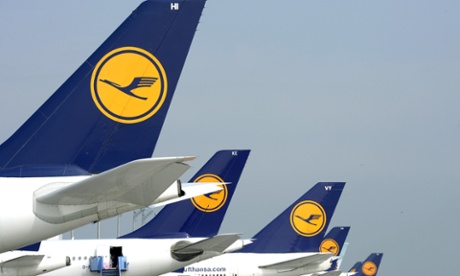
Over in Europe, German airline Lufthansa sees no let-up in pressure on ticket prices and warned of a tougher second half, as it reported better profits and sales for the second quarter.
Europe’s largest carrier has introduced a new fare structure as it battles against competition from low-budget rivals Ryanair and easyJet. It will make passengers pay extra if they want to take more luggage, book a seat in advance or need a flexible ticket. Plans by Ryanair to slash winter fares will prove another headache for Lufthansa.
“We do not see any relief on prices,” said the airline’s chief financial officer Simone Menne. “The competitive situation in Germany, as you can see from our rivals, is getting tougher, and the pressure in Asia is not easing.”
Deutsche Bank has a second-quarter pretax profit of €1.2bn, slightly below expectations. Germany’s biggest bank set aside the same amount to cover fines and settlements, and warned that it may not reach its 2020 performance targets as a result.
This is the first quarter for new boss John Cryan, the former finance chief of Swiss bank UBS, who has taken over from Deutsche’s co-chief executive Anshu Jain, who quit on 1 July. Fellow co-CEO Jürgen Fitschen is due to leave next May.
Cryan is expected to scale back the bank’s large trading operations and push for deeper cost cuts and reforms, while resolving regulatory investigations, which could mean further large fines. Deutsche received a record $2.5bn penalty in the first quarter over attempts to manipulate interest rates. Like many other big banks, it is also under investigation for allegedly rigging foreign exchange markets.
Updated
Good morning, and welcome to our rolling coverage of the world economy, the financial markets, the eurozone and business.
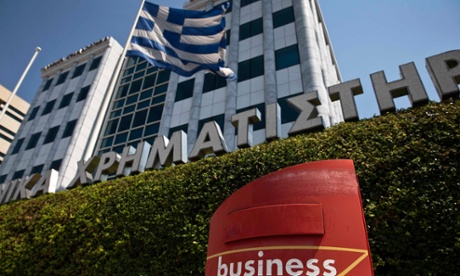
Looks like the Athens stock exchange will not reopen this morning, and probably not tomorrow either. It may reopen on Monday.
There’s a huge amount of corporate news this morning, in the UK and Europe.
Royal Dutch Shell is cutting 6,500 jobs this year, citing falling oil and gas prices. The energy giant, which is taking over BG, beat City forecasts with second-quarter adjusted profits of $3.8bn.
British Gas owner Centrica is to cut 6,000 jobs – after doubling profits to £528m in the first half. Centrica boss Iain Conn has just been asked to explain this on BBC Radio 4. He said the first half of the year has been boosted by a cold spring, falling commodity prices and the way price cuts have been phased in. He added that profits in the second half will be down “significantly” due to two price cuts for consumers. He also noted that the company is creating 2,000 jobs in other parts of the business at the same time.
Royal Bank of Scotland has reported higher profits of £293m for the second quarter, up 27% from a year ago. And its chief executive Ross McEwan is hopeful that the “bigger” fines and settlements the bank has faced in past years are coming to an end. He told Radio 5 live: “I’m hoping we will finish the bigger ones [fines and litigation] this year. But it’s in the hands of the regulators and courts.”
BT has also enjoyed a rise in profits to £694m, up 9%.
Travel company Thomas Cook warned that the recent terrorist attack in Tunisia, and mounting concerns around Greece’s potential exit from the euro, will drag down 2015 profits by about £25m. It made a pretax loss of £44m in the latest quarter, down from £81m, saying summer bookings to most destinations are on track.
Updated