During an online press conference on Oct. 1, U.S. Special Presidential Envoy for Arms Control Marshall Billingslea expressed concerns about China, pointing out that Beijing has freely developed and deployed ground-launched, intermediate-range missiles for more than 30 years and now has 13 kinds of nearly 2,000 missiles, while the United States does not possess those kinds of missiles. The press conference was held just after the State Department official had visited Japan.
Until the Intermediate-Range Nuclear Forces (INF) Treaty between the United States and Russia expired in August 2019, the United States had been banned from possessing ground-launched, intermediate-range missiles. On the other hand, China possesses a large amount of weapons for anti-access/area denial (A2AD), which is aimed at preventing intervention from U.S. forces and others, including the DF-21D anti-ship ballistic missile that has been dubbed the "carrier killer."
China is currently developing hypersonic glide vehicles (HGVs), which cannot be intercepted by existing missile defense systems.
Under such circumstances, the administration led by U.S. President Donald Trump released its National Defense Strategy in January 2018 in which it claims the United States needs to have military capabilities for competition with a major power like China. The U.S. government is currently reviewing strategies and equipment for each branch of the armed forces at a furious pace.
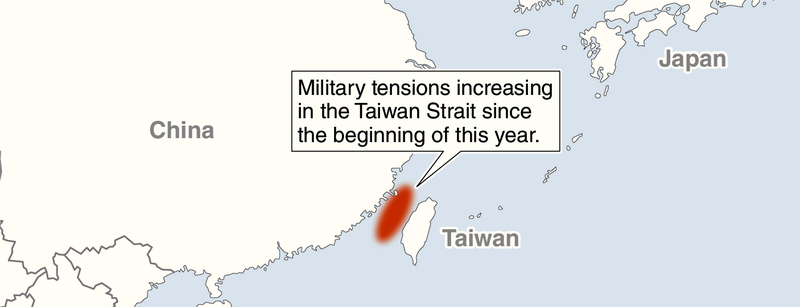
According to a senior Japanese government official, under the latest U.S. strategy, U.S. forces are believed to be withdrawing a carrier strike group to outside the range of China's missile threat in case of a contingency involving Taiwan. In the meantime, U.S. forces will intervene by deploying small U.S. Marine and Army units to the front lines in a dispersed manner, according to the official.
The U.S. side claims that it will have the carrier strike group and other main units back in the East China Sea after it secures safety at sea and in the air. However, the Japanese official said, "There is no guarantee that the carrier can come back."
The official added, "In order to stop China's ambition of forging a fait accompli wherein China occupies and unifies Taiwan in a short amount of time, the United States is thinking about tactics to have U.S. Marines and other forces intervene, even if it loses a war."
-- Countering China
The U.S. military is speeding up efforts to drastically enhance missile defense capabilities to deal with the increasing threat of Chinese missiles.
One of the main pillars is the Integrated Air and Missile Defense (IAMD), which networks various equipment in order to cope with missiles. Ultimately, the U.S. military aims to integrate all sensors including those mounted in a satellite constellation comprising several hundreds of small satellites with all interceptor missile systems held by the U.S. Army, Navy and Air Force so that interceptor missiles can be launched from equipment deployed at optimal locations.
The U.S. military also announced a plan to deploy the land-based Aegis Ashore missile defense system in Guam, where the Terminal High Altitude Area Defense (THAAD) has already been deployed. The latest plan is apparently aimed at enabling the forward deployment of THAAD in case of a contingency involving Taiwan among other cases.
-- Japan's plans
Japan has also tried to strengthen its missile defense capabilities with North Korea's missile development in mind.
Currently, Japan has a system to intercept missiles in two stages, using the Standard Missile 3 (SM-3) interceptor missile mounted on a Maritime Self-Defense Force's Aegis-equipped ship and the Patriot Advanced Capability-3 (PAC-3) surface-to-air guided missile that defends urban and other areas.
In addition, Japan had planned to build up its full-time monitoring and interception capabilities by deploying Aegis Ashore systems in Akita and Yamaguchi prefectures. However, in June, the government gave up the deployment, citing that it became clear there were concerns about a rocket booster falling outside a base, which would cause damage to nearby residents.
In order to prevent the loss of the planned full-time missile defense capabilities, the government intends to decide on a substitute plan before the end of this year. Originally, the Defense Ministry planned to introduce the SPY-7 radar and the Mark-41 launcher in the Aegis Ashore system. Now, the ministry is sounding out ruling Liberal Democratic Party lawmakers affiliated with defense-related organizations about a new plan to create a ship dedicated to ballistic missile defense by mounting the radar and the launcher on the ship.
While the ministry claims that the plan has an advantage in terms of cost, some LDP lawmakers are opposed to it, with one saying, "The ministry is trying to convert the already contracted radar and launcher to a different use."
There is a strong call for building the latest model of an Aegis-equipped ship capable of responding to U.S. forces' future missile defense concept.
The LDP's parliamentary association for national defense said in its proposal that the initial government plan could result in spending lots of money and time on the development and upgrade of equipment, to use for a lengthy period of over 30 years, that cannot respond to new missiles and HGVs.
At one time, the LDP considered reviewing the national security strategy, the national defense program guidelines and the medium term defense program in parallel with a debate on the substitute plan, but the momentum faded after the resignation of then Prime Minister Shinzo Abe.
In order to not foment the root causes of future trouble, the government is required to establish a necessary missile defense system without neglecting the handling of the increasing threat of missiles.
Read more from The Japan News at https://japannews.yomiuri.co.jp/