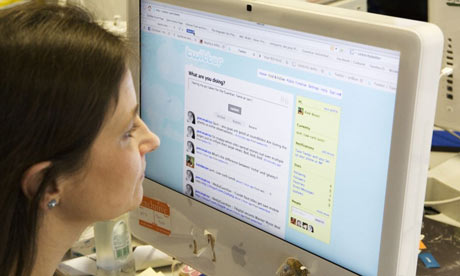
An internet attack that knocked micro-blogging service Twitter offline and disrupted Facebook, LiveJournal, Xbox Live and some Google services seemed random at first, but security experts say it was a coordinated strike targeting a single Georgian blogger.
Max Kelly, Facebook's chief security officer, told CNet news that the strike was an attempt to silence Cyxymu – an outspoken critic of last year's conflict between Georgia and Russia in South Ossetia – as the anniversary of the war approaches.
With a monicker styled after the Cyrillic name for the disputed Black Sea city of Sukhumi, Cyxymu runs a blog written in Georgianised Russian and subtitled "of Sukhumi, the war and Bolivia".
The attack was a distributed denial of service (DDOS) attack. DDOS attacks flood a website with traffic, overwhelming them and preventing them from responding to legitimate requests.
Average internet users play an unwitting role in such attacks. Your computer might have been be one of the thousands directing traffic at these social networks.
Exploiting common computer vulnerabilities, malicious hackers can surreptitiously install software on your computer. Your computer continues to function normally until the hacker launches the hidden program. This is why such compromised computers are referred to as "zombies".
Hackers and organised crime syndicates operate "botnets", networks of millions of these zombie computers. A botnet with 1.9m computers was discovered earlier this year. The US and UK were two of 77 government networks that had been compromised. Attackers can rent zombie computers for as little as five US cents apiece.
This is far from the first politically motivated cyber-attack. Hackers supporting both sides of the Israeli-Palestinian conflict have launched attacks scribbling political slogans on vulnerable websites. Indian and Pakistani hackers routinely do battle, and recently, US and South Korean computers were attacked, with some pointing the finger at North Korea.
With Twitter back up, Cyxymu has blamed Russian hackers. "This hackers was from Russian KGB."
However, it is difficult to prove for certain that this is state-sponsored activity from the Russian intelligence services. More often than not, the attacks come from a group of loosely organised patriotic hackers launching DDOS attacks as the 21st century virtual version of a sit-in.