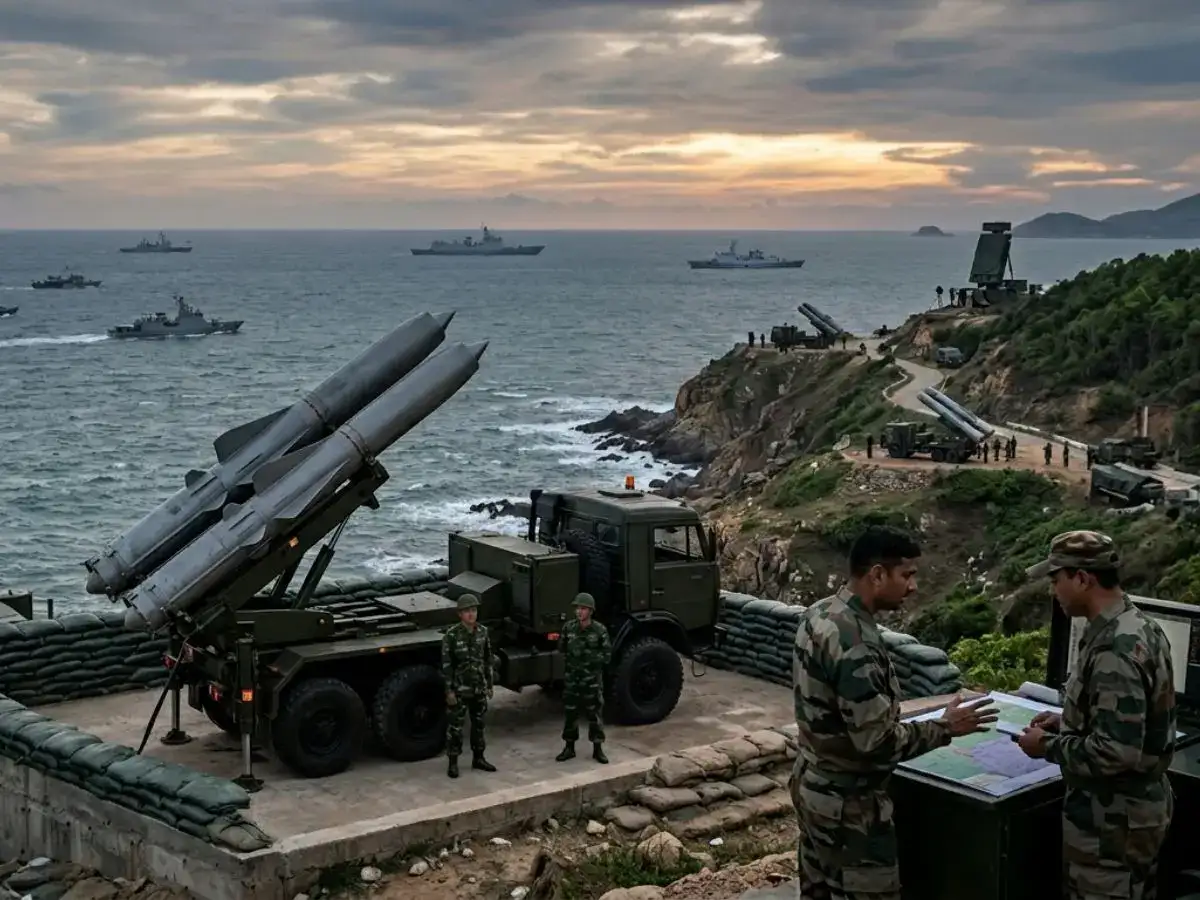
If you thought the Indo-Pacific was all about American ships patrolling the South China Sea and China’s navy flexing its muscles, think again. India is quietly carving a niche as a go-to arms supplier for smaller Southeast Asian nations, and the recent signing of a BrahMos missile deal with Vietnam is proof. Following the Philippines, Vietnam is the second buyer of the supersonic cruise missile, with Indonesia reportedly next in line. Malaysia and Thailand are also said to be interested. This can eventually lead to a chain of BrahMos batteries along the South China Sea coastal region, complicating regional military dynamics.
What makes this trend particularly interesting is the timing. The US under Trump seems to be shifting focus away from the Indo-Pacific region, while Trump has also been equivocal about militarily defending Taiwan. Countries facing China’s assertive posture might start looking for serious backup. India, ramping up its defence production, from missiles to drones to modern radar systems to air defence, has stepped into a vacuum that regional powers are keen to fill with indigenous and friendly-sourced options.
ALSO READ | Vietnam BrahMos deal already signed, Indonesia pact in final stages: Defence Secretary RK Singh
A new market can open as the US steps back
For decades, Southeast Asian nations could largely rely on the US for deterrence, either through formal alliances or the implicit security guarantee that American presence in the South China Sea offered. But the Trump-era changes in stance, coupled with a Middle East-centered US focus, might leave a perception gap. Smaller as well as large nations in the region have begun to openly voice the need to invest in their own capabilities.
This perception shift can create a fertile market for India. Unlike the US, which has historically restricted the sale of high-end systems to allies with strong political alignment, India’s approach is more flexible. By framing itself as a “friendly defence partner,” India is able to offer not just missiles and drones but full support systems, training programmes and maintenance networks. This makes Indian equipment a long-term partnership tool rather than mere hardware.
BrahMos: More than a missile
The BrahMos missile is central to this strategy. Developed jointly with Russia, it is the world’s fastest supersonic cruise missile, capable of flying nearly three times the speed of sound. It can be launched from land, ships, submarines and aircraft, giving nations flexibility in how they integrate it into their existing defence architecture. For Vietnam, which faces regular incursions in the South China Sea, a fleet of BrahMos missiles provides a tangible deterrent that is difficult for any adversary to neutralise.
Beyond its physical capabilities, the BrahMos deal also strengthens regional security networks. India supplies logistical support, maintenance and operator training, embedding itself into the operational routines of its partners. Over time, this creates a web of interoperability and mutual understanding that goes far beyond the sale of a single weapon system. For countries like Thailand and Malaysia, which have also reportedly expressed interest, this is appealing. India is selling missiles as well as helping build sustainable defence ecosystems.
Regional defence self-sufficiency
Southeast Asian nations might realise that relying solely on distant powers is risky. The recent Shangri-La Dialogue highlighted a growing consensus on countries scaling up their own defence capabilities quickly. Nations like Indonesia and Vietnam are investing in modern warships, drones and missile systems, while Malaysia and Thailand are exploring advanced radar and electronic warfare platforms.
India fits neatly into this emerging paradigm. Its defence industry is no longer just focused on domestic production. It is now export-ready. Systems like BrahMos, indigenously produced drones and next-generation radar and air defence technologies are designed for both local use and export. For buyers, India offers a combination of affordability, performance and political alignment that Western suppliers sometimes struggle to match. This makes Indian defence exports an attractive option for nations aiming to balance deterrence against China while maintaining strategic autonomy from the US.
India's Act East policy
India’s push into Southeast Asia is not simply commercial. It is a deliberate extension of its Act East policy. By embedding defence technology and operational know-how into partner countries, India strengthens long-term strategic ties. Logistics support, training programs and maintenance networks create dependency not in a coercive sense but as a framework for cooperation and mutual benefit. This positions India as both a security provider and a strategic partner at a time when US commitments are perceived as more transactional and less predictable. The US is also encouraging its allies and partners in the region to spend more on defence.
For India, this approach also helps counterbalance China’s growing influence. By building ties with countries on China’s region of dominance, India is creating a network of partners invested in a rules-based regional order. This not only enhances India’s diplomatic leverage but also opens up future opportunities for joint exercises, intelligence sharing and even co-development of technology. The defence partnerships are thus as much about influence as they are about business.
A regional arms race?
The BrahMos sales to the Philippines and Vietnam could spark a broader trend. As neighbouring countries see the operational advantages these systems provide, demand is likely to grow. Indonesia is reportedly in advanced talks, while Thailand and Malaysia have reportedly shown interest. Each sale strengthens India’s position as a trusted supplier and reinforces a regional shift toward diversified defence sources.
This pattern also dovetails with broader strategic trends. US officials have repeatedly called on regional actors to shoulder more of their own security responsibilities. While traditional allies like Japan and Australia continue to rely on the US, smaller nations are increasingly seeking alternatives that combine capability with flexibility. India’s rapidly expanding production base allows it to step in at precisely this moment, offering high-quality systems at scale.
Despite the opportunities, there are challenges too. India must navigate the sensitivities of China, which may view a proliferation of BrahMos systems along its maritime periphery as a threat. Exporting advanced missiles also requires careful management of technology transfer and operational secrecy. Yet India has demonstrated a disciplined approach, ensuring that technology is shared only with trusted partners while avoiding proliferation risks.
Another factor is the evolving nature of regional defence collaboration. Southeast Asian nations are increasingly interoperable and are experimenting with joint procurement, shared exercises and coordinated maintenance. India must not only sell systems but integrate into these networks, providing consistent support and adapting to the operational doctrines of different militaries. Success here will cement India’s role as a reliable long-term partner.
India's strategic-business moment
The Indo-Pacific is entering a phase of rapid change. US attention is divided, China is asserting itself and regional powers are investing in self-reliance. India, with its growing defence industrial base, flexible partnerships and strategic vision, is uniquely positioned to fill the gap. BrahMos missiles to Vietnam and the Philippines are just the start. With drones, radars and other modern systems, India can find an expanding defence market for its growing defence-industrial complex which is being driven by exports. Business and strategic goals can reinforce each other.
Creating new export markets is good commerce which expands strategic and diplomatic influence, which in turn fuel further defence trade, thus creating a self-reinforcing loop which can transform India into a key player in regional security for decades to come.