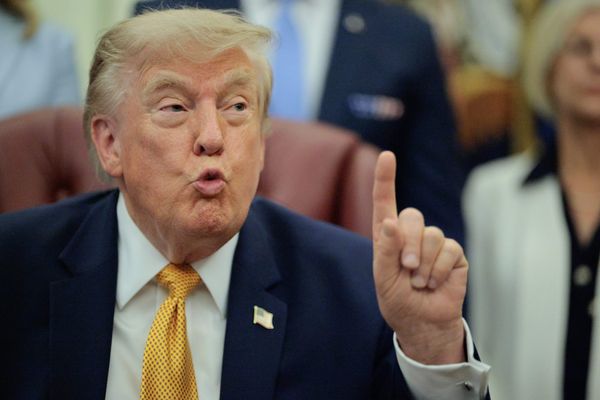
President Trump advised Iran to " quickly make a deal" on its nuclear program because a new U.S. attack on the country "will be far worse" than the last one.
Why it matters: Trump has ordered a U.S. military buildup in the Gulf ahead of a possible strike. Iran, Israel and other countries in the region have been on high alert for days expecting a U.S. strike.
- But White House officials say Trump still hasn't made a final decision and is still willing to explore a diplomatic solution.
- "We are open to business if Iran wants to talk," a White House official told reporters on Monday.
Driving the news: Trump told Axios on Monday that the U.S. "armada" off the coast of Iran was bigger than the one he sent to Venezuela.
- In a Truth Social post on Wednesday he doubled down. "A massive Armada is heading to Iran. It is moving quickly, with great power, enthusiasm, and purpose. ... Like with Venezuela, it is, ready, willing, and able to rapidly fulfill its mission, with speed and violence, if necessary," he wrote.
Between the lines: It's not entirely clear what that mission is.
- Trump initially threatened to intervene in support of protests in the country, but those have now been violently suppressed, with thousands dead.
- The range of options now include more limited strikes to punish the regime for slaughtering protesters, or a bigger operation to try to destabilize the regime and possibly ignite more protests.
What he's saying: Trump wrote he hopes Iran will "quickly" start negotiating with the U.S. on a "a fair and equitable deal... that is good for all parties" and includes "no nuclear weapons."
- "Time is running out, it is truly of the essence! As I told Iran once before, MAKE A DEAL! They didn't, and there was 'Operation Midnight Hammer' — a major destruction of Iran. The next attack will be far worse! Don't make that happen again," Trump stressed.
The other side: Iran's mission to the UN responded to Trump on X: "Last time the U.S. blundered into wars in Afghanistan and Iraq, it squandered over $7 trillion and lost more than 7,000 American lives."
- "Iran stands ready for dialogue based on mutual respect and interests—BUT IF PUSHED, IT WILL DEFEND ITSELF AND RESPOND LIKE NEVER BEFORE!"
Behind the scenes: U.S. officials say that at the moment there are no serious negotiations between the U.S. and Iran. Countries including Saudi Arabia, Turkey and Qatar have been talking to both parties and passing messages.
- On Tuesday, Trump spoke to Turkish President Recep Tayyip Erdoğan about the Iran crisis, according to a Turkish official.
- Then on Wednesday, Erdoğan's foreign minister, Hakan Fidan, spoke to his Iranian counterpart Abbas Araghchi and discussed "easing regional tensions," the Turkish official said.
- Araghchi also spoke on Wednesday with the foreign ministers of Qatar and Saudi Arabia.
- After the Saudi call, the Iranian foreign ministry said "the two sides warned of the dangerous consequences of any escalation of tensions in the region for regional peace and stability, and emphasized the shared responsibility of all countries in the region, as well as the need for joint efforts to preserve stability and security in the region."
The intrigue: Both Saudi Arabia and UAE said publicly that they wont allow the U.S. to use their airspace for strikes against Iran.
The other side: Araghchi said in a briefing with reporters on Wednesday that he hasn't been in touch with White House envoy Steve Witkoff in recent days.
- The two occasionally exchange text messages over Signal. Texts between the two are the primary direct communication channel between Washington and Tehran, and the messages they exchanged earlier this month were part of the reason Trump decided not to strike sooner.
- Araghchi said Iran hasn't asked the U.S. to start negotiations. He stressed that "conducting diplomacy through military threats cannot be effective."
- The Iranian foreign minister added that if the U.S. wants to hold negotiations, "it must abandon threats, excessive demands, and the raising of unreasonable issues."
The bottom line: That directly conflicts with Trump's posture that Iran needs to negotiate now, or else.