Franklin Graham, one of President Donald Trump's most prominent evangelical allies, is trying to draw a line that has become increasingly difficult to see in U.S. politics: the difference between spiritual guidance and political devotion.
In an interview with EFE, Graham said Trump "is only a man" and "is not God, is not Jesus Christ, is not the savior of the world." The comment came as Graham visited Madrid for a major evangelical event and faced renewed scrutiny over his closeness to Trump, his conservative views, and his influence among religious voters.
Graham, son of the late Billy Graham, has inherited one of the most recognizable names in American Christianity. But while his father was often described as the pastor to presidents across party lines, Franklin Graham has become more closely identified with Trump and the modern conservative evangelical movement.
"President Trump is a man. He is not God, he is not Jesus Christ, he is not the savior of the world. I think sometimes people get carried away and try to place him in a greater role. But he doesn't do that himself. I don't believe he seeks that for himself," he says.
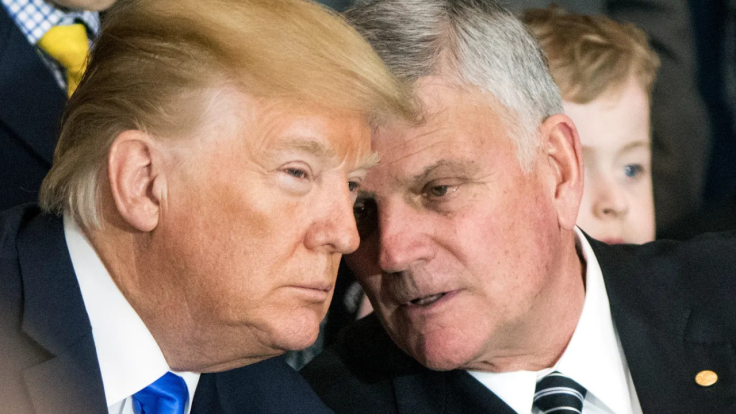
He did not deny the bond with the president. In the interview, Graham defended Trump and said the president "cannot do his job without God," while insisting that his relationship with him is not about partisan politics.
The timing made the remarks sharper. Graham was in Spain for the Festival de la Esperanza, a large evangelical gathering in Madrid that drew thousands of people, many from Latino immigrant communities.
El País reported that Graham used the event to preach conservative positions on abortion and homosexuality, while critics accused him of bringing Trump-style religious politics into Spain.
His visit landed in a country where evangelical churches are growing quickly, especially in Madrid neighborhoods with large Latin American, African and Asian immigrant populations. El País reported that the number of evangelical centers in Madrid has risen from 662 to 855 in a decade, turning some churches into both spiritual homes and social support networks for migrants.
That growth has also made evangelical communities more visible politically. Graham's appearance came during a weekend when Madrid was already packed with Latin American activity, from Colombian election voting to Bad Bunny concerts and the evangelical festival.
Graham's relationship with Trump has long been controversial.
In March, Trump shared a personal letter from Graham about salvation, after the president had publicly joked and fundraised around the idea of wanting to "get to heaven." Graham told him that salvation comes through faith in Jesus Christ, not good works or public office.
In Madrid, Graham appeared to repeat that same theological boundary, even as he defended Trump politically. For critics, that clarification does not erase Graham's role in sanctifying Trump's political image among conservative Christians. For supporters, it shows that Graham is doing what pastors are supposed to do, advising a president while keeping God above power. Either way, Graham's words revealed the central tension of the Trump-era evangelical movement: how to pray for a president without turning politics into religion.