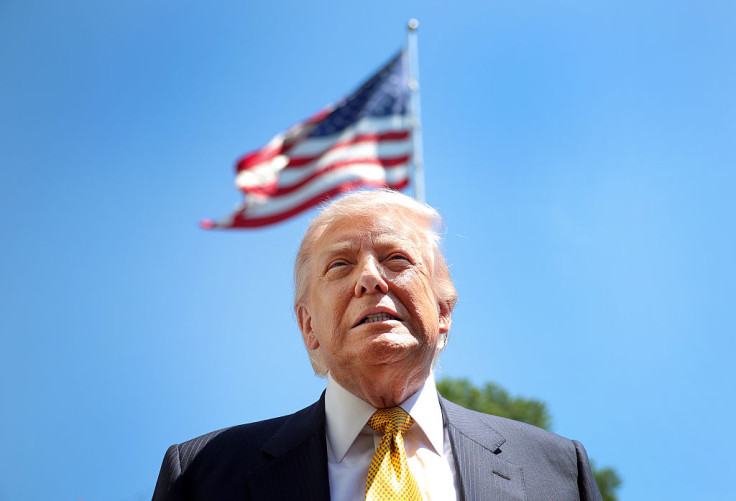
President Donald Trump defended his tentative agreement with Iran at the G7 summit in Évian-les-Bains, France, saying the deal helped avert an "economic catastrophe" that could have hit Americans through soaring oil prices, market turmoil and a prolonged disruption in the Strait of Hormuz.
"I didn't want to see an economic catastrophe," Trump said, according to Reuters, arguing that continued bombing could have pushed the global economy toward what he described as an "international depression."
Trump's comments came as he tried to sell a preliminary U.S.-Iran memorandum of understanding that remains politically fragile and not yet final. Reuters reported that Trump warned the United States could resume bombing if Iran does not "behave," underscoring that the agreement is still conditional.
The president also acknowledged that the deal is not complete. "I think it's going to go pretty quickly," Trump told reporters about the next phase of negotiations, which are expected to unfold under a 60-day deadline, according to Reuters.
The draft agreement, described by Reuters as a 14-point memorandum, includes an "immediate and permanent cessation of all hostilities," a reopening of the Strait of Hormuz, and a formal negotiation period aimed at reaching a final deal. It also includes U.S. commitments to end its naval blockade, withdraw forces, and issue oil export waivers, while Iran pledges not to produce nuclear weapons and to maintain its current nuclear posture during negotiations.
Trump framed the deal as much an economic rescue as a diplomatic one. The Strait of Hormuz, a narrow passage between Iran and Oman, carries a major share of global oil trade, and its closure during the war had raised fears of higher gasoline prices, inflation, and broader market instability.
The tentative agreement has drawn support from G7 leaders, who backed the framework as a way to reopen shipping lanes and lower the risk of a broader regional war. But it has also triggered sharp questions in Washington, Jerusalem and Tehran.
In Congress, lawmakers from both parties said they had not received enough information. Reuters reported that Trump said he was willing to send the interim deal to Congress for review, while senators pressed the administration for the text of the memorandum.
Democrats have been especially conflicted. Many criticized Trump for launching the war without explicit congressional authorization, but some are now cautiously backing the ceasefire because it could end the conflict. The Senate on Tuesday narrowly blocked a Democratic-led effort to limit Trump's war powers against Iran, with Reuters reporting a 48-47 vote. The resolution was sponsored by Sen. Raphael Warnock, while four Republicans joined most Democrats in support.
Israel's reaction has been more openly skeptical. Prime Minister Benjamin Netanyahu said Israel does not know the full terms of the U.S.-Iran deal and insisted that Iran will not be allowed to obtain nuclear weapons.
"With or without an agreement, Iran will never have nuclear weapons," Netanyahu said, according to The Jerusalem Post. "Not today and not tomorrow."
Netanyahu has avoided directly attacking Trump, but he has made clear that Israel does not see itself bound by a U.S.-Iran deal. The Associated Press reported that Netanyahu said, "As long as I am the prime minister of Israel, it will not happen," referring to Iran's push for Israeli withdrawal from Lebanon as part of the pact. "Iran wanted us to withdraw from there, but that did not happen," he said. "Because I stood very, very firm."
Israeli anger has extended beyond Netanyahu. The Washington Post reported that Israeli officials and commentators described the agreement as a "catastrophe," a "bad deal" and a lifeline to Tehran. The central Israeli concern is that the agreement could ease economic pressure on Iran before permanently dismantling its nuclear and regional military capabilities.
Iran, meanwhile, has been careful not to echo Trump's triumphant language. Reuters previously reported that Iranian officials said no final decision had been made while the country's decision-making bodies reviewed the terms. Tehran has not publicly released the full text of the memorandum, leaving uncertainty over how far Iran is prepared to go on nuclear restrictions, sanctions relief and maritime security.
The political risk for Trump is that the deal exposes him from several sides at once. Democrats want congressional review and limits on future military action. Israeli leaders fear the agreement gives Iran too much room to recover. Conservatives are questioning whether the United States will allow Iran access to frozen assets or other economic relief.
Trump's answer is that the alternative was worse. By arguing that more bombing could have produced an economic shock, he is recasting the deal as a choice between imperfect diplomacy and a war that could have reached every American gas pump. The agreement may still collapse during negotiations, and Trump has made clear he is willing to return to force. But for now, his message from France was blunt: the war may have been military, but the danger he says he stopped was economic.