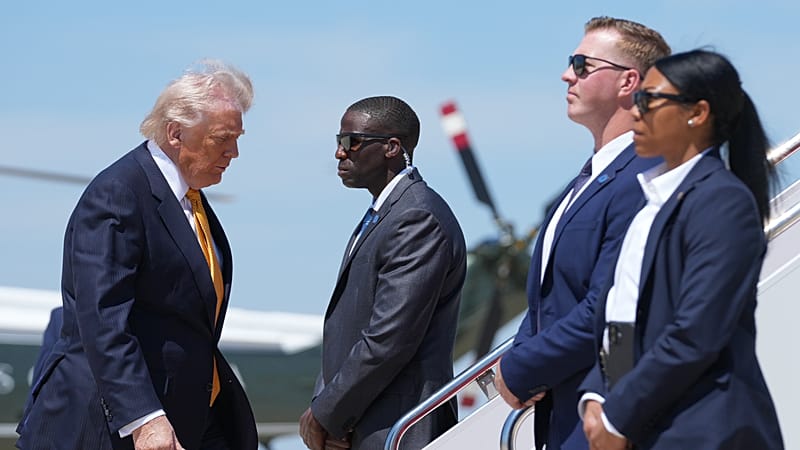
As US President Donald Trump arrives in Beijing on Wednesday for a summit with Chinese President Xi Jinping, where he aims to press China to "open up" to American firms, he will be accompanied by top US executives from tech, finance and manufacturing, including figures from AI and Wall Street.
A White House official, speaking on condition of anonymity, said that the visit is intended to facilitate dialogue on critical economic issues, including trade barriers, AI development and geopolitical stability, and provided a list of corporate leaders joining the trip.
In a significant late-stage development, Jensen Huang, President and CEO of Nvidia, has reportedly joined the presidential entourage. While it was previously reported that the semiconductor leader would not be participating in the trip, he apparently joined the delegation at the last minute.
Huang's presence is seen as vital given the current tensions over hardware exports.
The Trump administration has maintained strict limits on the sale of H200 AI chips to China, citing potential military applications and requiring rigorous third-party verification before any shipments can take place.
Nvidia has been active in urging the White House to reconsider these restrictions. The company argues that prolonged restrictions could be counterproductive, potentially incentivising China to accelerate its own domestic innovation while depriving American firms of access to a major global market.
Huang’s inclusion suggests that the future of the high-tech trade relationship will be a primary focus of the diplomatic agenda.
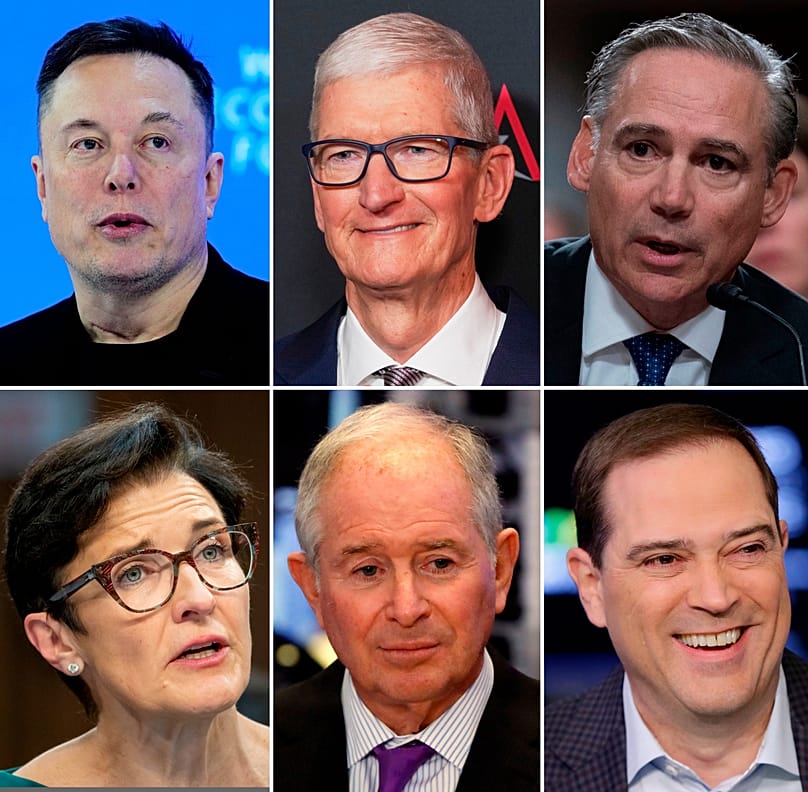
Elon Musk, Tim Cook, Larry Fink and others
The delegation also includes prominent figures such as Elon Musk and Tim Cook.
Musk, the CEO of Tesla and SpaceX, remains a central figure in the US-China economic relationship due to Tesla’s extensive manufacturing operations in the country.
This trip also follows his tenure leading the Department of Government Efficiency, a temporary agency that was dissolved in November 2025. Despite past public disagreements with the president, Musk's involvement highlights the continued importance of his enterprises in foreign policy.
Simultaneously, Tim Cook is participating in what is expected to be his final major diplomatic effort as the CEO of Apple.
With his retirement set for 1 September, Cook is preparing to hand over leadership to John Ternus. Throughout his time as CEO, Cook has managed the impact of trade wars by balancing domestic investment with overseas production.
To mitigate the effects of tariffs, Apple recently committed to a $600 billion (€510.8bn) investment in the US, a move that secured key exemptions for its flagship products.
The aviation sector is represented by Kelly Ortberg, CEO of Boeing, who is working to secure aircraft delivery targets amid a challenging regulatory environment.
Boeing has faced significant hurdles since Beijing increased import taxes on American goods to 125% in April 2025, a retaliatory measure following the US decision to raise tariffs on Chinese products to 145%.
Ortberg has previously expressed confidence that these trade tensions would not prevent a financial recovery, and negotiations for a major aircraft sale are reportedly ongoing.
Joining these industrial leaders is a group of Wall Street executives, including Larry Fink of BlackRock, David Solomon of Goldman Sachs and Jane Fraser of Citigroup. Leaders from Meta, Mastercard and Visa are also reportedly present, representing a broad coalition of American economic interests.
Together, these executives seek to stabilise a trade relationship that has become increasingly defined by protectionist measures and technological competition.