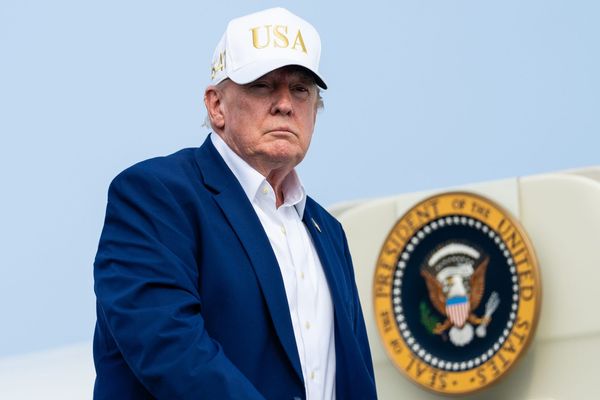
Donald Trump told the world's press he could end the Iran war 'in two seconds' while sitting next to Japan's prime minister, and then made a joke about Pearl Harbour.
The remarks came during a bilateral meeting at the Oval Office on 19 March 2026 between Trump and Japanese Prime Minister Sanae Takaichi, held as the US-Israeli conflict with Iran approached the end of its third week.
Asked by reporters to discuss the military campaign, Trump alluded to the overwhelming power of American weaponry, saying the conflict could be ended almost instantly if he chose, while stopping short of explicitly naming nuclear weapons. The comments, delivered feet from the leader of the only country ever to have been struck by atomic bombs in wartime, did not go unnoticed.
What Trump Said — And What He Left Unsaid
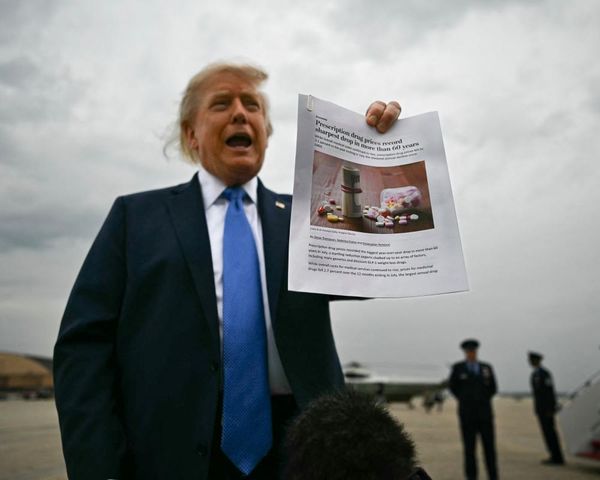
The remark that drew immediate international attention came mid-press conference, as Trump was discussing the pace and power of US military operations against Iran. 'This is a very volatile world, and the military equipment, the power of some of this weaponry is unthinkable,' Trump told reporters. 'You don't even want to know about it. Oh, you could end this thing in two seconds if you wanted to.'
He did not say 'nuclear weapons.' He did not need to. The phrase 'you don't even want to know about it' attached to 'weaponry that is unthinkable,' followed by a claim that the war could be ended instantaneously, carried an implication that multiple governments and analysts read in the same direction. Trump then added: 'But we are being very judicious.' The full exchange, confirmed by Al Jazeera's reporting, was a statement about restraint, framed, typically for Trump, as a demonstration of force held in reserve.
The context was Iran, not Ukraine. The headline under which the original video circulated described the comments as pertaining to a potential end to the Ukraine-Russia conflict, but no evidence from the transcript supports that interpretation. At no point during Thursday's press appearance did Trump connect the 'two seconds' remark to Ukraine. The comments were made exclusively in reference to Iran. That distinction matters for accuracy.
The Defence Department had, as reported by The Washington Post, asked Congress for a £153 billion ($200 billion) supplemental funding package to support ongoing military operations in Iran. Trump confirmed that figure in Thursday's session but said the request extended beyond Iran to broader military readiness. Defence Secretary Pete Hegseth said separately that the request 'could move.' 'It takes money to kill bad guys,' Hegseth said at a press briefing.
The Pearl Harbour Moment That Silenced a Room
The nuclear implication was not the only remark to land badly. Asked by a Japanese reporter why Washington gave Tokyo and its European partners no warning before the initial strikes on Iran began on 28 February, Trump invoked the 7 December 1941 attack on the US Pacific Fleet. 'We went in very hard and we didn't tell anybody about it because we wanted surprise,' he said. 'Who knows better about surprise than Japan? Why didn't you tell me about Pearl Harbour?'
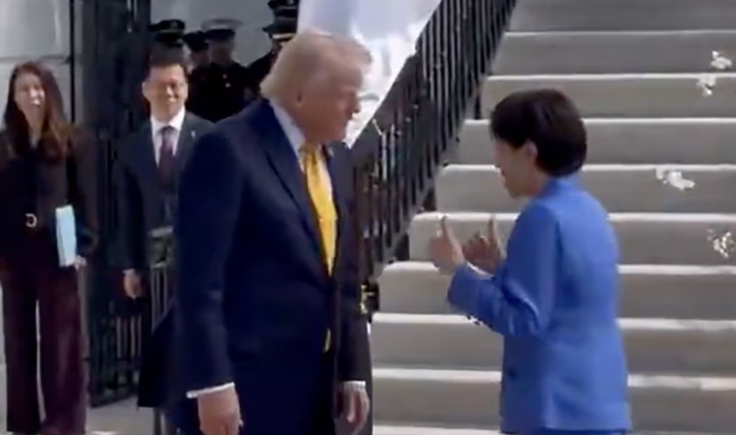
Takaichi did not laugh. She did not respond. Photographs taken in the room by Reuters and Getty Images show her expression shifting as Trump spoke, a slight smile dropping, eyebrows raised. The attack on Pearl Harbour killed 2,403 Americans and precipitated the United States' entry into the Second World War.
The same war ended with the United States dropping atomic bombs on Hiroshima and Nagasaki in August 1945, killing an estimated 110,000 to 210,000 people in the two cities combined. Those events form the bedrock of modern Japanese political identity and its constitutionally enshrined pacifism.
Trump added: 'You believe in surprise, I think, much more so than us.' The comment drew laughter from some in the room. Eric Trump, the president's son, wrote on social media: 'One of the great responses to a reporter in history!'
Not everyone agreed. Japan's post-war constitution, as CNN noted in its pre-meeting analysis, imposes strict limits on the use of force, and the Takaichi government had already signalled domestically that any involvement in a US-led Middle Eastern conflict would face steep legal and political barriers.
What Takaichi Came For — And What She Got
Takaichi had arrived in Washington as the first leader of a major US ally to visit the White House since the Iran conflict began. The trip had been planned to focus on trade, critical minerals and the US-Japan security alliance.
Those goals were overtaken entirely by the war, and by Trump's frustration that Japan, which imports roughly 95 per cent of its crude oil from the Middle East, had not committed forces to help secure the Strait of Hormuz, through which Iran had effectively halted commercial shipping.
'I expect Japan to step up, you know, because we have that kind of relationship,' Trump told reporters. In a striking admission of the contradictions in his own position, he also said: 'We don't need anything from Japan or from anyone else.' The two statements were delivered within minutes of each other.
Takaichi, speaking through an interpreter, had told Trump earlier in the session: 'The global economy is about to experience a huge hit because of this development. But even against that backdrop, I firmly believe that it is only you, Donald, who can achieve peace across the world.' The flattery was deliberate. She had described the meeting as likely to be 'very difficult' before leaving Tokyo.
Japan had, the same morning, joined a joint statement with France, Germany, Italy, the Netherlands and the United Kingdom, pledging to take steps to stabilise energy markets and expressing readiness to join 'appropriate efforts' to ensure safe passage through the Strait. What those efforts might look like remained deliberately vague.
Japan, Nuclear History and the Weight of the Setting
For most countries, a president's oblique reference to weaponry so powerful 'you don't even want to know about it' would register as bluster. For Japan, it lands differently. The country remains the only nation to have suffered nuclear attack in wartime, and its entire post-war political architecture, the pacifist constitution, the three non-nuclear principles that bar Japan from possessing, producing or permitting the introduction of nuclear weapons, was constructed in the shadow of Hiroshima and Nagasaki.
Takaichi, Japan's first female prime minister and a protégé of the late Shinzo Abe, is a hard-line conservative who has pushed to revise that constitution and increase defence spending. But even she, as NBC News reported ahead of the meeting, faces a domestic public with no appetite for involvement in a Middle Eastern conflict and a security environment of historic tension, with China increasing military activity around Taiwan, and North Korea continuing to advance its missile programme.
Those pressures converge on the US-Japan alliance as its single indispensable anchor, which is why Takaichi, despite the awkwardness of Thursday's session, called the two leaders 'best buddies' at the dinner that followed the Oval Office meeting, and declared, in English, 'Japan is back.'
Trump can claim he is being 'very judicious' about ending the war in two seconds; the real test of that judgement will come in the halls of the US Congress, where a £153 billion ($200 billion) bill for the Iran campaign is waiting to be paid.