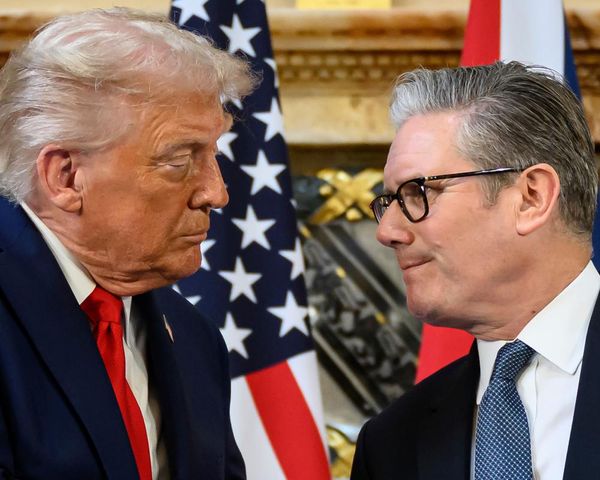
A rejuvenated, expanded “Quadrilateral” – the four-nation security dialogue between the US, Australia, Japan, and India that is seen as a counterweight to the growing influence of China in the Indo-Pacific – will be a key element of talks between Donald Trump and the Australian prime minister, Malcolm Turnbull, in Washington this week.
The Quadrilateral was formed in 2007 but Australia withdrew the next year, fearing the opprobrium of Beijing. However, “the Quad” has been revived in the face of continued Chinese expansionism in the South China Sea.
And it appears set to broaden beyond security, with the four countries reportedly seeking to create a joint regional infrastructure scheme as an alternative to China’s multibillion-dollar belt and road initiative.
A US official told the Australian Financial Review the infrastructure plan was still “nascent” and “won’t be ripe enough to be announced” during the prime ministerial visit, but was under serious contemplation.
China has long opposed the Quad, seeing the group as an attempt to gang up against it.
But the Quad is representative, too, of the broader geopolitical landscape of the Indo-Pacific, and a demonstration of the tightrope Australia will increasingly find itself forced to walk, balancing relations with its traditional security ally, the US, and its dominant and rising trading partner, China.
Turnbull has confirmed discussion of regional security will be prominent when he meets the US president on Thursday: “It’s on the agenda every time I talk to Donald Trump.
“Keeping Australians and Americans safe is the first priority of an Australian prime minister and a US president.”
Euan Graham, the director of the international security program at the Lowy Institute, told the Guardian that Australia was already having to balance the two competing powers.
“Australia is not an immediate worry for the Trump administration, it is still a very strong military-to-military relationship,” he said. “But I think there is an underlying concern about Australia’s long-term trajectory, given some of the unease that’s crept into the debate around US leadership in particular, and also the tendency to draw the comparison with China, with China as the next major power in the region, beyond a trading partner, but as a future hegemon, and future protector.”
The presumptive US ambassador to Australia, Harry Harris, has spoken in hawkish terms about China’s military rise and growing economic influence, warning in testimony before Congress that Chinese “intent is crystal clear” in the region.
“China’s impressive military build-up could soon challenge the United States across almost every domain,” he said.
He said of the risk of conflict with China: “I think it’s important you must plan and resource to win a war at the same time you work to prevent it.”
Australia will welcome 1,500 Marines on rotation this year – up from 1,250 – as well as more state of the art Raptor fighter jets.
“We have a very strong, the strongest possible alliance with the US. Our forces work together. We welcome more rotations of US marines and other units into Australia and vice versa,” Turnbull said.
China’s expansionism in the South China sea has continued in recent months, undeterred by international opposition and a 2016 ruling from the permanent court of arbitration in The Hague, which said there was no legal basis for China’s claim of historic sovereignty over waters within its so-called nine-dash line in the sea.
The US national security strategy, released in December, identified China as a major strategic risk with which the US would be in “continuous competition”. The strategy said efforts to attempt to shape China’s rise into that of a cooperative major power had failed, and China wanted to shape a world “antithetical to US values and interests”.
“China seeks to displace the United States in the Indo-Pacific region, expand the reaches of its state-driven economic model, and reorder the region in its favour,” it said.
The UK, too, is being urged to re-engage militarily, economically and diplomatically in the Indo-Pacific to help preserve the international “rules-based order” many fear is threatened by China’s unrestrained rise.
In a speech to King’s College London, the foreign affairs minister, Julie Bishop, said the UK, as a global trading nation, had a strong interest in preserving open and free access to markets across the world, and resisting protectionism.
“I believe it is now more important than ever that … we join in promoting, defending and upholding the rules-based order – including together in the Indo-Pacific,” she said.
Bishop said preserving regional security was crucial. Five of the 10 highest military-spending nations in the world were in the region, and six of the nine nuclear-armed countries.
While the meeting between Trump and Turnbull will focus heavily on security in the Indo-Pacific, the conflation of security and infrastructure in the Quadrilateral means economic talks will also be key.
A significant Australian business contingent, including asset fund managers, is trailing the prime minister to the US, exploring opportunities to be part of Trump’s multibillion-dollar plan to revive infrastructure spending in the US.
The US vice president, Mike Pence, has said the Trump administration is keen to adopt Australia’s asset recycling model of funding upgrades of roads, airports and ports through the sale of old government-owned assets.