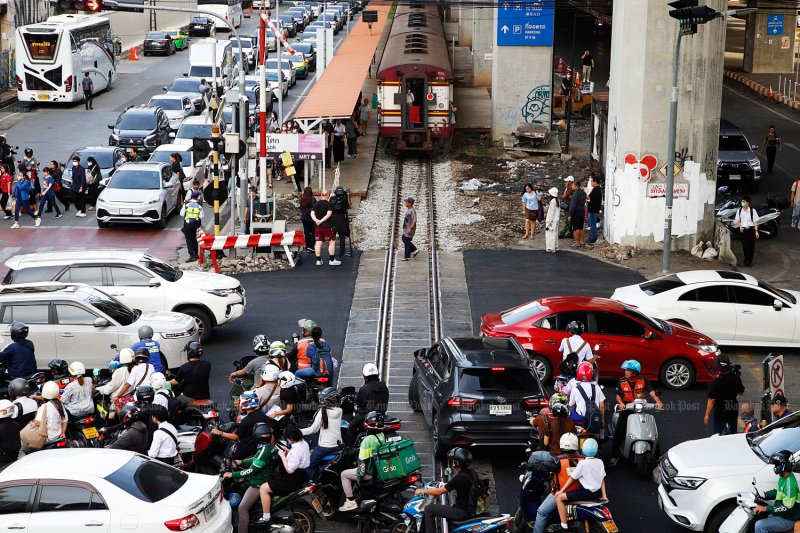
In a bid to avoid another tragic crash after a freight train collided with a bus at the Asok-Phetchaburi crossing last Saturday, resulting in multiple casualties, Transport Minister Phiphat Ratchakitprakarn has come up with the idea of scrapping commuter train services into central Bangkok.
Unsurprisingly, this has drawn public outrage, with brickbats being hurled from many directions.
Mr Phiphat, who is also a deputy prime minister, told the media he had ordered the State Railway of Thailand (SRT) to study the plan and propose measures within three months.
Initially, he said all the commuter trains from the east, including some from the border province of Sa Kaeo, and the south must now terminate at outskirt stations -- Lat Krabang for the former, and Taling Chan for the latter -- instead of at Hua Lamphong or Bang Sue stations.
Under his plan, train passengers would have to switch to using city buses or other rail systems. Given the higher cost, he has pledged subsidies for low-income groups.
Yet the transport minister must know this plan misses the mark. To address such rail-crossing accidents, the transport minister needs to hit the nail on the head.
It is self-evident that the collision on Saturday was the result of bad road design and recklessness on the part of road users. Weak or nonexistent law enforcement regarding public safety merely aggravates the problem.
Looking into the details of the case, the existing road infrastructure, with frontage roads along the main Asok-Din Daeng Road, where drivers can turn left or right through many lanes, made the crossing busier than ever.
Few, if any, road users care about railway barriers. Most choose to violate the yellow box rule by entering the space next to the intersection, which must be kept clear at all times for safety. The ill-fated bus was stuck in the yellow box when the approaching freighter train smashed straight into it.
In fact, there are a few dangerous spots similar to the Asok-Phetchaburi crossing that look like disasters waiting to happen. That list includes the Makkasan crossing and another one on Rama VI Road, near the Highway Department. It is common to see car drivers and motorcyclists breach the safety rules and risk crashing into a train.
Mr Phiphat must see to it that the authorities tackle all the dangerous spots, with immediate, short- and long-term measures. It's not any single agency's responsibility.
First and foremost, the traffic lights near the crossing must be integrated with the system governing train-related data to ensure there is no backlog at any given time. In addition, police and train officers must be deployed near busy crossings to facilitate traffic flow, improving mobility while preventing reckless road users from breaking traffic rules.
Mr Phiphat must drop his no-commuter train plan now, as it is tantamount to punishing innocent train users who rely on the system, which serves as an affordable means of transport. He needs to improve the commuter train service to ensure punctuality and comfort, and attract more users.
The minister needs to understand that in advanced countries, commuter trains and/or trams that carry large numbers of people always have the right of way over private vehicles, which are the real cause of traffic congestion. Mr Phiphat must think again and get his priorities right.