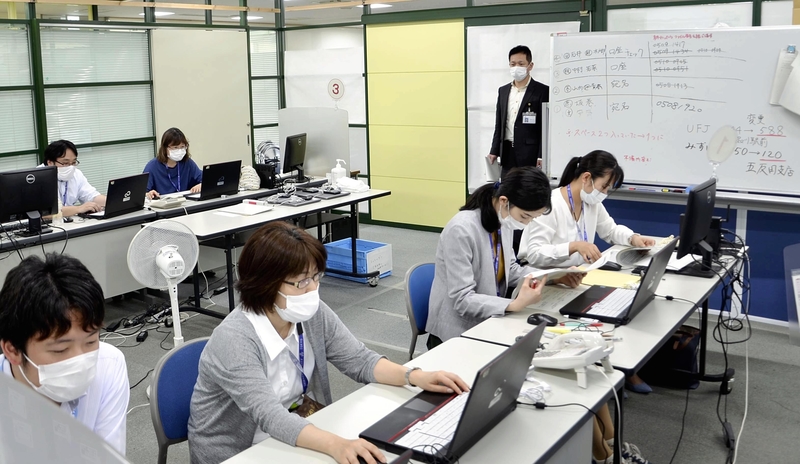
Online applications for the coronavirus-relief payment of 100,000 yen per person are now being accepted in various parts of Tokyo.
Some local governments in Tokyo have already been providing the benefits while others have no choice but to push the payment date to June in order to complete confirmations on the surge of applications. When residents will receive the relief payment depends on where they live.
"I want to receive the benefit as soon as possible," a 60-year-old female care worker said when she visited the Itabashi ward office on Tuesday.
Her main job is to accompany elderly people to the hospital and other places. Her income has decreased as the number of people who go outside has decreased.
"Since I'm in direct contact with elderly people, I have to pay for protective masks and disinfectant out of my pocket, and that cost is pressing my budget," she said.
To receive the benefit, applicants must mail an application form sent from local governments or use their My Number cards via a special website. Prior to the mailing applications, local governments began accepting applications online this month.
According to a survey by The Yomiuri Shimbun, Adachi and Edogawa wards have already started providing the benefits, while Setagaya Ward and the city of Komae plan to provide them in early June. Some local governments set the dates of payment as "to be decided." The Itabashi Ward government plans to pay out the cash late this month at earliest.
"I wonder why the dates of the payment vary depending on local governments although it is a national benefit," the woman said.
The local governments need to do lots of clerical work before distributing the money.
The Shinagawa ward government has received about 10,000 online applications as of Monday. The ward government makes a team of two officials to cross-check information filled out on an application form with the basic resident registration data of the applicant. They check each case meticulously to see if there are any defects and also correct any mistakes in the bank name, account number of the recipient and other information.
The ward's section chief in charge of emergency relief payments said, "There are many items that need to be put in manually for online applications, and if there is any mistake, it takes more time until it is paid."
Setagaya Ward has the largest population in Tokyo of 920,000.
"As dealing with the huge amount of paperwork, we've received complaints from the residents saying, 'It's slow,'" a Setagaya ward official in charge said, adding that the division is gaining support from the other sections to process. "We're doing our best to start paying as soon as this month."
Shibuya Ward is asking its residents via its official Facebook page to use a postal application, which is scheduled to begin in late May. The ward is encouraging them to use the mail form based on the concern that if a user makes a typo in an online application, it will take longer for the ward office to check the information, resulting in possibly delaying the payment later than the mail application.
Adachi Ward, which began remitting payments on Monday, had been preparing for early payments by setting up a section in charge in late April. The ward office has been paying the money whenever the application process is completed.
Edogawa Ward, which started providing the relief on May 7, began building an online application system in late April, when the Diet was still debating on whether to include an emergency cash benefit in the government's emergency economic package. Residents who received the 100,000 yen in hand have expressed their appreciation to the ward – with one person saying: "I have a lot of children and was worried if we could eat tomorrow. We were saved by your quick response."
An Edogawa ward official said: "There must be many people who have trouble making a living due to the outbreak. We wanted to provide the relief right away."
Former Mie Gov. Masayasu Kitagawa, who is currently professor emeritus at Waseda University, said it is not easy to distribute the benefits in large metropolitan areas.
"There are such restrictions as preventing residents from rushing to the office and workers from working in a crowded condition," he said. "In order to provide the relief promptly, the government needs to take flexible measures, such as reviewing the way it is distributed."
Read more from The Japan News at https://japannews.yomiuri.co.jp/