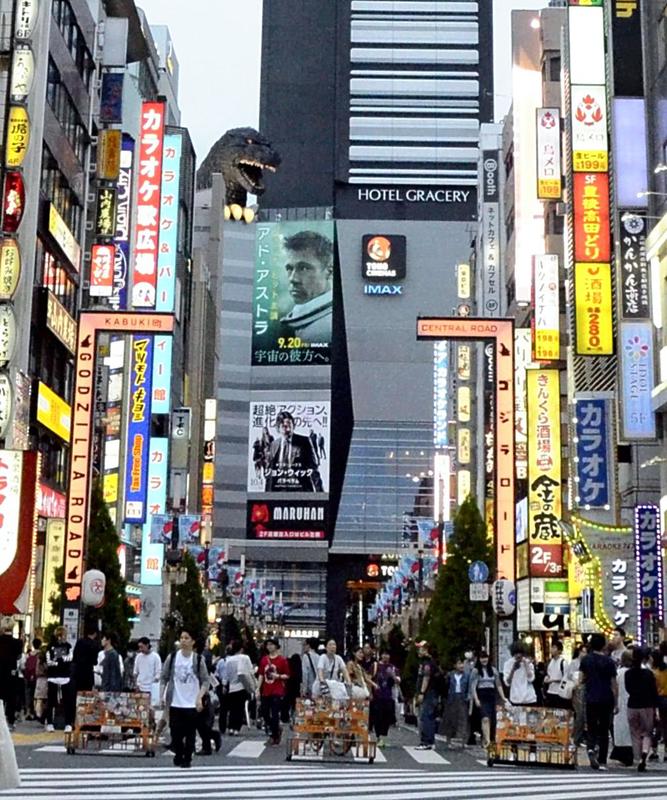
Kabukicho is known as one of the busiest districts in Japan, and is packed with an abundance of shops, including restaurants, movie theaters and adult-related locations. However, there are no kabuki theaters there. So why was the name Kabukicho assigned to the district?
Heading to Yasukuni-dori street from JR Shinjuku Station, a sign reading "Kabukicho Ichibangai" is visible that enables visitors to get a sense of the tradition there. Also noticeable behind the sign are establishments that include izakaya pubs, mahjong parlors and karaoke shops.
The street to the right of where the new cinema and hotel complex stand is called Godzilla Road. It was so named because there was a huge Godzilla figure that drew picture-taking foreign tourists shouting "Oh, Godzilla!"
I visited the Shinjuku Historical Museum to find out when all the buzz began in Kabukicho.
In the early Showa era (1926-1989), Kabukicho was home to the residence of former Prime Minister Keisuke Okada, whose life was threatened in a "Feb. 26 incident" in 1936, and Tokyo girls high school No. 5 (predecessor of Tokyo Metropolitan Fuji High School).
There were only private houses and shops at the time, with no sign of the coming downtown area yet. And wartime air raids devastated the Shinjuku area.
"After the war, there was a plan to invite a Kabuki theater," said Masaru Jo, 65, secretary general of the Kabukicho Shopping District Association.
Kihei Suzuki (1891-1967), led the project and was also the head of the north neighborhood association of the first district of Tsunohazu, which is now part of Kabukicho. The history is depicted in his 1955 book "Kabukicho."
"Create an orderly reconstructed downtown with morals in Shinjuku," was Suzuki's intention once the war ended.
When he returned to Tokyo after evacuating, he visited owners of large plots of land and members of the neighborhood association to explain to them the necessity of rezoning and creating a new city, instead of simply rebuilding houses as they liked.
Suzuki obtained the consent of the landowners, and it is said that Hideaki Ishikawa, who was the chief of the city planning section at the Tokyo metropolitan government, compiled the plan. A kabuki theater played a central role in the reconstruction project.
The theater plans to have seating for about 1,850 visitors, a moderate size compared to other locations. Based on Ishikawa's proposal, some districts were merged and named Kabukicho in April 1948.
However, no progress was made in attracting kabuki theaters. It is widely believed that this was because of the difficulties in procuring funds and preventing the construction of large-scale entertainment facilities amid a shortage of goods after the war.
Growing without kabuki theaters
Although there were no kabuki theaters, the area grew into an entertainment district.
Movie cinemas and theaters such as Chikyuza, Shinjuku Odeonza, and the Shinjuku Koma Theatre opened in succession. Toshio Hashiguchi, director of the Shinjuku Historical Museum, 64, said, "As the Anti-Prostitution Law went into effect in 1958, women from the Yukaku red-light district nearby were said to have fled to Kabukicho."
Decorated with neon lights in an erotic setting, Kabukicho saw about 500,000 visitors a day during a period from 1975 to 1984.
However, because of the enforcement of the law on control and improvement of amusement businesses in 1985, movie theaters were prohibited from operating during late-night hours, and public safety continued to deteriorate amid a series of organized crime group rivalries, with the number of people visiting Kabukicho cut in half to 250,000 by around 2000.
A fire broke out in 2001 in a multi-tenant building in which 44 people died, and its reputation as an unsafe district grew stronger.
In 2005, the shopping district associations, Shinjuku Ward government and the police set up a Kabukicho Renaissance Committee. Since then, the ward government enacted the anti-touting ordinance, and efforts to give the image of the area a facelift have been made through changes such as widening sidewalks.
In 2015, the Shinjuku Toho Building, a commercial complex that houses Godzilla art objects, opened on the site of the Shinjuku Koma Theatre -- which closed down in 2008.
New development efforts continue. Shochiku Co. held a kabuki performance in May at a spot for live shows. Construction on a 48-story high-rise building, that includes five basement floors, with hotels, theaters and live halls, began in August.
"Suzuki's spirit of a downtown with morals, is still alive today," said Motoshige Sugiyama, 66, president of Suzuya pork cutlet restaurants whose grandfather was involved in Suzuki's reconstruction project.
"A wide variety of entertainment has been created, and it is becoming a town that you can enjoy many ways. I feel that over time, we are approaching Kihei's ideal Kabukicho," he said.
Read more from The Japan News at https://japannews.yomiuri.co.jp/