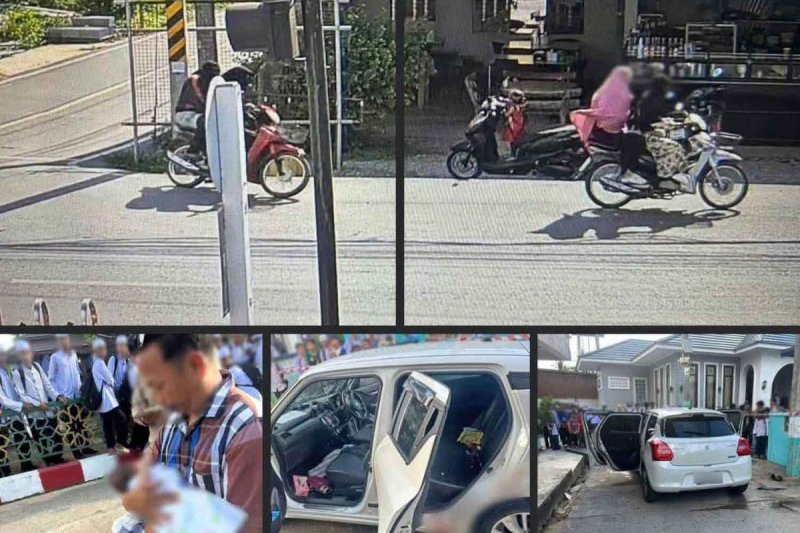
A recent ambush on a police officer in Pattani province, which resulted in the tragic death of his wife as she held their baby in her arms, reminds us that violence in the deep South remains deeply troubling.
The attack occurred on May 25 in Yarang district, when Pol Sgt Maj Adul Hayisulong, attached to Yaring Police Station, drove to pick up his children from school. His wife, Patimoh Yago, a teacher, was seated in the back holding their 35-day-old infant daughter, while their three-year-old son sat in the front passenger seat. Gunmen on motorcycles, reportedly wearing women's clothing to conceal their identities, ambushed the vehicle and opened fire, leaving the policeman injured and his wife dead. Both children survived unharmed.
I hope the police will bring those responsible to justice as quickly as possible so that we may understand the motive behind this ambush shooting.
The unrest in Thailand's southern border provinces, covering Pattani, Narathiwat, Yala and four districts in Songkhla, erupted most violently and visibly in 2004. There were major incidents that left deep scars, most notably the Krue Se Mosque incident on April 28 and the Tak Bai incident on Oct 25 of the same year. Yet, the latest ambush in Pattani stands out as one of the most profoundly distressing acts of violence, for it illustrates that such tragedies can befall anyone, whether for holding a different opinion or simply for serving as a state official, even when sharing the same faith.
Is this justifiable? It is a pressing question that all parties, particularly the Barisan Revolusi Nasional Melayu Patani (BRN) and the Thai government, must collectively address.
Yet responsibility does not rest solely with the BRN. The Thai government, with its political legitimacy and advantage, must act decisively. Both sides must begin working in earnest, ensuring tangible results through clear timelines and action plans.
Despite the turbulent situation, I remain hopeful after Prime Minister and Interior Minister Anutin Charnvirakul signed Order No.139/2026 on May 11, establishing a Special Government Committee to resolve unrest in Thailand's southernmost provinces. The move reflects the government's policy to create a safe environment for people's lives and property, while advancing economic development and improving the quality of life. The latest peace effort is also in line with the National Strategy (2018–2037) and the National Security Policy and Plan (2023–2027).
The committee is chaired by Deputy Prime Minister and Foreign Minister Sihasak Phuangketkeow. Defence Minister Lt Gen Adul Boonthamcharoen serves as the first vice-chair, while National Security Council Secretary-General Chatchai Bangchuad acts as the second vice-chair. Veteran politician Wan Muhamad Noor Matha has been appointed as an adviser.
A few days later, the prime minister appointed National Intelligence Agency director Thanat Suwannanon as the new chief of peace dialogue for Thailand's southern border provinces, to lead and determine the next steps in talks with the BRN. Currently, the BRN remains the dominant player in the conflict, while Malaysia continues to broker peace talks between the Thai government and the BRN.
But if, in the future, more conflicting groups emerge beyond the BRN, I hope Mr Thanat will be able to engage in dialogue with those groups, including individuals involved in violent incidents and those holding views that differ from the state's.
In my view, the establishment of the Sihasak-led government committee and the appointment of Mr Thanat as chief of the peace dialogue represent positive signs and a promising beginning for this government. The committee led by Mr Sihasak must support ongoing peace dialogue efforts in the southern border provinces to make them more effective and beneficial for the nation and its people.
Despite the passage of 12 governments and 10 prime ministers, the southern conflict remains unresolved. More than 500 billion baht in taxpayer funds have already been spent over the past 22 years. Yet peace, security and the basic safety of daily life -- fundamental rights of all citizens -- have still not been achieved.
Nevertheless, I worry about the enormous amount of taxpayers' money that will continue to be spent in the region to advance these initiatives. I fear such funds may be misused or directed inappropriately, while the outcomes may still fall short of expectations.
I do not want to see the problems in the deep South persist, violent incidents continue, and more lives lost or people injured. The killing of teacher Patimoh must be the final such incident in the deep South.
Anucha Charoenpo, PhD, is the News Editor of the Bangkok Post.