This is the week that cost millions. It's also the week when coaches really earn their money. Fail and you get found out. As the clock counts down to the Six Nations, this is when we should reap the benefits of deals such as the ones done between the Rugby Football Union and the English clubs and Wales and its regions that guarantee managers and coaches like Martin Johnson and Warren Gatland time – something like two weeks – to work with their players before internationals.
Once – and not so long ago that there aren't plenty of former players who can remember the days and recount them in great detail – Test teams used to get together in the middle of the week of an international, have a couple of practice sessions which weren't much more than kickabouts, dish out the match‑day kit and then play on the Saturday. Gradually that got extended to a week, before in some countries that week became a fortnight.
Now, thanks to the agreement in England, and that five-year deal done between the Welsh Rugby Union and the regions last September, we are all, more or less, on a level footing and have a decent amount of time to manage, micro-manage if you like, the players in the run-up to the Six Nations.
England and Martin Johnson are in Portugal doing some warm-weather work; Andy Robinson has Scotland up at St Andrews working and living alongside the Old Course; the French are in residence at their stately pile in Marcoussis, just outside Paris; Declan Kidney has taken the champions, Ireland, to his home patch, Limerick; Nick Mallett has the Italy training squad of 30 based just south-east of Rome; and we have Wales at our state‑of‑the-art and much admired centre recently opened alongside the team hotel to the west of Cardiff.
We are all working away in pretty pleasant surroundings but only too soon we'll see how clever we've been making best use of our time, and particular that extra time recently agreed, because it is the work done during that first week in camp that is particularly important.
As I have said, not so long ago teams had a couple of training games to get to know one another. There might be a bit of scrummaging and lineout work, but that was that. Now it's no longer one size fits all and we have plenty to fit in.
Circumstances change which means that training regimes have to alter as well. For example, a player who has just gone through a bruising Heineken Cup encounter can't be expected to arrive in camp and get down to the heavy stuff straight away. His week probably starts with plenty of R&R and some conditioning, whereas someone who has played only lightly needs something more physical.
Regime's are tailored to the players, with Adam Jones, our tighthead prop who hasn't had much game-time since damaging his shoulder on tour with the Lions in the summer, actually opting to play for his club this weekend to get match-hardened. Likewise, Shane Williams, Kristian Phillips and Tom Prydie will also play for the Ospreys tonight against the Dragons, while the Scarlets hooker Matthew Rees has a match against Wasps to look forward to, and Tom Shanklin and Sam Warburton are both set to play for Cardiff Blues against Newcastle. The coaches will look on with fingers and toes crossed, hoping no one gets injured.
For others in the squad there may be some light contact work or conditioning, but that is backed up with plenty of analysis of the upcoming opposition and time learning the drills and calls for set plays like scrums and lineouts and what follows them and how we want to play.
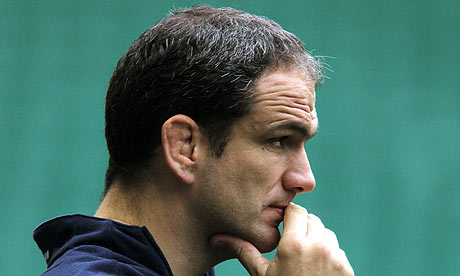
So why was the week just gone more important? Well everyone has their own style of coaching; Leicester, for example, have the reputation of being fairly rigorous and physical, so I'd be surprised if there had not been plenty of contact work organised by Martin Johnson, left, in Portugal, whereas other clubs take a softly, softly approach. However, it seems to be common thinking among many coaches that as the big day get closer, the players are increasingly left to themselves.
Obviously there are training sessions, but there comes a point when players can take only so much on board and have to work things out for themselves. That being so, it could be said that if we, the coaches, haven't done our stuff by now then there's a good chance it might never get done.