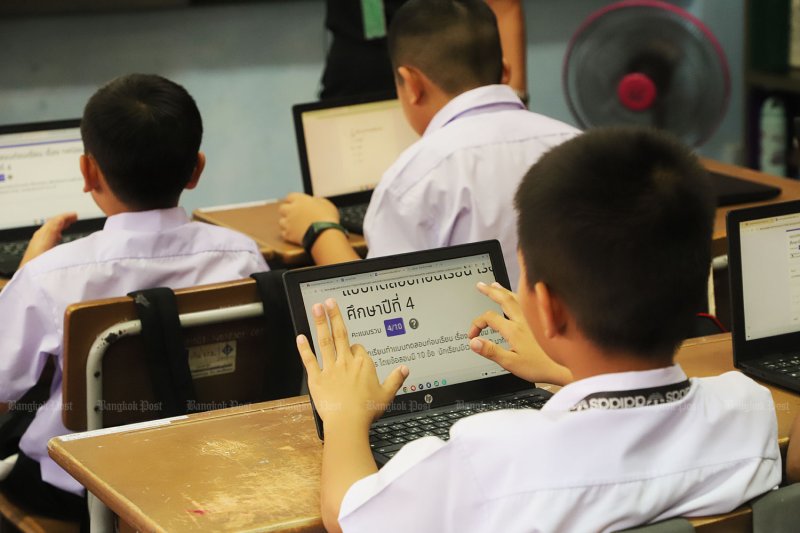
Last week, it was bringing e-sports into schools; this week, the Education Ministry is floating the idea of training teachers to produce short educational videos for TikTok.
While the earlier e-sports idea sparked healthy debate, the TikTok campaign invites criticism. Critics say the project runs counter to global efforts to curb social media use. Governments around the world -- including Australia, European countries, and China -- have imposed regulations on mobile phones and other online devices in classrooms to create a safe learning environment free from inappropriate use and distractions, and to encourage greater opportunities for social interaction and physical activity. Having teachers use apps to teach their pupils will make it harder to control the learning process and may further increase students' dependence on mobile devices.
The short educational video initiative on TikTok was unveiled after Education Minister Prasert Jantararuangtong met with TikTok Thailand executives. That raises the question of whether it is appropriate for a minister to enter into agreements with a particular private company regarding national education policy.
It has become a trend for public policies to be shaped after ministers meet and sign MOUs with the private sector. While this may speed up public service delivery, it raises questions about transparency. Lest we forget, Mr Prasert himself -- when he was digital minister -- was investigated by the Department of Special Investigation over the signing of a memorandum of understanding (MoU) between the Ministry of Digital Economy and Society (MDES) and Singaporean company Prime Opportunity Fund VCC. The MoU reportedly allowed a private company to access the iris-scan data of 1.2 million Thai people.
Yesterday, Mr Prasert backpedalled by announcing another digital policy. This time, he ordered officials to draw up guidelines to limit students' screen time based on age. He pledged that all state schools will soon have mobile phone regulations and screen-time rules in place. While his digital guardrails are praiseworthy, it is rather shocking to learn that the Education Ministry does not already have a mandatory mobile-use policy.
Make no mistake: digital innovation is part of the classroom, and anyone who mounts a crusade to return education to the analogue era will go nowhere fast. Schools have used digital tools to improve learning experiences and reduce teachers' workloads. Effective education policy is more than buying gadgets and promoting apps -- it must be carefully crafted to harness the benefits of digital innovation while limiting negative outcomes such as reduced concentration, impacts on physical development, cyberbullying, and fraud. The ministry's latest vision falls short. It is hastily conceived and misses the mark.
For example, training teachers to produce educational TikTok clips will neither free them up nor bring them closer to students. State teachers are already burdened with unnecessary paperwork and administrative duties -- in some rural schools, teachers are even required to double as security guards or administrative staff. The Education Minister should address these burdens first.
To be fair, Mr Prasert -- a list-MP from Pheu Thai -- is attempting to digitise an archaic education system. But the era of simply putting tablets and devices in students' hands is long gone; we are now in the era of regulating digital content. The education minister must think anew and act anew.