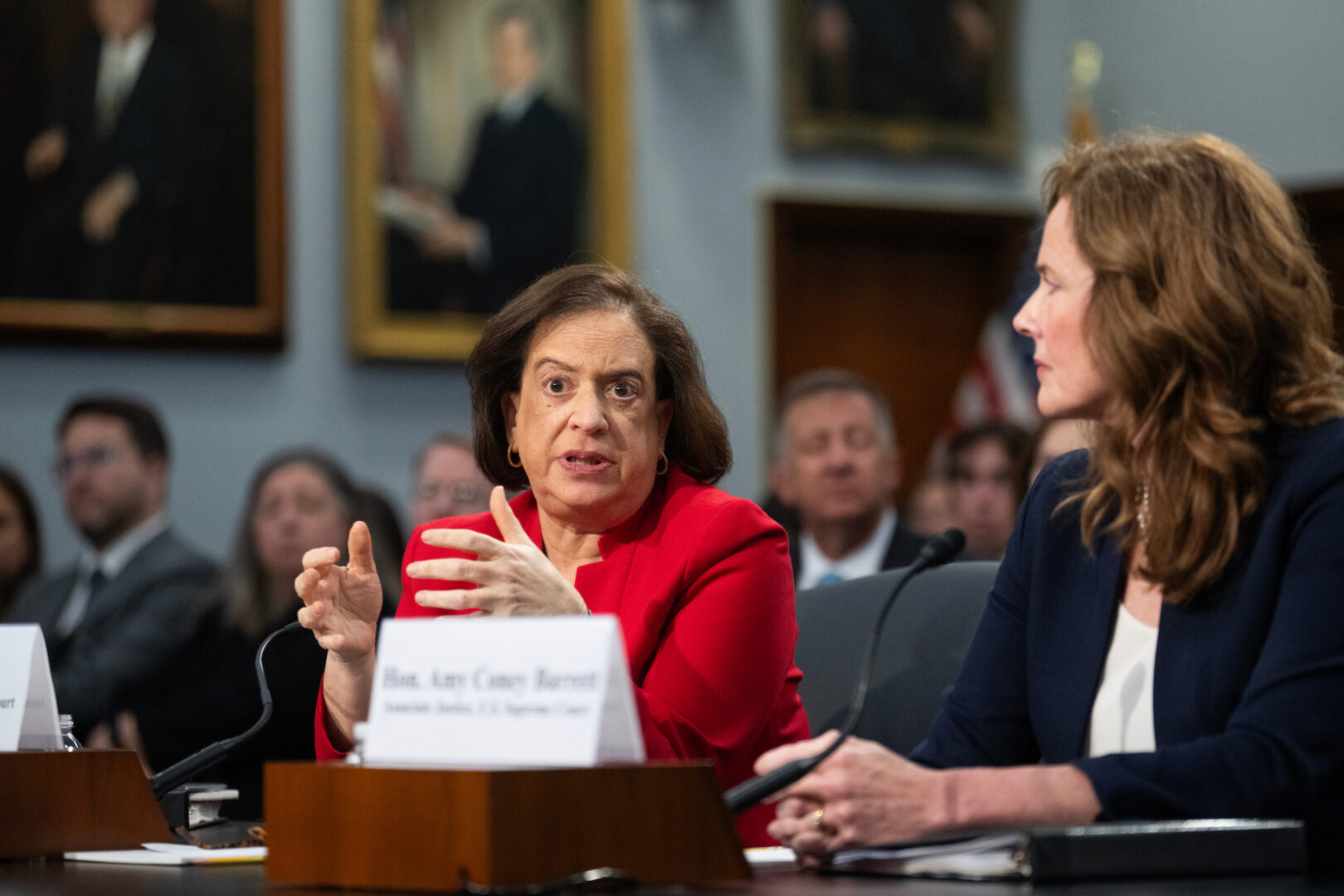
Justices Elena Kagan and Amy Coney Barrett pitched increased security funding for the Supreme Court next year at a pair of rare congressional hearings for sitting justices Tuesday that covered issues ranging from emergency cases to judicial ethics.
Kagan and Barrett focused most of their testimony on increased security concerns at the court amid rising threats in recent years. The pair’s testimony to House and Senate Appropriations subcommittees marked the first time that justices have appeared before Congress since 2019.
Barrett told the House panel that increased threats have had a personal impact on her family. When she first started receiving intense personal threats, she was sent home with a bulletproof vest, which her 12-year-old son saw.
“Maybe I lack imagination, but I didn’t expect that performing this service was going to put me in the position of explaining to my children what a bulletproof vest was and why I had to wear one,” Barrett said at the House hearing.
Barrett also said the justices have received deliveries at their personal homes in the name of Daniel Anderl, the son of a federal judge killed by a disgruntled attorney in 2020 who was targeting his mother. Six weeks ago, Barrett also said she had been the victim of a “swatting” incident – where police were called to her house with a false report of gunshots – that was stopped by the Supreme Court police before local police entered her home.
Kagan said the justices have faced a steadily increasing pace of threats against them, up 38 percent in the past year after increasing 25 percent the year before. Kagan said the court’s recent spending increases have been “almost entirely for security expenses,” including round-the-clock protection from Supreme Court police and contractors.
For the coming fiscal year the court requested a roughly 10 percent increase in its funding, to $225.1 million. Most of that total, $207 million, would go toward salaries and expenses while $18.1 million would go to the court’s building and grounds.
Kagan said the justices used a recent $28 million supplemental appropriation to transition the justices’ home security from the U.S. Marshals Service to Supreme Court police. Now, Kagan said the justices intend to expand their current four- to eight-member security teams to ensure round-the-clock protection, reduce overtime and burnout.
Both hearings touched on numerous issues surrounding the court. Rep. Rosa DeLauro, D-Conn., pushed Barrett and Kagan to explain whether the court would adopt a binding ethics code with an enforcement mechanism. The justices adopted a voluntary one in 2023 after reporting about gifts and travel accepted by Justices Clarence Thomas and Samuel A. Alito Jr.
Kagan responded that the court had discussed a more formal process, but it presented “an extremely difficult question” of who would enforce the code. Kagan said it would be awkward for lower courts to enforce a code against their superiors, and worse for another branch of government to supervise the justices.
“I don’t think that you would want an enforcement system controlled by the executive branch or the legislature,” Kagan said to the House panel.
Barrett diverged on that, an uncommon sign of public disagreement between the court, saying she was “less certain” than Kagan about an enforcement mechanism within the court.
“I mean, I’m certainly fully committed to the code, as are all of our colleagues, but because of some of the complexities that Justice Kagan identified, I’m just not quite sure,” Barrett said to the House panel.
Several Democratic members of the panel asked about the number of emergency applications – including nearly three dozen by the Trump administration. Those are fast-moving appeals from lower courts which the justices typically decide on a short-term basis without full briefing and oral arguments.
Kagan said she felt as though the court had done better in handling those emergency cases, but the rise in the number of them had been encouraged by the court itself.
“Why are all these people coming to us for this relief when they didn’t in the past? I think partly it has to do with the fact that the court did grant some of these petitions, and then you encourage everybody else to bring them to you,” Kagan said to the House panel.
Sen. Susan Collins, R-Maine, said some of the blame for the threats facing the justices comes from public officials “who should know better” – referencing a statement in 2020 by Senate Minority Leader Charles E. Schumer, D-N.Y., who, speaking on the abortion issue, said justices had “released the whirlwind” and would “pay the price” for their decisions. Schumer later walked back those comments, saying they did not come out as he intended.
“This overheated language, this completely inappropriate rhetoric against the Supreme Court endangers the lives of the justices and erodes public trust in our system of government,” Collins said.
Sen. Jack Reed, D-R.I., also countered with statements from President Donald Trump, where he criticized the justices as unpatriotic and said they had sold out the country.
Kagan said that those statements are inappropriate “wherever they come from,” and make justices less safe.
“These statements are really unhelpful, they are dangerous in terms of individual justices’ security and they’re not appropriate in the way to treat a coordinate branch of government,” Kagan said to the Senate panel.
At both hearings, the justices received bipartisan support from the dais – members of both parties emphasized the importance of keeping the justices safe. Rep. Steny H. Hoyer, D-Md., and others said they wanted to make sure that the court had enough funding for round-the-clock in-house security for the justices.
Several members also suggested additional support for Supreme Court security – Rep. Mark Alford, R-Mo., spoke about adding an additional secure entrance to the complex, akin to the Capitol Visitor Center. Rep. Marie Gluesenkamp Perez, D-Wash., floated additional support for Supreme Court police to ensure that those who threaten the justices face prosecution.
Public testimony from the justices has become rare. Tuesday’s testimony from Barrett was her first congressional appearance since her record-breaking speedy confirmation ahead of the 2020 election.