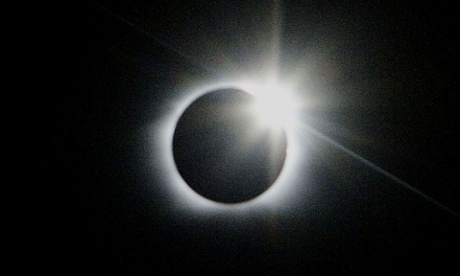
Thousands of visitors are expected to flock to the north of Scotland and its outlying islands next week in order to enjoy some of the most complete views of the solar eclipse available in Europe.
While the line of totality for the eclipse on Friday morning will not touch land anywhere across the UK, it will pass six miles to the north-west of the uninhabited island of Rockall, west of the Outer Hebrides. On the Isle of Lewis, coverage of the sun is predicted to reach 98%.
Shetland expects to be one of the darkest places in the country, with an eclipse of approximately 97%. Sumburgh lighthouse, at the southern tip of the Mainland, will be live-streaming images of the cosmic event to the Rosemount observatory in Cornwall, where a total eclipse was viewed in 1999.
Dedicated solar eclipse cruises will be stopping off in Shetland and Orkney, with more than 2,500 passengers heading north to take advantage of the islands’ dark skies and minimal light pollution.
Aberdeen is expected to be the best venue on the UK mainland to watch the eclipse, with the total coverage of the sun expected to reach 94%. Torry Battery, east of the city and usually a location for dolphin spotting, is being recommended as the best place for viewing with its unspoilt views of the harbour and North Sea.
Professor John Brown, Scotland’s astronomer royal, urged all eclipse-watchers to take the necessary safety precautions but added: “People think that there’s something especially dangerous about the eclipse, but it’s very silly to look at the sun at any time.”
Before advances in telescope technology, Brown explained, eclipses offered rare opportunities to examine the rim of the moon or examine stars. “In terms of research forefronts, eclipses are less important these days, but people are still impressed that we can predict these events with such precision,” he said.
“The sky operates like clockwork. And it is still a magical thing to see the sun vanishing. The sky does some amazing things.”