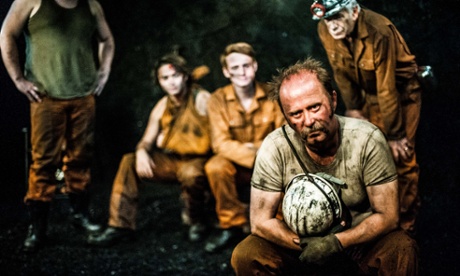
Land Of Our Fathers, On tour
Wales Millennium Centre revives Chris Urch’s 2013 debut play. Setting out on a tour that will take it across Wales, including some former mining communities, Land Of Our Fathers is set down a pit in 1979, when Margaret Thatcher – described here as “a Nazi in pearls” – was on the brink of electoral victory. But while the play cleverly uses dramatic irony and the audience’s knowledge of events to come, the miners are facing a more immediate problem: an electrical explosion has trapped them below ground. Urch certainly knows how to write a cliffhanger.
Weston Studio, Wales Millennium Centre, Sat to Wed; touring to 28 Nov
LG
The Choir, Glasgow
Glasgow’s Citizens Theatre clearly has further ambitions for this new musical, produced in partnership with the Ambassador Theatre Group. Set in Wishaw, on the edge of the Clyde valley, it tells the story of a community choir created by a newcomer, which brings together a disparate group of people, including those who have lived there all their lives and recently arrived immigrants finding it hard to settle. But can singing really bring these people together or will the tensions beyond the room tear them apart? The musical is written by Paul Higgins with music and songs by Ricky Ross from Deacon Blue, who has also written hits for Nanci Griffith, Ronan Keating and others. Dominic Hill directs.
Citizens Theatre, Sat to 14 Nov
LG
Husbands & Sons, London

A welcome return to the stage for Anne-Marie Duff – currently in the BBC crime drama From Darkness and the film Suffragette – for a bit of earthy, working-class DH Lawrence. Husbands & Sons may sound like an existing Lawrence novel but is an amalgamation of three of his best plays: The Daughter-In-Law, A Collier’s Friday Night and The Widowing Of Mrs Holroyd. Adapted by the National’s deputy artistic director Ben Power, it will play in three separate houses on stage, and during the interval the audience will move seats to see the action from another perspective. It’s directed by Marianne Elliott (The Curious Incident Of The Dog In The Night-Time), who also directed Duff in the award-winning National Theatre production of Saint Joan.
National Theatre: Dorfman, SE1, Tue to 10 Feb
MC
Pomona, Manchester
Like a mirror constantly reflecting darkly back at you, Alistair McDowall’s Pomona gets a deserved transfer to Manchester, the city where it is set. But you might not recognise the city of this play, which seems a world as wired and weird as anything you might find in a computer game or maybe the novels of Neil Gaiman. It shifts between the grimly believable and fantastical with real assurance, as Ollie sets out to look for her missing twin sister and discovers that all roads lead to Pomona, a hole in the heart of the city. It is a creepily compelling evening, like finding yourself caught in a maze of mirrors. But it has a sharp comic edge and is directed with real care and swagger by Ned Bennett, whose production of Anna Jordan’s Yen at this same Manchester address transfers to London’s Royal Court next year.
Royal Exchange Theatre, Thu to 21 Nov
LG
The Moderate Soprano, London
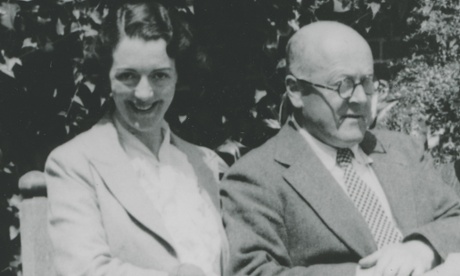
The Hampstead Theatre has scored a coup in snagging local resident David Hare’s new play. The Moderate Soprano, based on the early days of Glyndebourne before the second world war, opens this week. It finds decorated war veteran John Christie, played by Roger Allam, trying to fulfil his dream of building an opera house on his Sussex estate. His story also involves a group of German refugees and his wife (played by Nancy Carroll), the soprano of the title. This run is sold out but there’s a good chance that it will transfer, like Hampstead’s recent Mr Foote’s Other Leg, a comedy about the Georgian celebrity satirist and playwright Samuel Foote, which is at the Haymarket Theatre from Wed to 23 Jan.
Hampstead Theatre, NW3, to 28 Nov
MC
The Distance, Sheffield
Deborah Bruce’s play about middle-class lives in crisis was first seen at the Orange Tree in Richmond and was credited with helping to drag the venue into the 21st century. There are echoes of Ibsen’s A Doll’s House in this story of Bea, who returns from Australia, where she has been living with her husband and children, into the embrace of her former university friends Kate and Alex. Bea has left her family and it becomes clear she has no intention of reclaiming her children. Her choice reflects on the choices of her friends, too. It’s a play about the good and bad things in female friendship, but also highlights the gap between who we thought we’d be when we were young and the people we become as life bruises and batters us.
Crucible Studio, Thu to 14 Nov
LG