Donald Trump's behaviour during a White House event on Monday has renewed questions about his fitness for office, after a clinical and forensic psychologist said the president's apparent confusion, slurred speech and repeated episodes of nodding off point to potential 'neurological' problems rather than the ordinary effects of ageing.
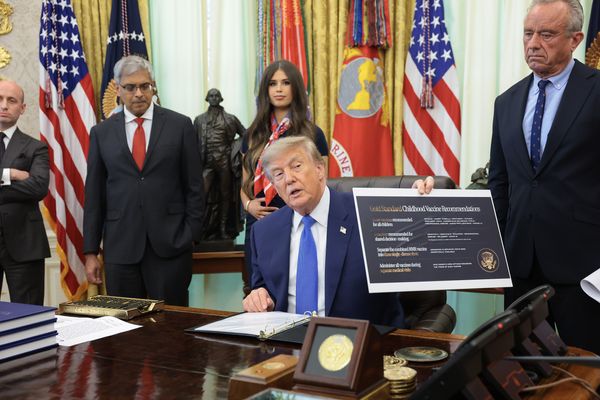
Trump appeared in the Oval Office to sign an executive order, flanked by officials and advisers, in a seemingly routine presidential photo-op.
It was anything but routine to John Paul Garrison, a US-based clinical and forensic psychologist who later released a detailed video analysis of the footage. In his view, Trump was 'exhibiting a wide variety of worsening neurological symptoms' that have been creeping into public view for months.
Garrison, who has not examined Trump in person, based his assessment on what he described as clear behavioural patterns captured on camera. He stressed that his comments are observations, not a formal diagnosis, but insisted that what he is seeing is unlikely to be explained simply by Trump's age.
At the start of the event, Trump turned to address Health Secretary Robert Kennedy Jr. and, according to Garrison, immediately began to struggle. The president 'misses words,' he said, believing he is speaking clearly when in reality he is garbling his message.
'He thinks he's saying things correctly, and he doesn't even realise how badly he's messing up what he's trying to say,' Garrison observed, arguing that this disconnect between intention and output can itself be a warning sign.
Donald Trump, Sleepiness and Signs of Neurological Strain
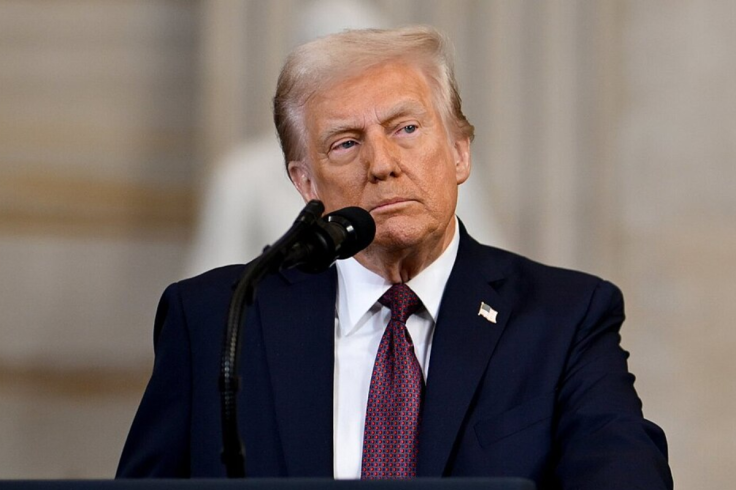
As Kennedy spoke, Trump could be seen drifting in and out of sleep. Garrison described the president as 'dozing off' before jolting back to attention, apparently aware that he was losing focus but unable to correct course.
'There's some awareness that he is drifting,' Garrison said. 'And he doesn't have the good judgment to realise that everybody's watching him right now. He really is having a hard time thinking through these situations.'
Trump then appeared to fall fully asleep, on camera, in the middle of the meeting. When he woke, Garrison noted 'some confusion' and a period in which Trump tried to catch up with what was being said, nodding along as though attempting to mask his disorientation.
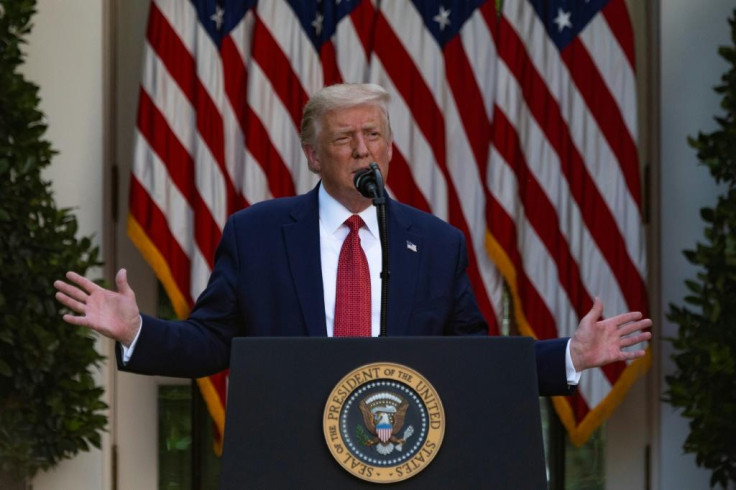
For Garrison, this is where the age argument collapses. 'This is not normal behaviour even if somebody is 80,' he said. 'I get that that's an advanced age, but that doesn't explain when you're sitting in front of lights around a lot of other people how you would fall asleep.'
He pointed instead to possible neurological explanations. Excessive sleepiness in such a setting, he argued, can follow a stroke or damage to brain regions such as the hypothalamus or thalamus. 'What does explain it is either neurological problems, post-stroke behaviour or some sort of neurological impairment that is causing this,' he said. 'His age truly does not explain this behaviour.'
Donald Trump's 'Neurological Twitch' and Worsening Pattern
According to Garrison, Monday's footage is not an isolated incident. He claims Trump 'just keeps falling asleep over and over again' throughout the roughly 40‑minute Oval Office session. If each brief lapse is counted, he said, the number of times Trump drifts off runs to 'dozens.'
The psychologist argued that the pattern is becoming more pronounced over time and more intrusive in the middle of high-profile engagements, which in his view is precisely when most people will try to exert maximum control over their presentation.
'This has been happening for months now, but this is a great example of a time where it's happening very clearly right in the middle of an important meeting,' he said. Trump, he added, appears to have 'a very hard time orienting when he wakes up again.'
On top of the drowsiness and slurred speech, Garrison highlighted what he called a 'neurological twitch' in Trump's right arm. In several clips, he said, the president begins to lose coherence verbally and, at the same moment, his elbow jerks outward in a sudden, involuntary motion.
'When he's standing, he's doing it constantly,' Garrison claimed. 'They're really large motions, but it does seem to be there's an involuntary twitch, which once again, all signs point to something neurological and something serious neurological going on.'
The White House has not publicly addressed Garrison's remarks or provided any updated medical information in response to the latest concerns. There is no confirmation from Trump's physicians that he has suffered a stroke or other neurological event, and, in the absence of official medical records, all external assessments remain speculative and should be taken with a grain of salt.
Even so, Garrison was unambiguous in his closing warning to those inclined to dismiss what they are seeing as nothing more than an elderly man having an off day. 'I really suggest that anybody that truly believes that this is entirely because of his age reconsider that position,' he said. 'Because that absolutely does not adequately explain what we're seeing.'