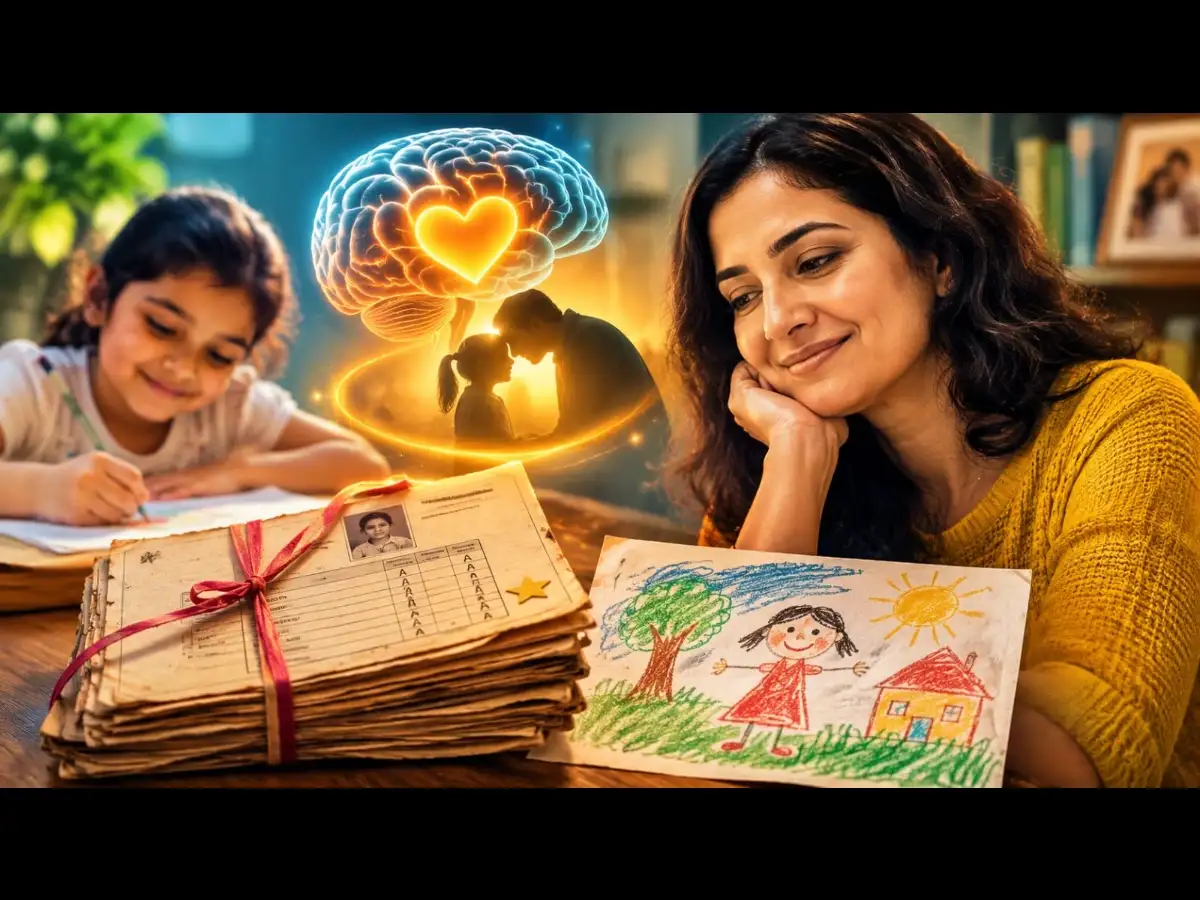
A faded report card, a drawing made with uneven crayons or a tiny handwritten note can look completely ordinary to everyone else. Yet many parents find it surprisingly difficult to throw these things away. Years after a child has grown up, a folder of school papers may remain tucked inside a cupboard, while old drawings continue to occupy refrigerator doors, memory boxes or desk drawers. Psychology suggests that this behavior may involve much more than simple sentimentality. Objects connected to emotionally significant periods can become powerful cues for autobiographical memory, identity and nostalgia.
For parents, these seemingly ordinary pieces of paper can represent not only what a child once created, but also a particular period of family life that cannot be experienced in exactly the same way again.
Psychology Says Old Drawings Can Become Memory Cues
One reason parents preserve childhood artifacts is that physical objects can help trigger autobiographical memory , the recollection of personally experienced events and periods of life.
Research on autobiographical memory shows that remembering is influenced by social relationships, language and the way families talk about the past. Psychologist Elaine Reese's work highlights the important role parents can play in the development of children's autobiographical memories through conversations about past experiences.
A child's drawing can therefore become more than a piece of artwork. Looking at it years later may remind a parent of where the family lived, what the child sounded like at that age, what was happening at school or even what the parent was going through at the time.
For example, a drawing of a family made by a six-year-old might immediately bring back memories of a birthday party, a particular home or the child's excitement when showing it to a parent.
Nostalgia Can Make Ordinary Objects Emotionally Valuable
Psychologists Constantine Sedikides and Tim Wildschut have conducted extensive research on nostalgia, describing it as an emotion rooted in memory and often directed toward meaningful people, events and objects from the past. Their recent psychological review also emphasizes that nostalgia is predominantly positive and can involve specific objects.
This helps explain why an objectively worthless piece of paper can become emotionally priceless.
A report card may have no practical purpose once the child is an adult. But it can symbolize the period when that child was still coming home from school, asking for help with homework or proudly showing a parent a new achievement. The object becomes a shortcut to a larger emotional experience.
Psychology Says Parents May Be Preserving Their Own Life Story
There is also an important connection between autobiographical memory and identity .
Psychologist Dan P. McAdams' narrative identity theory proposes that people construct a sense of who they are through the stories they create about their lives. Major relationships and experiences become part of this personal narrative.
Parenthood can become a particularly important chapter in that story. Keeping a child's first drawing or an early report card can therefore preserve evidence of a stage in the parent's own life.
The paper says something like, “This was when I was raising my child.” It captures not only the child's development but also the parent's identity during that period.
That can explain why parents sometimes remember exactly where a particular drawing came from, even when they have forgotten dozens of other everyday details.
READ ALSO: Psychology says people often defend decisions they once made even after the reasons disappear
Why a Child's Handwriting Can Feel So Powerful
The emotional power of these artifacts may also come from their sensory details. A child's handwriting, spelling mistakes, uneven coloring or unusual drawing style can provide concrete reminders of how young that child once was.
Research has found that children's drawings can serve as cues during recollection because they contain visual and perceptual information connected with remembered experiences.
Imagine a parent opening an old folder and finding a drawing labeled “My Famly.” The misspelling itself may suddenly evoke the child's voice, personality and age.
The drawing is not valuable because of its artistic quality. Its value comes from what it helps the parent remember.
Psychology Says Attachment Can Shape How Families Remember the Past
Attachment theory , associated with psychologist John Bowlby and later researchers, also provides useful context for understanding why emotionally significant parent-child experiences can become deeply embedded in memory.
Research examining attachment and autobiographical memory has found connections between attachment, emotional content and parent-child conversations about past experiences.
This does not mean that every parent who saves schoolwork necessarily has a particular attachment style. Instead, it highlights how emotional relationships can influence the way families remember and discuss their shared history.
A report card showing a child's first excellent grade may become part of a family story repeated for years: “You were so proud that day.” Eventually, the document becomes a physical anchor for that story.
Keeping Memories Can Also Reflect the Experience of Time Passing
There is another reason these objects can become difficult to discard: they make change visible.
A parent may look at a child's tiny drawing and compare it with the adult standing in front of them today. The contrast can make the passage of time suddenly tangible.
The paper becomes a reminder that childhood was temporary.
This may be particularly powerful during transitions, such as when a child leaves home, graduates, gets married or starts a family of their own. Research on nostalgia suggests that memories of meaningful past experiences can help people maintain a sense of continuity across changing stages of life.
Not Every Parent Who Keeps Everything Is Being Nostalgic
It is important not to overinterpret the behavior. Some parents simply enjoy collecting memories. Others keep schoolwork because they expect their children may want it later. Some people naturally save physical objects, while others prefer photographs or digital archives.
Keeping old drawings is therefore not a psychological diagnosis or proof of a particular relationship. What psychology does help explain is why these objects can acquire emotional significance far beyond their practical value.
FAQs
Why do parents keep their children's old drawings?
Parents may keep them because they act as cues for autobiographical memories and represent emotionally meaningful periods of family life. Nostalgia can also make ordinary objects feel unusually valuable.
Why are old report cards emotionally meaningful?
A report card can represent a child's development, achievements and a particular period of parenthood. Its emotional value often comes from the memories associated with it rather than the document itself.