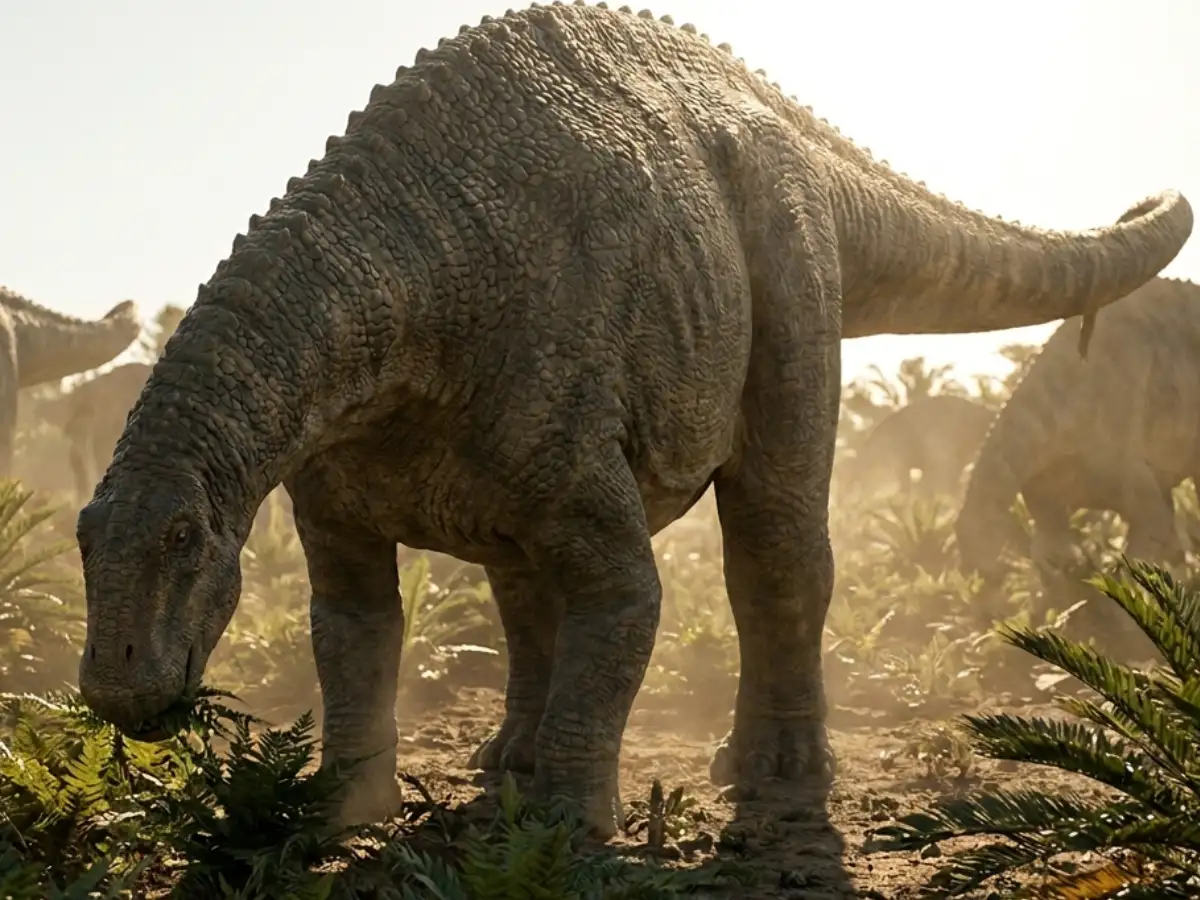
Picture a sauropod dinosaur. Your brain most likely instantly creates the same image you have been shown since kindergarten: a massive body, a whip-like tail, and that impossibly long neck reaching into the treetops. It’s the most recognizable shape in natural history, and for millions of years, it worked. Sauropods were some of the most successful creatures ever to walk the Earth.
So when paleontologists digging in the dusty rock of Argentine Patagonia pulled out the bones of a sauropod with a surprisingly short neck, it was more than just a find. That was a curveball. Meet Brachytrachelopan mesai, a dinosaur that was doing everything wrong by its own standards, and it still thrived.
Why the long neck was supposed to be non-negotiable
For most of the evolutionary history of the sauropods, bigger and longer was the name of the game. According to research published in Biological Reviews on the biology of sauropod gigantism, neck elongation was not only achieved by adding more vertebrae, some species had up to 19, but also by stretching each individual vertebra to extraordinary lengths. These were not small changes. They were deep, iterative evolutionary commitments to a single architecture.
The payoff was worth it. A long neck enabled a sauropod to browse over large areas for food without moving its massive body. It can pick high canopy, or graze low scrub, or anything in between. Consider it nature's first reach-and-eat machine.
Then this little rebel came along
The fossil, described in a landmark study by Rauhut and colleagues in the journal Nature in 2005, changed the rules of the game entirely. Brachytrachelopan mesai means "short-necked shepherd," after the ranch worker who found the dinosaur. The dinosaur had a neck about 40 percent shorter than its closest known relatives. Its individual cervical vertebrae were as short as they were tall, a proportion almost unheard of in the world of the sauropod.
It belonged to a group called the dicraeosaurids, already known for being the squat end of the sauropod spectrum. But even by their standards, this was an animal in a category of its own. They confirmed it was a new species, different from everything else. The shortness wasn’t damage or a quirk of preservation. This was just what the animal was.
This is where it gets really interesting, and a bit humbling. Scientists don’t fully know. The short neck strongly suggests that Brachytrachelopan was not competing with the tall browsers in its ecosystem. It was most likely eating lower down, ground-cover plants, low shrubs, plants the tall-necked giants would have stepped over without a second thought.
Complementary work, such as a 2020 study in Scientific Reports examining the skeletal adaptations of the sauropod Spinophorosaurus, found that even slight differences in vertebral structure and neck flexibility resulted in vastly different feeding ranges. Sauropod anatomy, in other words, was not one-size-fits-all. Brachytrachelopan seems to have filled its own niche, which would have been more difficult to exploit with a 15-meter neck.
It probably had a lot to do with the breakup of Gondwana
Timing is the key to evolution. The Late Jurassic was a time of dramatic reorganization of the continents. Gondwana, the ancient southern supercontinent, was breaking away from the northern landmasses. South America was becoming an island continent unto itself, and populations of animals that once roamed freely were suddenly split apart, isolated to evolve on their own.
The discovery in Patagonia indicates that as the Southern Hemisphere fragmented and dispersed, dicraeosaurids rapidly spread and quickly evolved to occupy new ecological niches. Brachytrachelopan might be the result of exactly this kind of pressure: an animal that carved out a niche in the local ecology and filled it by becoming shorter, not taller.
What this means for our understanding of evolution
In science, as in everyday thought, there is a tendency to view evolution as moving in straight lines. Dinosaurs grew larger. Necks grew longer. All moved towards some theoretical optimum, but Brachytrachelopan serves as a reminder that evolution is fundamentally opportunistic rather than directional. It goes where the food is, where there is no competition, where it can survive.
This is a helpful corrective for Americans who grew up with the image of Brachiosaurus looming over every museum diorama and Jurassic Park sequel, but the Mesozoic world was not a parade of giants, either. It was a complicated, shifting ecosystem in which even the most iconic body plan could be, and was, renegotiated on the fly.
The short-necked sauropod did not fail to be a sauropod. It was good at being what it was, and 150 million years later, the bones on a hillside in Patagonia are still arguing the case for going your own way.