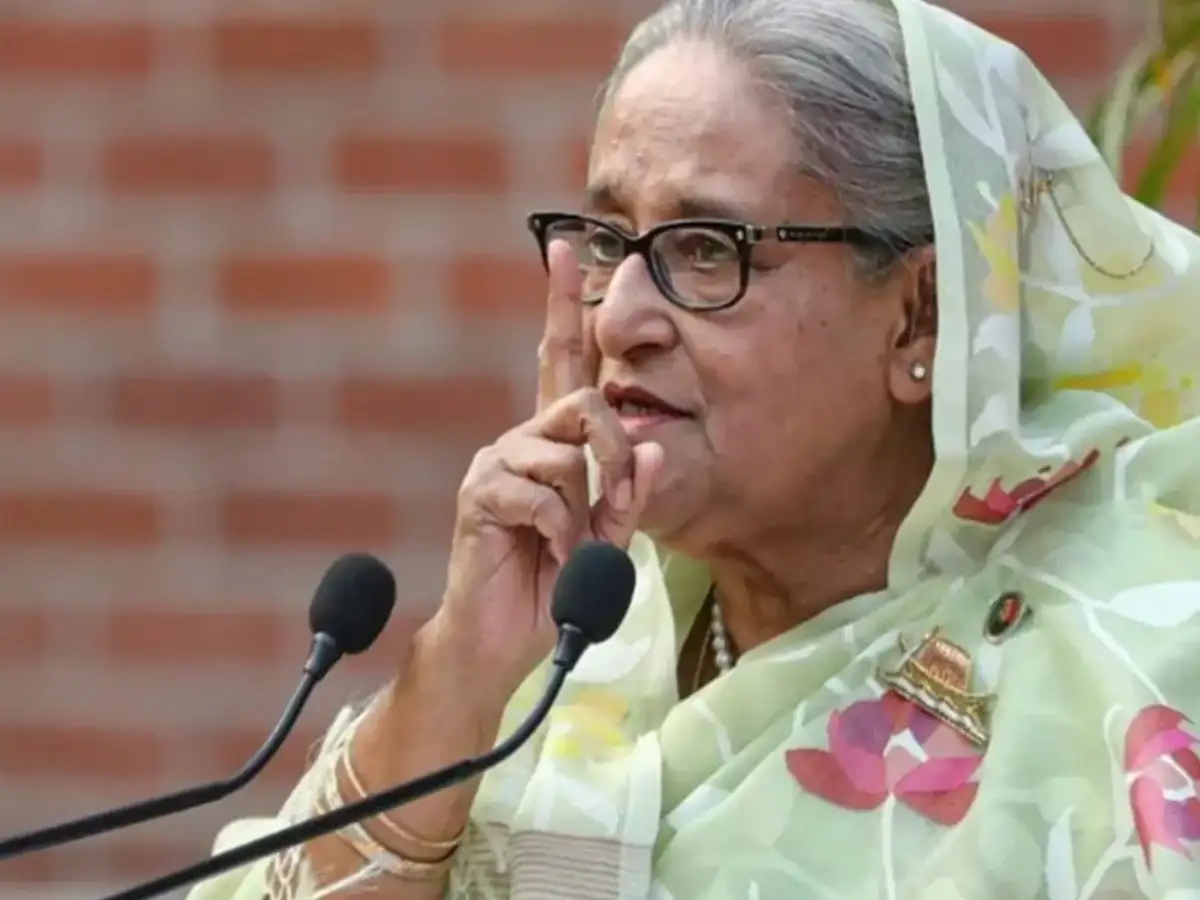
Former Bangladesh Prime Minister Sheikh Hasina on Wednesday accused the country's interim government of halting a judicial inquiry into the violence that rocked Bangladesh in July-August 2024, alleging that the move was aimed at preventing the truth from emerging.
Addressing a media event in New Delhi virtually in her first media address in two years, Hasina said she had expanded the probe into a three-member judicial commission on August 1, 2024, to ensure a "credible" investigation, but claimed the inquiry was stopped after the change in government.
"At first, on 1st August, I strengthened the inquiry into a three-member commission so that the investigation would be credible and competitive.
But after giving power, the political interim government led by Muhammad Minyoz stopped the investigation?
They did not allow the truth to come out. They gave indemnity to those who involved in the killings if they truly wanted justice. Why did they stop the inquiry?
If they had nothing to hide, what about the killers?
That one decision tells the truth.
They did not want justice. They wanted power. They did not want investigation. They wanted the evidences for it. Their old words expose the truth."
Hasina maintained that the protests over the quota system in July 2024 were not a peaceful student movement but were transformed into an organised political campaign aimed at removing her government.
She said her administration had initially attempted to resolve the issue through dialogue, legal measures and discussions with student representatives, including meetings at the prime minister's residence involving senior ministers. According to Hasina, the movement later shifted from demands for quota reforms to calls for her resignation, while "false propaganda" was used to mobilise students.
Citing remarks she attributed to Muhammad Yunus, Hasina alleged that the agitation had been "meticulously designed" and was directed by unseen organisers rather than being a spontaneous protest.
The former prime minister further alleged that the protests escalated into widespread violence from July 15, with attacks on police stations, government offices, transport infrastructure, hospitals, businesses, media establishments and prisons. She claimed weapons were looted, prisoners released and hundreds of police installations attacked, while law enforcement personnel were killed or assaulted.
Questioning criticism of the security forces' response, Hasina said it was the responsibility of law enforcement agencies to protect public property, government institutions and citizens during violent unrest.
Turning to Bangladesh's economy, Hasina alleged that project costs had risen sharply under the interim administration and claimed law and order had deteriorated, with extortion, killings and violence becoming common. She also alleged that women and children were facing growing insecurity and said ordinary citizens no longer felt safe.
Hasina contrasted the current situation with her government's record, saying Bangladesh had maintained GDP growth of 6.5-7.5% during her tenure and executed major infrastructure projects including the Padma Bridge, Dhaka Metro Rail, the Rooppur Nuclear Power Plant, the Matarbari deep-sea port, the Bangabandhu Tunnel and the Bangabandhu Satellite programme. She said these investments had helped build national capacity and positioned Bangladesh as a "Rising Tiger of Asia."
Calling Bangladesh's current situation a regional concern, Hasina appealed to the international community to support the restoration of democracy, justice and peace in the country. She demanded the lifting of emergency measures, release of political prisoners, withdrawal of what she called false cases, restoration of media freedom and judicial independence, and reforms to ensure law enforcement agencies served the public.
Ending her address on an emotional note, Hasina reiterated her intention to return to Bangladesh despite the risks, saying she was prepared to face detention or imprisonment. "I want to return because the people deserve security, development, prosperity, and peace," she said, adding that her objective was not power but to help restore democracy and development.