Welcome to the Tuesday, May 19, 2026, Brew.
By: Briana Ryan
Here’s what’s in store for you as you start your day:
- The Utah Supreme Court undergoes another change in structure with the resignation of Justice Diana Hagen
- It’s Election Day in eight states
- We need one key thing to cover 45,000 local elections this year… you!
The Utah Supreme Court undergoes another change in structure with the resignation of Justice Diana Hagen
On May 8, Utah Supreme Court Justice Diana Hagen resigned, marking another structural change within the Court.
Hagan’s resignation comes after Gov. Spencer Cox (R) signed a bill on Jan. 31 to increase the number of justices on the Court from five to seven — making Utah the first state since 2016 to expand its state supreme court. Utah is now one of 29 states to have a state supreme court with seven justices. Among all states, seven is the most common number of justices for a state supreme court.
Deseret News’ Brigham Tomco wrote that the bill “coincides with an increase in workload for Utah’s highest courts, and intends to speed up decisions, according to legislative leadership. It also comes amid Republican frustration over recent rulings that have stalled legislation and scrapped legal precedent.”
The bill gives Cox the opportunity to appoint two justices to the Court. Utah uses an assisted appointment process to select justices. During this process, the governor selects a nominee from a list of recommended candidates from a judicial nominating commission. The Utah Senate then votes whether to confirm the nominee. New appointees serve for at least three years, after which they must run for retention. If a majority of voters decides to retain, justices serve subsequent ten-year terms. The judicial nominating commission has announced a list of recommended candidates to fill the vacancy that the bill created, but Cox has not announced nominees for either seat.
The judicial nominating commission has not announced a list of recommended candidates to fill the vacancy that Hagen created. Hagen's resignation means that Cox will have another opportunity to appoint a justice. It also means only one justice is running for retention on Nov. 3. Hagen was running for retention alongside Justice Jill Pohlman, who is still running for retention.
Utah is one of 14 states holding retention elections for state supreme court justices this year. A retention election happens when voters must decide whether an incumbent justice should remain in office for another term. The justice, who does not face an opponent, is removed from the position if a certain percentage of voters decide the justice should not be retained.
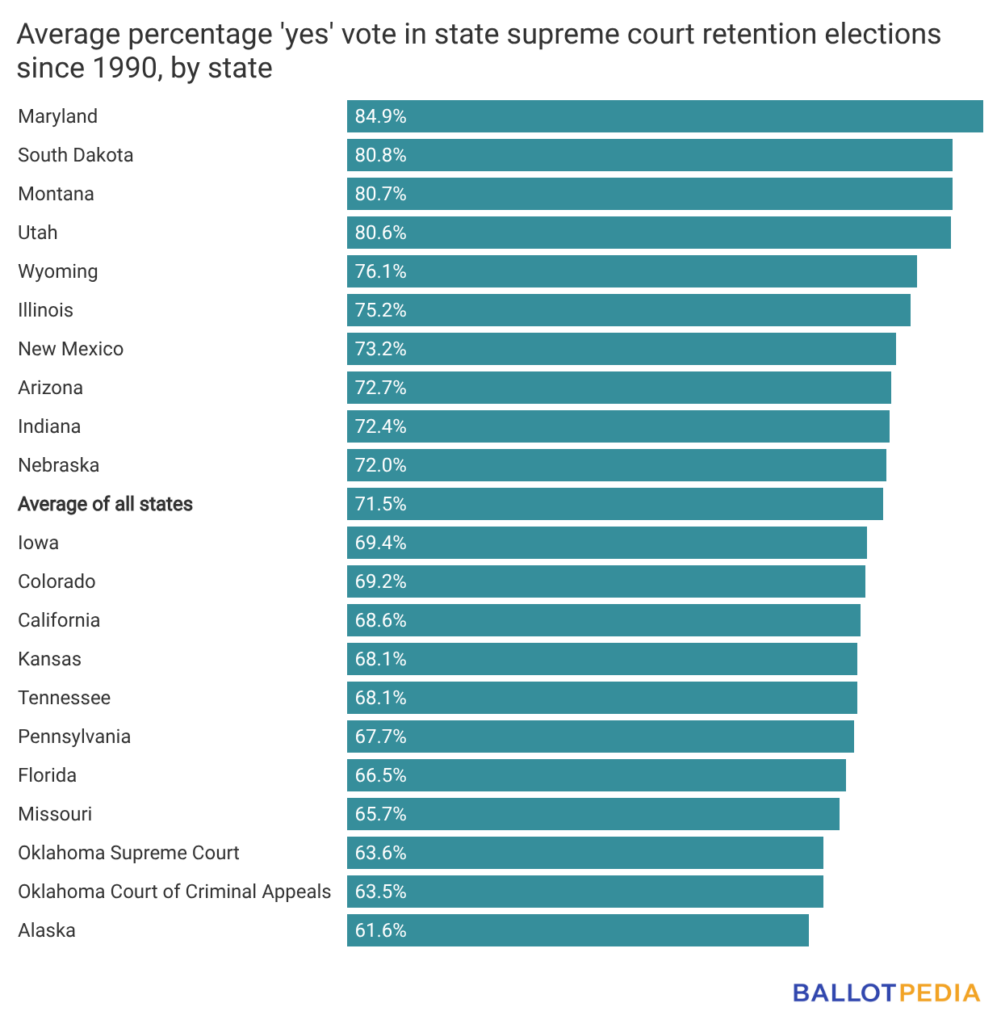
No Utah Supreme Court Justice has ever lost a retention, and in our data going back to 1990, Utah Supreme Court Justices have received an average of 80.6% of support across 17 elections. The most recent justice to stand for retention was Matthew Durrant in 2024. He received 77% of the vote favoring retaining him. Additionally, since 1990, only nine justices in seven states have lost a retention election.
At the Utah Republican Party convention in April, state party chair Robert Axon opposed retaining Hagen and Pohlman. According to Axon, his opposition stems from a July 2024 decision in which the Court ruled that the Utah Legislature violated the Utah Constitution when it repealed and replaced Proposition 4.
The citizen initiative that voters approved 50.3% to 49.7% sought to create a seven-member independent redistricting commission to draft and recommend to the Legislature maps for congressional and state legislative districts according to certain criteria. According to The Salt Lake Tribune's Emily Anderson Stern, the decision led to "a district judge subsequently order[ing] Utah to adopt a new congressional map that includes a left-leaning district."
At the time of the decision, Republican governors had appointed all five members of the Court. Specifically, Cox had appointed two — Hagen and Pohlman. Before Hagen’s resignation, Cox said he was undecided on how he would vote in the retention election.
Click here to read more about this year’s Utah Supreme Court election.
It’s Election Day in eight states
Voters in Alabama, Georgia, Idaho, Kentucky, Oregon, Pennsylvania, and parts of Arizona and New York are headed to the polls today, May 19. Here's a look at the 11 battleground primaries that we're watching closely.
Alabama
Six candidates, including one, President Donald Trump (R) endorsed, are running in the Republican primary for the state's open U.S. Senate seat. Jared Hudson, Steve Marshall, and Barry Moore lead in polling and media attention. Although Trump endorsed Moore, his past endorsements in the state's U.S. Senate primaries have produced mixed results. Trump's preferred candidate lost in 2017 and won in 2020. In 2022, Trump withdrew his endorsement of Mo Brooks (R) and endorsed Katie Britt (R), who went on to win the Republican primary.
Georgia
Two of the three candidates running in the Republican primary for the open 10th Congressional District — Houston Gaines and Ryan Millsap — come from different backgrounds. Hoodline's Bella Cruz wrote that "This primary will test whether Republicans in the 10th favor an outsider [Millsap] with money and theatrical messaging or stick with [Gaines] who has climbed the statehouse ladder." Both Gaines and Millsap lead in media attention.
Six candidates are running in the Democratic primary for the 13th Congressional District, which became vacant following the death of incumbent Rep. David Scott (D). Scott, who filed to run before his death, will still appear on the ballot. The Georgia Recorder's Alander Rocha wrote that Scott's death "has scrambled the race and left the seat wide open for one of these candidates, who would initially have settled for a second-place finish and a spot in a runoff." Everton Blair Jr., Jasmine Clark, Emanuel Jones, and Heavenly Kimes lead in fundraising, endorsements, and media attention. A special general election to fill the vacancy is scheduled for July 28.
The governor's office, which Republicans have controlled since 2003, is open. However, in the 2024 presidential election, Joe Biden (D) won the state. Additionally, both of Georgia's U.S. senators are Democrats. Seven candidates are running in the Democratic primary, including Keisha Bottoms, Geoff Duncan, Jason Esteves, and Michael Thurmond, who lead in fundraising and media attention. Eight candidates are running in the Republican primary, including Chris Carr, Rick Jackson, Burt Jones, and Brad Raffensperger, who lead in media attention.
Eight candidates are running in the Republican primary for the open lieutenant governor's office. Greg Dolezal, Steve Gooch, John Kennedy, and Blake Tillery lead in polling and media attention. While all four leading candidates served in the state Senate, they have taken different approaches with their campaigns.
Five candidates are running in the nonpartisan general election for three seats on the Georgia Supreme Court. Incumbent Justice Charlie Bethel is running against Miracle Rankin, and incumbent Justice Sarah Hawkins Warren is running against Jen Jordan. Incumbent Justice Ben Land is running unopposed. Republican governors have appointed all current justices — except John Ellington — to the Court. If Rankin and Jordan win their respective races, that would bring the number of Democratic-affiliated justices to two. If Bethel and Warren win their respective races, the number of Republican-affiliated justices would remain at eight. In our 2020 analysis of state supreme court justices, Ellington received a confidence score of Indeterminate.
Kentucky
Eleven candidates are running in the Republican primary for the state's open U.S. Senate seat, where two candidates' relationships with the incumbent they are running to succeed, Mitch McConnell (R), have been a theme in the race. Andy Barr and Daniel Cameron, who lead in polling, fundraising, endorsements, and media attention, both worked with McConnell. According to the University of Kentucky's Stephen Voss, this has created a dynamic in which the candidates are trying to appeal to voters who support McConnell and "voters' unhappiness with Mitch McConnell's old-school Reagan-Bush era Republicans."
Incumbent Rep. Thomas Massie — the only Republican in the U.S. House whom Trump has endorsed a challenger to — and Ed Gallrein are running in the Republican primary for the 4th Congressional District. According to the University of Kentucky's Stephen Voss, "A lot of Republican voters in Massie's district are going to be willing to consider an alternative to Massie because of Donald Trump's spats with Massie. But just because you're not fully happy with your member of Congress doesn't mean you end up willing to vote for someone else."
Pennsylvania
Four candidates are running in the Democratic primary for the open 3rd Congressional District, where the Pennsylvania Capital-Star's Whitney Downard wrote that the candidates have used endorsements to distinguish themselves. Christopher Rabb, Ala Stanford, and Sharif Street lead in fundraising, endorsements, and media attention. The Philadelphia Democratic Socialists of America endorsed Rabb, the district's incumbent Rep. Dwight Evans (D) endorsed Stanford, and Philadelphia Mayor Cherelle Parker (D) endorsed Street.
Bob Brooks, Ryan Crosswell, Lamont McClure, and Carol Obando-Derstine are running in the Democratic primary for the 7th Congressional District, where the incumbent had the smallest margin of victory (MOV) in the 2024 U.S. House general elections in Pennsylvania. That year, Ryan Mackenzie (R) defeated then-Rep. Susan Wild (D) 50.4% to 49.4%. That MOV was also the eighth-smallest nationwide.
Click here to check out more about the elections we're following today, May 19. If you're a voter in one of these states, make sure to check out our Sample Ballot Lookup Tool before you get to the polls.
We need one key thing to cover 45,000 local elections this year… you!
The school board. The city council. The county commission. The elected officials who serve on these boards debate issues and establish rules and laws that can affect our daily lives. Regrettably, they are also the very elected officials who most voters know little or nothing about. Ballotpedia is determined to make sure voters have a better sense of who the candidates are for these offices – what they stand for, what they hope to achieve, who has endorsed them, and more.
This year, we’re covering more than 45,000 local elections in 32 states. Our goal is to help make sure that when voters head to the polls, they have more than a name to go on when they make their choices. You can play a key role in our work with your monthly gift of $13 or more. Your support helps us keep voters informed about candidates in every election, everywhere, big or small. And as a thank you for supporting our work, everyone who commits to making a tax-deductible gift of $13 a month or more will receive a completely ad-free experience on every one of Ballotpedia’s more than 650,000 pages. To get started, just click here – and thank you for your support!