
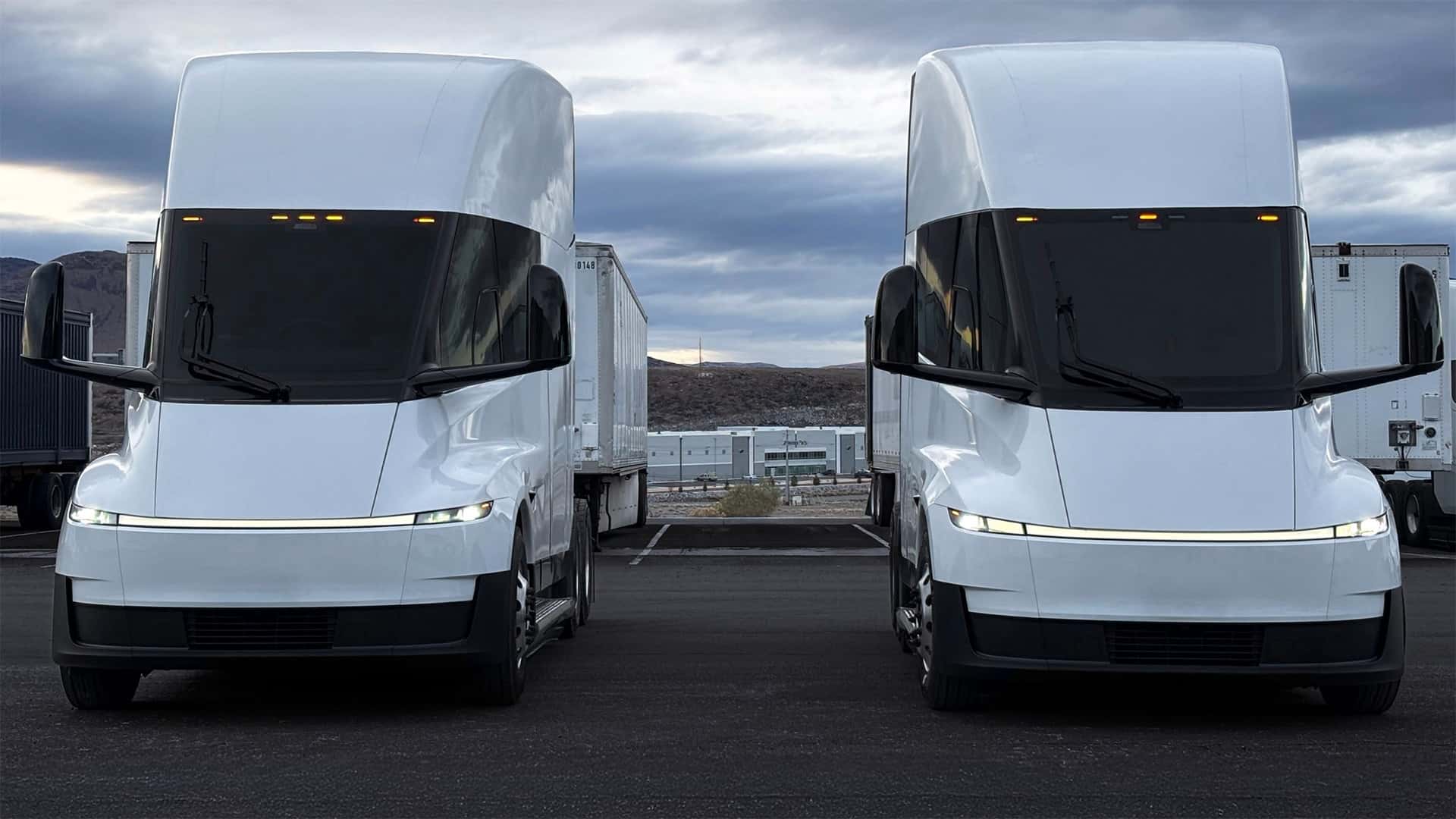
- Tesla wants to take the hassle out of charging the Semi electric truck.
- The Class 8 tractor can charge at 1.2 megawatts through a liquid-cooled cable.
- However, two company execs told Jay Leno that an automated charging system is in the works.
The Tesla Semi has had an on-again, off-again type of relationship with the media, going from the top of the news feed when it debuted in 2017 to the bottom of the barrel shortly after. Now, the Class 8 truck is making headlines once again, thanks to a lengthy video published by Jay Leno on YouTube, showing the latest model’s features.
Speaking with Leno, Dan Priestly, the Semi’s program director, and Franz von Holzhausen, Tesla’s head of design, said that the company is working on bringing an automated charging system to the megawatt-capable truck.

The Tesla Semi can accept up to 1.2 megawatts from a liquid-cooled cable, but alternative solutions are being developed that would help drivers and fleet managers keep the batteries topped up even easier.
“We see an opportunity for doing automated charging in the future,” said Priestly. “It’s something we’re working on with the cars,” added Holzhausen, who likely referred to the wireless charging system in the upcoming Cybercab two-seater. “You drive over [a pad],” said the chief designer, but then he added, “Yeah, conductive charging.”
Conductive charging refers to wired charging, whereas inductive charging refers to wireless charging. So at this point, we don’t know if it’s a charging pad kind of situation, like on the Porsche Cayenne EV, or some sort of system that automatically plugs a cable into the charge port, like Hyundai’s charging robots or even Tesla’s ill-fated charging snake from over a decade ago.
If an inductive charging solution is in the works, it could be reserved for longer rest stops. On a 1,200 kW cable connection, the Semi can add 300 miles of range in 30 minutes, or 60% of its total 500-mile range, which is plenty. On a wireless connection, though, charging speeds are typically much lower.

On the new Porsche Cayenne Electric, the optional wireless charging pad can deliver up to 11 kW, but a Utah-based company called Wave Charging claims that its wireless charging system can send up to 500 kW of power through a floor-mounted pad. Back in 2021, the same company said that it was developing a solution for the Tesla Semi that could deliver up to 1 MW of power without a physical connection between the charger and the vehicle.
Tesla’s relationship with wireless chargers has so far missed the mark. The automaker teased a solution for EV owners who had access to a garage in 2023, but nothing came to fruition. Then, the Tesla Cybertruck was supposed to get some sort of wireless charger, but the company decided against it because the car sits too high off the ground.
More recently, the two-seater Cybercab was advertised as being fitted with all the necessary parts to make wireless charging possible, with the idea being that a self-driving car should be capable of replenishing its battery without human intervention.