NVIDIA (NASDAQ: NVDA) has invested billions in photonic companies so far this year, pointing to the next generation of AI. Investment topped $6.5 billion as of early June, and the size and scope of individual investments should be an eye-opener for investors.
The company is working hard to bypass the bottlenecks presented by traditional copper wiring, so it can unleash even more AI power, and that drive to stay ahead is exactly why NVIDIA remains the number one play for investors. As the leading supplier of AI hardware and services, NVIDIA's dominance isn't tied to any single technology. Photonics or not, it leads.
Advantages of photonics include exponentially faster speeds and improved efficiency, but perhaps even more important, parallelism, the ability to handle multiple data streams across a single conduit. Parallelism is critical to AI because it relies on massive amounts of data from various sources, which require simultaneous processing. The need for parallelism is not going away, as data load sizes and the number of inputs keep growing as AI models advance. Parallelism is also critical because it helps computers more closely mimic natural brain function and provide real-time results.
NVIDIA Bets on These 3 Players to Build the Future of AI
Beyond the technology itself, these deals strengthen NVIDIA's supply chain and signal its ability to adapt as standards evolve. Notably, none of the agreements are exclusive, meaning NVIDIA isn't locked into any single manufacturer or technology—it's free to pivot toward whatever solution proves most capable.
Marvell Technology (NASDAQ: MRVL), Lumentum (NASDAQ: LITE), and Coherent Corporation (NYSE: COHR) are all established leaders in the field with the maturity to deliver and capacity to deliver at scale.
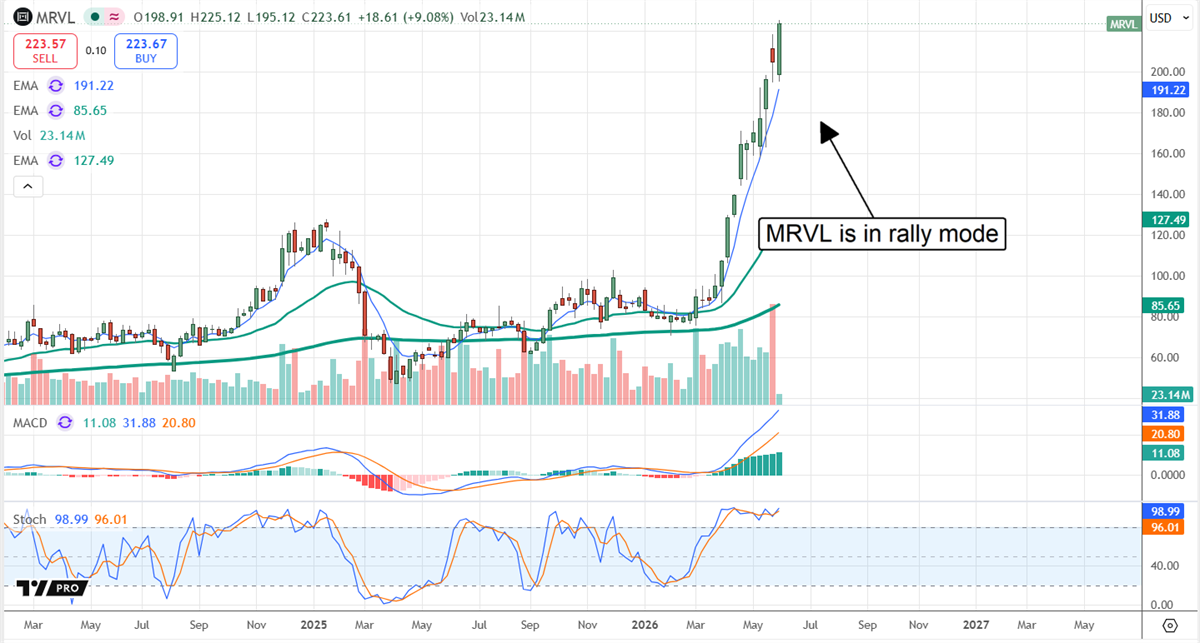
These three companies are not start-ups. They make money today and deliver value to their investors. Beyond NVIDIA, they are the #2, #3, and #4 ways to play photonics this year. Their products span the range, including lasers, optical components, and transceivers. Additionally, their stock prices are in rally mode, underpinned by business outperformance and improving guidance.
NVIDIA’s photonics investment also includes future supply and capacity, helping to derisk the outlook. More importantly, it is investing throughout the stack, ensuring future integration as technologies advance. As it stands, the global photonics industry is valued at approximately $1.25 trillion and is expected to grow at a mid-single-digit compound annual growth rate through the middle of the next decade. Within that, silicon photonics, which embeds optical components directly onto silicon wafers, is worth a few billion and is expected to post industry-leading growth, upwards of 30% annually for the foreseeable future.
Aeluma Stands to Disrupt Silicon Photonics Manufacturing
Aeluma’s (NASDAQ: ALMU) claims to fame are twofold, including high-quality quantum-dot lasers for silicon photonics and an industry-disrupting manufacturing process. These advantages make it the #5 way to play photonics.
Quantum dot lasers are significant, enabling high-speed data transmission suitable for numerous applications.
The real story, however, is manufacturing. Traditional photonics require optical materials to be glued to the silicon substrate—creating complexity, scalability, and functionality challenges.
Aeluma's process instead grows optical-quality substrate directly onto the silicon wafer, producing a homogeneous result that's cheaper and suitable for far more applications.
The reason NVIDIA is not investing in this company is that it is still in the pre-revenue phase. Therefore, the advancement of commercial capabilities and the acquisition of sales contracts present a near term catalyst. Aeluma is not marketing a branded product so much as seeking partnerships in the data center and defense contractor fields. The goal is securing design wins and prototype certifications that lock in future revenue. Once completed, the company will enter production and, in theory, begin generating significant revenue in 2027.
Aeluma Can Disrupt, But Will OEMs Buy In?
Aeluma faces adoption risk and dilution risk. While Aeluma’s product offers numerous advantages, there is some question about adoption, and NVIDIA’s investment trend only underscores this. Hyperscalers are rushing to build out their data center networks and may opt for alternative technologies. In this scenario, Aeluma may never gain traction. However, that seems unlikely, given the cost of data center construction and operation. The more likely scenario is that contract wins emerge by year’s end.
Dilution is a more pressing risk. The company is still an early-phase company relying on government research contracts. Execs have relied on dilutive sales to fund operations and will likely need to raise additional capital before achieving profitability. As it stands, the company appears to have a clear runway through the end of next year.
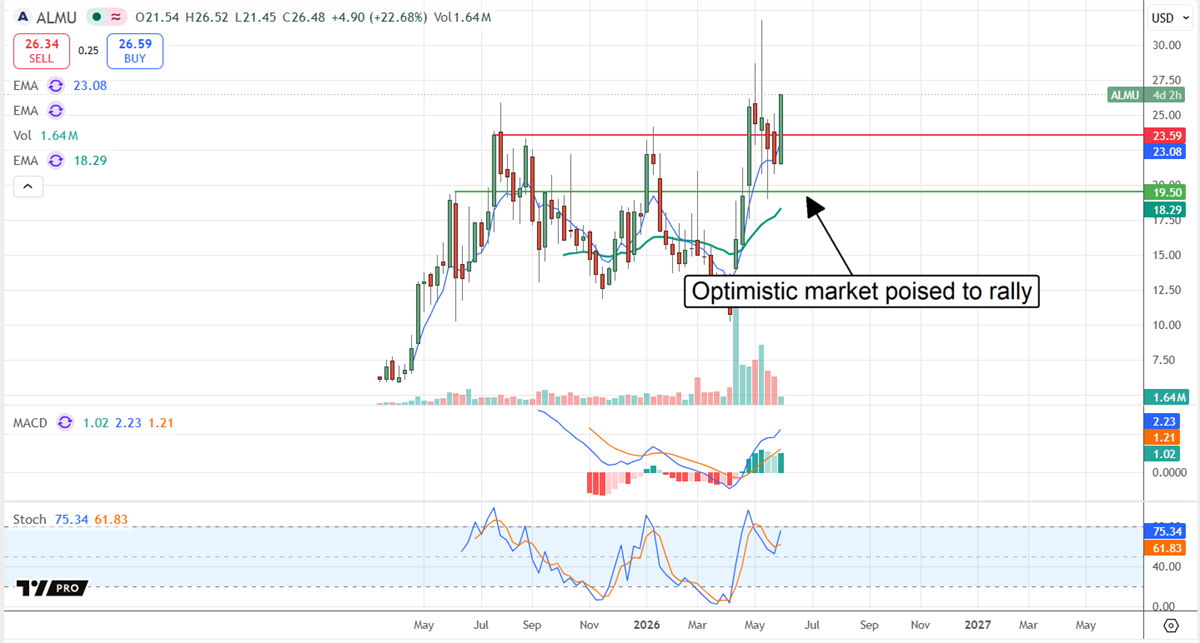
Aeluma’s price action reflects growing optimism that a contract will be signed before more funds are needed. The market advanced strongly in Q2, hit a fresh high, and threw a continuation signal worth more than 100% in upside.
The article "The Speed of Light: 5 Stocks Powering AI’s Optical Future" first appeared on MarketBeat.