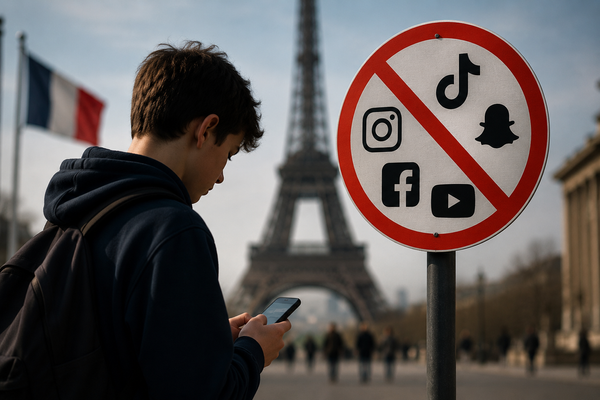
France has become the first European Union country to approve a nationwide social media ban for children under 15, a landmark measure that could reshape digital regulation across Europe.
French lawmakers passed the legislation on 21 July after securing support in both the National Assembly and Senate, making France the first EU member state to adopt such sweeping restrictions on youth access to social media. President Emmanuel Macron backed the measure, arguing that stronger protections are needed to shield children from online harms and excessive screen time.
The law is expected to take effect from 1 September, ahead of the new school year, and will require social media companies to introduce age-verification systems while removing existing accounts belonging to users under 15. Platforms will be given four months to comply with the new requirements.
Why France Decided to Act
French officials said the legislation was driven by growing concerns over the impact of social media on children's mental health and wellbeing.
Lawmakers cited rising cases of cyberbullying, anxiety, depression and exposure to harmful content among young users. The issue has gained increasing attention in France as health experts and parents warn about the effects of excessive screen use and algorithm-driven content on teenagers.
The law also forms part of a broader package of measures aimed at reducing children's exposure to digital risks, including restrictions on mobile phone use in schools.
Je m’y étais engagé, c’est désormais voté : les réseaux sociaux seront interdits aux moins de 15 ans à la rentrée. Merci aux parlementaires. Au Conseil constitutionnel de statuer puis place à l’action pour rendre cette mesure concrète et protéger nos enfants en ligne. pic.twitter.com/jC79unxX67
— Emmanuel Macron (@EmmanuelMacron) July 21, 2026
What the New Rules Require
Under the legislation, social media companies must verify users' ages before allowing access to their platforms. Children under 15 will be unable to create accounts unless specific legal conditions are met, while existing accounts belonging to underage users must be removed.
Major platforms including TikTok, Instagram and Snapchat are expected to fall within the scope of the rules. Educational and scientific websites are excluded, while questions remain over how some services such as YouTube and messaging applications will be treated under the final framework.
The age-verification systems will require approval from France's privacy regulator, adding further pressure on technology companies to strengthen compliance measures.
Could the Rest of Europe Follow?
France's move is being closely watched across the continent.
Several European countries, including Spain, Denmark and Greece, have already explored similar restrictions. At the same time, European Commission President Ursula von der Leyen has previously indicated support for stronger protections for minors online.
The European Commission is also reviewing whether France's legislation fully aligns with EU digital regulations, a process that could influence future policy discussions across the bloc.
Supporters of the legislation argue that France is positioning itself as a leader in child online safety, while critics warn that enforcement challenges and privacy concerns could complicate implementation. The debate is expected to influence future digital policy discussions throughout Europe as governments consider similar measures.
A New Test for Big Tech
The law creates a major challenge for social media companies operating in Europe.
Technology firms have generally opposed blanket age restrictions, arguing that implementation and enforcement remain difficult. Critics have also questioned whether age-verification systems can effectively prevent children from bypassing restrictions.
Nevertheless, France's decision establishes a precedent that could influence future digital policy across the EU. If the measure proves effective, pressure may grow on other governments to adopt similar rules, potentially transforming how young Europeans access social media in the years ahead.