Those who have been wondering why and how Thailand has lost its way in the world and at home should focus on what's been happening with the Senate. The current 200-member upper chamber mandated by the 2017 constitution, drafted and promulgated under a military government following the May 2014 military coup, is an apt prism to see how this country has become so rotten. Addressing the corrosion will require redrafting the constitution while unrigging and reshaping the political system to promote transparency, accountability, and effectiveness.
In most multi-party parliamentary systems, a bicameral legislature with upper and lower houses is common. Lawmaking and legislation normally reside in the lower House of Representatives. The Senate, as the upper chamber, traditionally plays a checks-and-balances role with oversight and legislative review powers. In turn, the legislature works with -- but is independent from -- the executive branch, alongside an impartial judiciary, in a separation-of-powers framework, buttressed by a free media and a vibrant civil society to engender a representative democratic system.
That sounds theoretical, but Thailand roughly passed as a working democratic system in the late 1990s following a five-year bottom-up charter-drafting process that culminated with the 1997 constitution. The twist in the Thai model was the formation and empowerment of so-called "independent" agencies, particularly the constitutional and administrative courts and the election and anti-corruption commissions.
The 200-member Senate in that period was fully elected in March 2000 for a six-year term. But the subsequent years saw a fierce political contest between political forces aligned with Thaksin Shinawatra and conservative columns, underpinned by yellow-shirted street protests that paved the way for the September 2006 coup. The 2007 charter that derived from that coup period rebalanced political power away from the lower house and reduced the Senate to 150, while making it half-appointed and half-elected and transferring more discretionary authority and power to the independent agencies.
This pattern was repeated with greater intensity and autocratic conviction after the May 2014 coup. After launching the 2017 charter and enlarging the Senate to 250, the junta known as the National Council for Peace and Order appointed the entire upper chamber in May 2019 for a five-year term and gave the unelected chamber the authority to vote on the prime minister in Parliament. Among the manipulated outcomes, this resulted in the Senate effectively rejecting Pita Limjaroenrat from becoming prime minister after his Move Forward Party won the March 2023 poll.
By that time, the engineering of political outcomes was crystal clear. The Senate is granted power to decide who becomes commissioners or judges of independent bodies, such as the Constitutional Court and Election Commission, thereby allowing wider control over the political system. Over the past two decades, this system has worked as intended. Polls took place, but outcomes were changed, or even subverted. The evidence is the repeated dissolutions of election winners, not just Move Forward in 2024, but also Mr Thaksin's Thai Rak Thai Party in 2007 and People's Power (Palang Prachachon) in 2008. Despite fraud charges, the Democrat Party was left intact back then, and it remains to be seen whether the Bhumjaithai Party today will be left untouched in the foreseeable future.
When the 250 coup-appointed senators' five-year terms ran out in May 2024, the new lot of 200 had to be secured. This is the issue we are witnessing today. The 2017 charter gave the Senate a semblance of popular representation despite not being directly elected by voters. Instead, 20 professions were earmarked for wide-open applications. Each professional category would reduce its applicant numbers to 10 for the final 200-member upper chamber. Many thousands applied nationwide, and they were tasked to vote among themselves to see who stayed or skipped out from the district, provincial, and ultimately national levels in June-July 2024.
With so many applicants involved in such a complicated internal election process, it seemed next to impossible to game the whole system because it would require a conspiratorial plot and execution among hundreds of organisers and applicants. Still, there are reports of rigging.
Immediately after this Senate election process, a host of unsuccessful candidates filed complaints with the Election Commission, alleging organised voting, vote allocation, transportation of candidates, and money payments. But these complaints did not go far initially. By early 2025, the Department of Special Investigations dug deeper and found several participants in the alleged operation who agreed to cooperate with investigators. By mid-2025, the first concrete insider testimony was incorporated into the investigation, leading to the decision to pursue 229 individuals, including 138 senators, involved in organising the elaborate scheme.
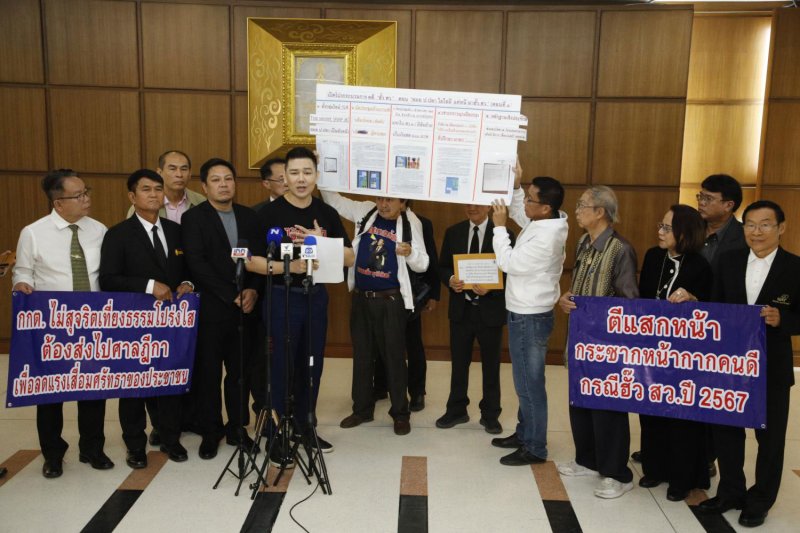
It was only earlier this month that whistleblowers began to surface in earnest, with four Senate candidates -- Direk Phornsima, Tharin Phanthumai, Sananchai Chuayudomthanikit, and Montri Chiaplaem -- appearing at an opposition-organised public forum marking the second anniversary of the Senate election. They explained how the alleged collusion worked, including organised candidate placement, voting arrangements, and financial enticements.
The case has now been highlighted by Bhumjaithai Party leader and Prime Minister Anutin Charnvirakul's effort to sue Yingcheep Atchanont of iLaw, a widely respected rights-protection NGO. Mr Yingcheep presented a dossier based on witness testimonies and documentary evidence to the opposition whip, arguing that these materials linked senior politicians connected to the alleged operation, including the prime minister himself.
We will now likely see official efforts to obfuscate, stymie and shake off these charges over constitutional interpretations, legal technicalities, and foot-dragging. What happens to Mr Yingcheep will also have much to say about Thai politics. If he is legally persecuted without a societal response, it will be a bad omen for those who try to improve accountability.
Other explosive scandals, such as systematic exam fraud involving local administration officials, point to a wider rot that has beset the Thai bureaucracy for years. If these scandals are allowed to be covered up, Thailand will be seen as full of cheats, graft, and fraud in the highest corridors of power and thereby remain on track for more decay and stagnation.