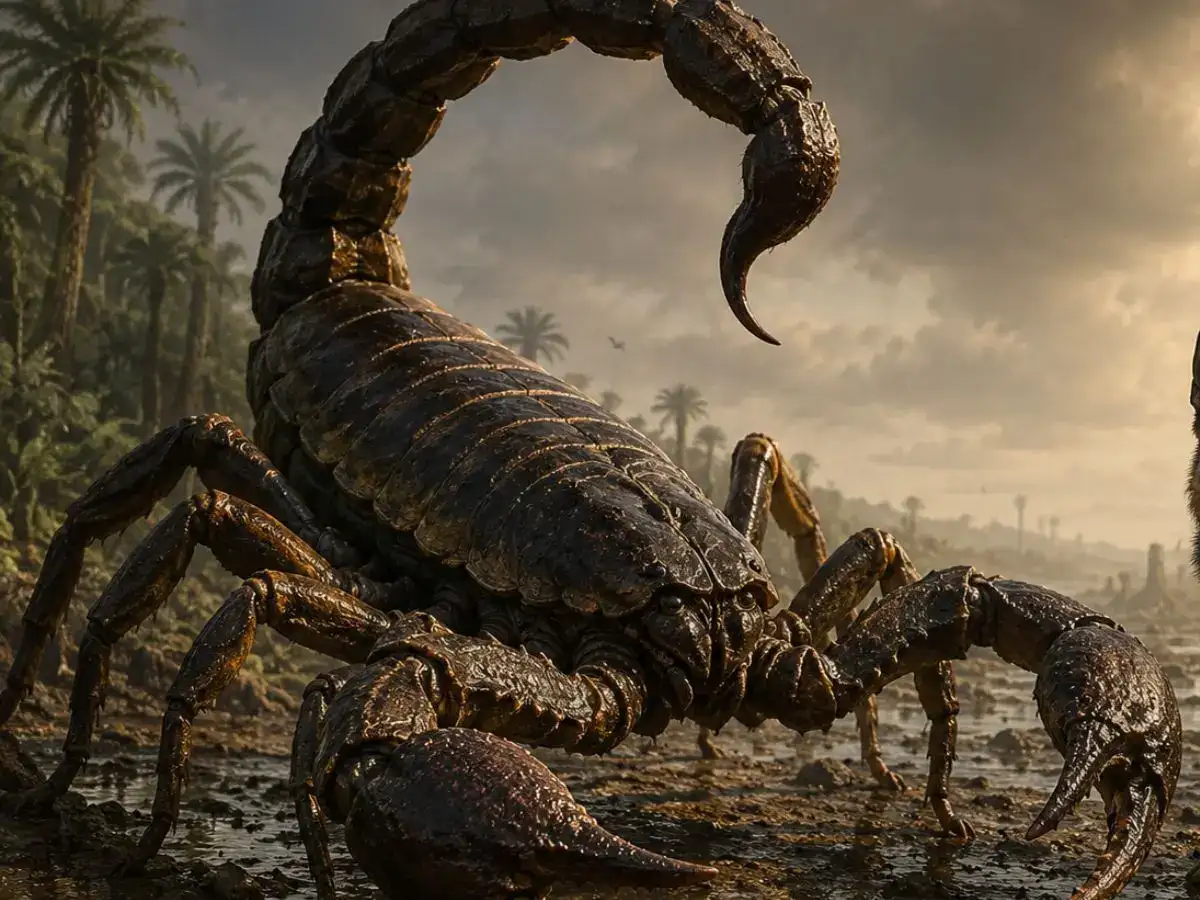
More than 400 million years ago, giant scorpions measuring over a metre in length prowled the landscapes of what is now Britain, according to a new scientific study. Researchers examining ancient fossils have identified a species called Praearcturus gigas, a predator so large that it rivalled the size of a modern Labrador or German Shephard dog. The findings suggest these creatures dominated their environment long before dinosaurs appeared on Earth.
Ancient Fossils Uncover A Forgotten Giant
Scientists from The University of Manchester and the Natural History Museum studied fossil remains dating back around 415 million years. Their research, published in the journal Palaeontology, points to the existence of an enormous scorpion species that lived during a period when much of Britain was covered by shallow coastal waters.
Unlike present-day scorpions, which are relatively small, Praearcturus gigas may have reached lengths exceeding one metre. Researchers believe it occupied the top of the food chain, hunting prey with strong claws and venomous attacks.
A Predator From A Very Different World
The discovery offers a glimpse into an ancient Earth that looked nothing like today's landscapes. During that era, trees had not yet evolved and life on land was only beginning to establish itself.
"When we think of giant arthropods, people often picture Carboniferous rainforests with giant millipedes or dragonfly-like insects from later in Earth's history," Dr Richard J Howard, Curator of Fossil Arthropods at the Natural History Museum, London, and lead author of the study, said in a statement.
"But Praearcturus lived at least 50 million years earlier, well before the evolution of trees, when life on land was only just getting started."
"Confirming that this animal is a scorpion fundamentally changes our understanding of how and when these creatures evolved to such extraordinary sizes."
Discovery Changes What Scientists Knew About Early Life
The findings challenge long-held assumptions about the evolution of large arthropods. Researchers say the giant scorpion demonstrates that some invertebrates reached remarkable sizes much earlier than previously thought.
The study also suggests that ancient ecosystems were capable of supporting huge predators despite the relatively simple forms of life present at the time. Scientists believe environmental conditions may have helped these creatures thrive.
Century-Old Mystery Finally Solved
For decades, Praearcturus remained a puzzle for palaeontologists. By combining fossil specimens from different collections and using modern imaging methods, researchers were able to build a more complete picture of the animal.
"Praearcturus has puzzled us palaeontologists for more than a century. By bringing together material from several collections and using cutting-edge imaging techniques, we've been able to build a clearer picture of the animal than was previously possible, which is really exciting," Dr Russell Garwood, Palaeontologist at The University of Manchester, said as per the statement.
"What makes Praearcturus so interesting is that it became enormous at a time when life on land was otherwise very small. But it was a world that could somehow support a giant predator. To try and better understand this ancient world, we compared the size of fossil scorpions with other animals alive at the time. To reach such extraordinary sizes, and conclude that perhaps it lived in water, where life was bigger."
Britain Before Humans, Before Dinosaurs
The fossil discovery paints a striking picture of prehistoric Britain. Long before mammals, birds or dinosaurs existed, giant scorpions may have ruled coastal habitats and shallow waters.
For scientists, the remains of Praearcturus gigas offer a rare window into a distant chapter of Earth's history, one where a creature as large as a dog was among the most formidable predators around.