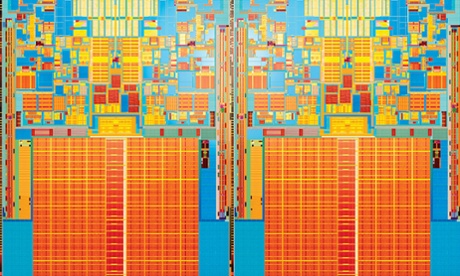
Moore’s law will slip within 10 years. In some products we may see signs of this soon. Replacing silicon with carbon nanotube transistors, and finding efficient ways to conduct electricity through narrow metal lines connecting the transistors, may extend the law by some years. But look beyond Moore’s law and at new technologies. Light will be increasingly used to transmit data from chips and new types of dense memory placed close to the processor will speed computation.Expect breakthroughs in cognitive and biologically inspired computing that, collectively, will tackle problems such as pattern recognition, inference and reasoning.
Supratik Guha, Director, physical sciences dept, IBM Thomas J Watson research center, Yorktown Heights, New York
Moore’s law has already started to fail. In the past, smaller transistors were cheaper, faster and more energy efficient. But now any further increase in performance comes at a premium in cost. Design costs have gone through the roof, too. Moore’s law originally related to the growth in the number of transistors that can be manufactured economically on a single microchip but some have misinterpreted it as being about the increasing performance of computers.I think we will continue to extract more performance despite the end of Moore’s law, through the use of 3D integration, improvements in architecture and, when all else fails, through better understanding of how to exploit parallelism and how to write more efficient software.
Steve Furber, ICL professor of computer engineering, University of Manchester
It is only resolute engineers infected with Moore’s law that want devices to forever be made smaller. That was key when size was the benchmark for cost and power savings. However, research groups are now looking at architectures for greater functionality/speed to replace logic gates. What we really want is more elegant computation architectures; something that emulates the brain. Let’s redefine what progress is rather than stick to Moore’s law, which is inappropriate now.
Rona Belford, CEO, Belford Research