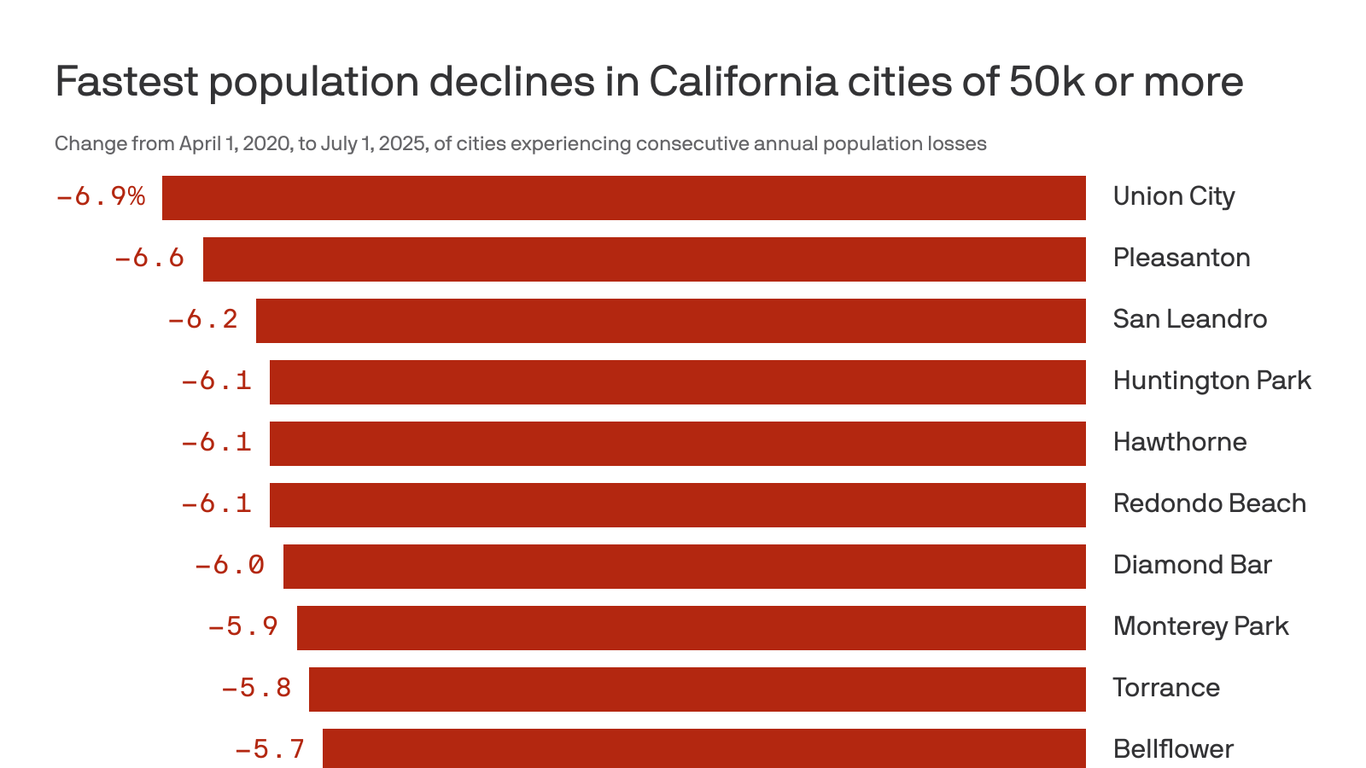
Data: U.S. Census Bureau, Vintage 2025 Population Estimates; Chart: Russell Contreras/Axios
California is losing people from suburbs year after year, revealing a deeper demographic shift reshaping America's most populous state.
Why it matters: If California's commuter engines keep shrinking, the state risks losing the diverse workforce that powers its economy — while shifting political clout to the states where those families relocate.
- The cities losing people generally aren't the ultra-wealthy coastal enclaves typically associated with California flight, but places that were supposed to be attainable.
By the numbers: A new Axios analysis of Census Bureau estimates reveals widespread population losses across parts of the Golden State.
- 52 of California's 177 cities with at least 50,000 residents shrank every year between 2021 and 2025.
- Seven of the top 10 fastest-shrinking cities are Los Angeles County suburbs. The remaining three are Bay Area suburbs (Union City, Pleasanton, San Leandro).
- 11 of the top 15 large U.S. cities with the steepest cumulative losses during that window were in California.
The intrigue: San Francisco has lost more than 52,000 residents since 2020. The 6% drop has effectively erased a mid-sized city from its core, despite gaining some population back every year between 2022 and 2025.
Zoom in: The census doesn't list reasons for moving, but the geography points directly to a crushing housing affordability crisis.
- Many of the shrinking suburban hubs feature large Latino and Asian American populations — groups that historically used inner-ring suburbs as a launchpad for generational stability.
- The industrial core : Places like Union City, San Leandro and Huntington Park are working-class, immigrant-anchored communities on the manufacturing and logistics edges of the Bay Area and Los Angeles.
- The aspirational hubs: Cities like Pleasanton and Cerritos once symbolized California's mid-century promise of middle-class prosperity.
Zoom out: Nationally, the Census data show the nation's fastest-growing places are increasingly on the far edges of major Sunbelt metros, not in their urban cores.
- Even as big cities grow, they're often outpaced by outer-ring suburbs and exurbs around metros such as Dallas, Phoenix and Atlanta.
- California's pattern is the flip side: many of its larger suburbs aren't absorbing growth but posting some of the state's steepest population declines.
Yes, but: California still added housing units in raw numbers, and its total state population has not collapsed.
- Some growing California cities, including Lathrop (+48.9%), Manteca (+15.7%), and Menifee (+15.7%), show that the state's inland fringes are still attracting residents, the Axios analysis found.
- The losses are concentrated in the expensive, established inner suburbs.
The bottom line: It's a slow bleed with consequences for local tax bases, schools, labor markets and eventually congressional apportionments.