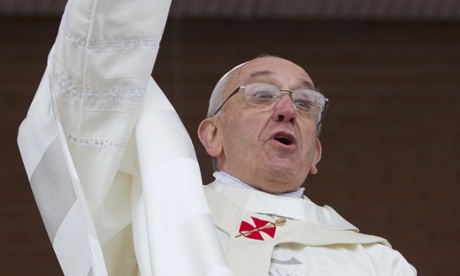
Pope Francis’ encyclical on the environment was delivered to the entire world, but much of what he wrote was important for those of us in the US – especially our political leaders. It is a strong wake-up call that market-driven approaches to climate change and environmental degradation are not sufficient. Strong government action is needed, but most people, including political leaders, really don’t like a call to conversion.
Pope Francis was right when he asked politicians: “What would induce anyone, at this stage, to hold on to power only to be remembered for their inability to take action when it was urgent and necessary to do so?” He was referring to continued reluctance by leaders in the US and elsewhere to effectively tackle these crises.
Contrary to what many of our politicians maintain, Pope Francis stated that human activity is most responsible for global warming. And his strong criticisms of technology and other profit-driven “solutions” to environmental problems were not welcomed by many of our political and business leaders.
Moreover, his historic encyclical goes far beyond climate change and technology. His repeated reminders that all of life is interconnected mean that piecemeal approaches to worldwide problems are doomed to failure. Throughout the document, he powerfully integrates issues of economic and ecological justice.
The pope’s frequent criticisms of consumerism run counter to much of what is considered part of US lifestyle. We Americans especially prize freedom, but he notes that although many believe they are free when they have the “supposed freedom to consume”, in reality, the only free ones are “the minority who wield economic and financial power”.
There was a telling moment during the Vatican press conference on Thursday marking the release of the encyclical. A journalist asked about politicians, especially in the US, who insist that the pope should stick to religion and not delve into areas such as science, politics and economics. Cardinal Peter Turkson, a key Vatican spokesman who helped draft the encyclical, replied that such a “claim … is not worth sustaining.” He added: “I would imagine that when they themselves become politicians without being scientists they will not say another word about science.”
Both sides of the political aisle will find some nourishment in the encyclical, but progressive leaders will find more to fuel their arguments. He wrote people have a fundamental right to water, food and housing. We need to address inequality. We need to create a system of living where nothing is wasted and all serve the common good. And we need to listen to indigenous people when decisions are made about them. This last argument has special resonance in current congressional debates about US trade policies.
Pope Francis calls us to be converted from a “throwaway culture” and an economy of exclusion, to solidarity and care for those who are most vulnerable. We must all be engaged in making that happen, with a vital role played by our leaders, many of whom happen to be Catholic. This will be a hard lesson for some to hear. But, as the pope also reminds us, people are capable of change so there is hope for a better world for this and future generations.