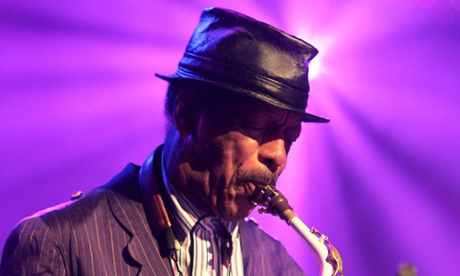
Ornette Coleman: Lonely Woman
Plenty of eloquence has greeted the death of the musical visionary Ornette Coleman but six words from New Yorker writer Alex Ross – “no better definition has been devised”, in response to Coleman’s contention that “composing is a way of not repeating” – get close to the heart of the matter. Coleman was a hero to improvisers from many genres and cultures, and an extraordinary spontaneous player himself. Yet he saw his work primarily in composition, albeit a non-dictatorial version aiming in each piece to catch a mood and establish a tonal palette that would oblige improvisers to play and listen to each other without recourse to habit. Since the most selflessly democratic of musical kings is dead, I therefore make no apology for starting June’s playlist with the same theme – Coleman’s Lonely Woman. This raggedly ecstatic classic was first played by Coleman, trumpeter Don Cherry, bassist Charlie Haden and drummer Billy Higgins in 1959, revisited here by its composer in 2008.
Geri Allen, Paul Motian, Charlie Haden: Lonely Woman
The gifted pianist Geri Allen showed just what a free-thinking close listener she was when she helped break the almost 30-year spell that had prevented Coleman from working with keyboard players (he disliked the instrument’s fixed pitches). Allen performed on Coleman’s 1996 Sound Museum album, but almost a decade before she had demonstrated her affinity with the composer’s work in a rich account of Lonely Woman on the 1987 trio album Etudes, with an impassioned Haden on bass and empathic drummer Paul Motian.
John Zorn: Lonely Woman
There are earthy, early-jazzy interpretations of Lonely Woman like Coleman’s own, patiently lyrical ones like Geri Allen’s and then there’s John Zorn’s. Zorn’s intense alto-sax playing and adventurous composing were significantly inspired by Coleman, but his work has also drawn on punk, heavy metal; Jewish and east Asian traditions – just as Coleman would have wished. That’s why Zorn’s angle on Lonely Woman, from 1989’s Naked City, sounds like this. Also, Coleman’s minimalist anthem Dancing in Your Head, gets a briefly affectionate nod at the end.
Terri Lyne Carrington/Nguyen Le: Voodoo Child
Coleman leads to Allen, and Allen leads to Terri Lyne Carrington, the brilliant genre-bending drummer with whom the pianist has frequently performed, and whose music for the German ACT label in the early noughties was showcased on a compilation released in May. Carrington is an influential enabler who can casually blend jazz and funk/fusion grooves. Some of the most exciting passages on the album came from the 2002 Jimi Hendrix tribute album she made with French-Vietnamese guitarist Nguyen Le – they’re heard here at Montreux with French-Malian singer Aida Khann on Voodoo Child.
Joshua Redman/The Bad Plus: Warsaw 2012
Warming to the Coleman theme of the dialectics of composition and improvisation, the popular genre-bending postmodernists the Bad Plus recently released a studio appraisal of their now four-year-old relationship along with saxophonist Joshua Redman . They launch the European leg of their current world tour at the star-packed Love Supreme Jazz festival in Sussex on 4 July. One year into their collaboration after their New York Blue Note debut in 2011, the trio of left-field composers and the consummate jazz improviser were clearly getting used to each other …
Frederic Chopin/Martha Argerich: Ballade No 1
Now what might join Coleman, classical pianist Martha Argerich, and former Guardian editor-in-chief Alan Rusbridger? Perhaps it’s a stretch, but I’d suggest that Rusbridger (though maybe he might not wholly share Coleman’s distrust of the tempered scale) shared the saxophonist’s faith in sketching a theme and letting other creators run with it – and Argerich has shown her own kind of fearlessness about independent interpretation. Argerich’s vibrant take on Chopin’s Ballade No 1, the piece that seems to have steadied the editor through thick and thin, is this column’s bow to his remarkable 20 years.
Michel Camilo: On Fire
Michel Camilo, the spectacular pianist from the Dominican Republic made a one-stop visit to the UK at the weekend – and occasioned the contradictory thoughts that his infrequent visits here are a shame, but that if he came more often we might start taking his dazzling skills for granted, and even begin to wish he might turn the dial down from 11. But Camilo in full flight, as he was here with bassist Anthony Jackson and drummer Horacio Hernandez at North Sea in 2002, can convert even the sternest advocates of less-is-more.
Beats & Pieces: Jazzahead! 2013
Manchester’s Beats & Pieces released All In, their second album, this month - they play the Soup Kitchen on 7 July, Ronnie Scott’s 8 July. Heirs to the eclectic big-band traditions of Loose Tubes, they make their own sounds from many styles and as altoist Sam Healey demonstrates on this 2013 gig in Germany.
Scottish National Jazz Orchestra: Steppin’ Out
A major highlight of the 29th Glasgow Jazz festival is the Scottish National Jazz Orchestra’s gig on 26 June, under its saxophonist/leader Tommy Smith, and with the skilful singer Eddi Reader in the central role on a programme of classic Scottish songs. The partnership tour Scotland from Sunday of that week, but the power and empathy of the band enhance the work of all their star guests – including American vocalist Kurt Elling.
Van Morrison: Moondance
Finally, to the newly appointed Sir Van The Man, who’ll be winding up the weekend of the Love Supreme on Sunday, 5 July. Morrison’s a worthy representative of this ambitious festival’s aim to unite the edgy and the accessible. So what better way to flag it than a jazz-infused version of his iconic Moondance?