
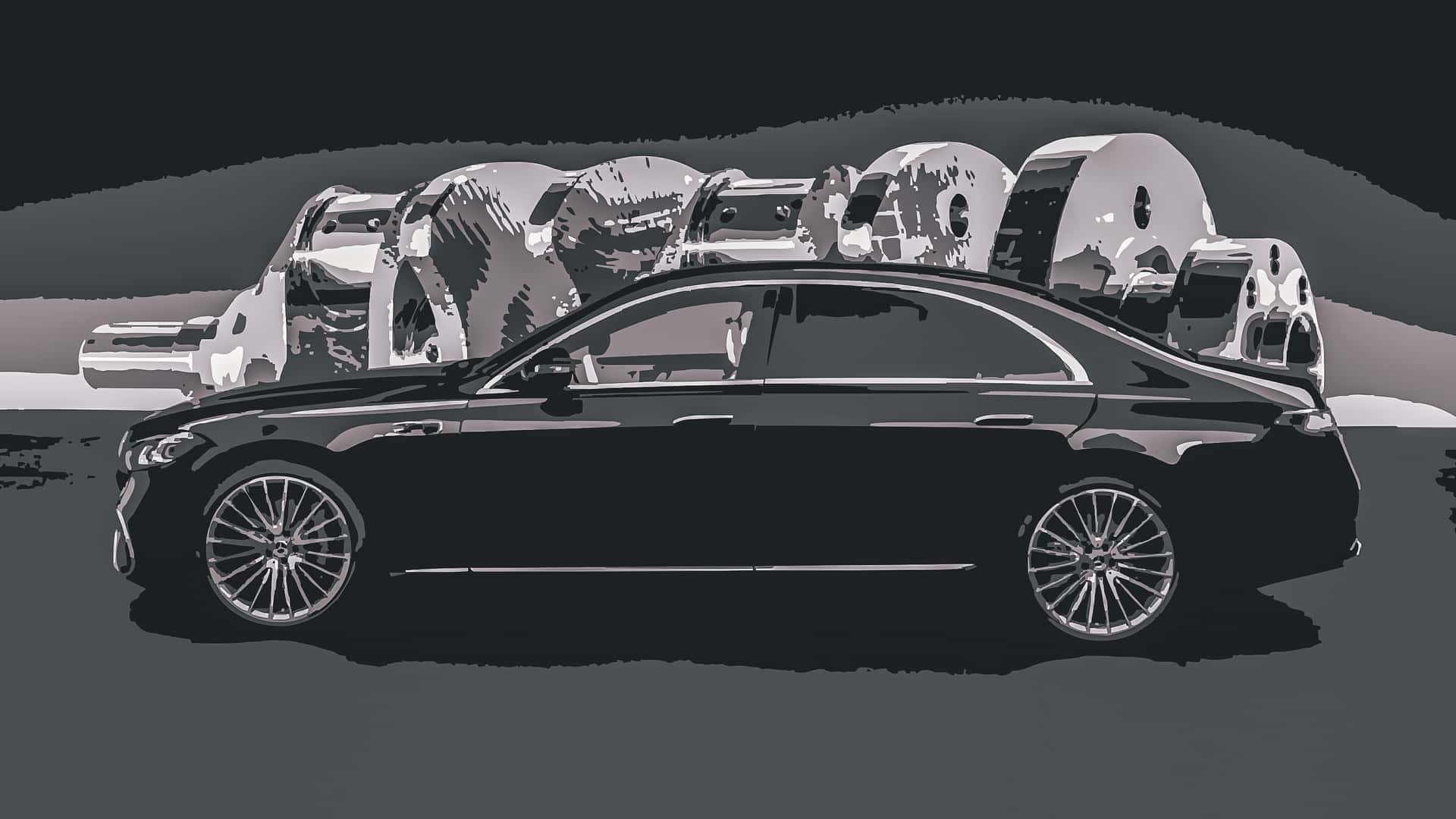
It’s a big deal when a new Mercedes-Benz S-Class hits the block. The big Benz is a staple, and in a world where SUVs are the new zeitgeist, Mercedes keeping sedans alive is something worth celebrating.
But the new S-Class has an extremely odd detail that you might have missed in the press release: Under the hood is a freakin’ flat-plane engine.

If you don’t know, most V8s throughout history are cross-plane—the traditional rumbly-sounding engines commonly found in pickup trucks. Flat-plane V8s are almost always exclusive to supercars. For most of automotive history, in fact, flat-plane V8s were limited to ultra-high-end sports cars.
For a high-end luxury sedan like the S-Class to use a flat-plane V8 is highly unusual, primarily because of the engine's characteristics. A flat-plane crankshaft is technically simpler to make than a cross-plane crank, but it requires some engineering compromises, primarily related to vibration—something you don't want on a luxury sedan.
For a high-end luxury sedan like the S-Class to use a flat-plane V8 is highly unusual, primarily because of the engine's characteristics.
Flat-plane V8s vibrate like hell with second-order vibrations—the same kind of vibrations you get with a four-cylinder engine. They’re nasty and buzzy due mostly to the 180-degree offset between piston pins. This means that the natural up-and-down motion of the pistons doesn’t naturally cancel each other out.
It’s difficult to attenuate those vibrations without external measures like balance shafts, and even then, flat-plane V8s still struggle with noise and harshness. Especially with increased displacement. There’s a point where these engines will simply vibrate themselves to death, which is what made the 5.5-liter flat-plane V8 in the Corvette Z06 such an achievement.
A cross-plane V8 still vibrates, sure, but mostly primary vibrations. Basically, the engine rocks back and forth with big, relatively slow motions, which are easily counteracted with counterweights on the crankshaft. With counterweights, a cross-plane V8 is extremely smooth and receptive to large displacements. It’s why you see 6.2-liter cross-plane V8s and 4.0-liter flat-plane V8s.
The thing is, most supercars use flat-plane V8s because they’re naturally lighter, more responsive, and much revvier, giving them a more exotic feel. Flat-plane V8s don’t naturally make less torque at low RPMs than a cross-plane; that’s more a function of limited displacement.
But the bald truth is that a cross-plane V8 is simpler, smoother, and functionally more suited to the demands of a luxury sedan. No S-Class owner is looking for a peaky, revvy monster of an engine; the old M177 had a cross-plane crank.
Mercedes didn’t tell us exactly why it chose to go flat-plane (at least, not yet), but the company did promise that the engine has "exceptional smoothness." It’s possible that all future Mercedes V8s go flat-plane, and that this is just a byproduct of manufacturing consolidation. That means we could, in theory, have something as preposterous as a flat-plane V8 G-Wagen in the future.
I think I speak for everyone in saying that would be extremely cool.
Still, it’s pretty neat that we live in a reality where an S-Class has a flat-plane V8. I’ll be curious to see how Mercedes developed its way around those inherent issues, and I’m sure we’ll report back once we drive one.