Picture this: it’s Saturday night in a field in Cropredy, Oxfordshire. An impressively large multimedia stage is framed by bars, food stalls, and little markets selling acoustic instruments, arty trinkets, pointy felt pixie hats. Under stars, or come clouds, rain or wind, 15,000 music lovers gather with real ale or frothy hot chocolate for the customary headline set by Fairport Convention, which closes the band’s annual three-day festival, Cropredy Convention.
The finale is a mass singalong to a song that has become a signature for Fairport Convention in the 40-odd years of this event, and is widely adopted as a hymn to the hereafter: Meet On The Ledge. When it appeared on the group’s second album, What We Did On Our Holidays, in 1968 it was played down by its young songwriter, lead guitarist Richard Thompson.
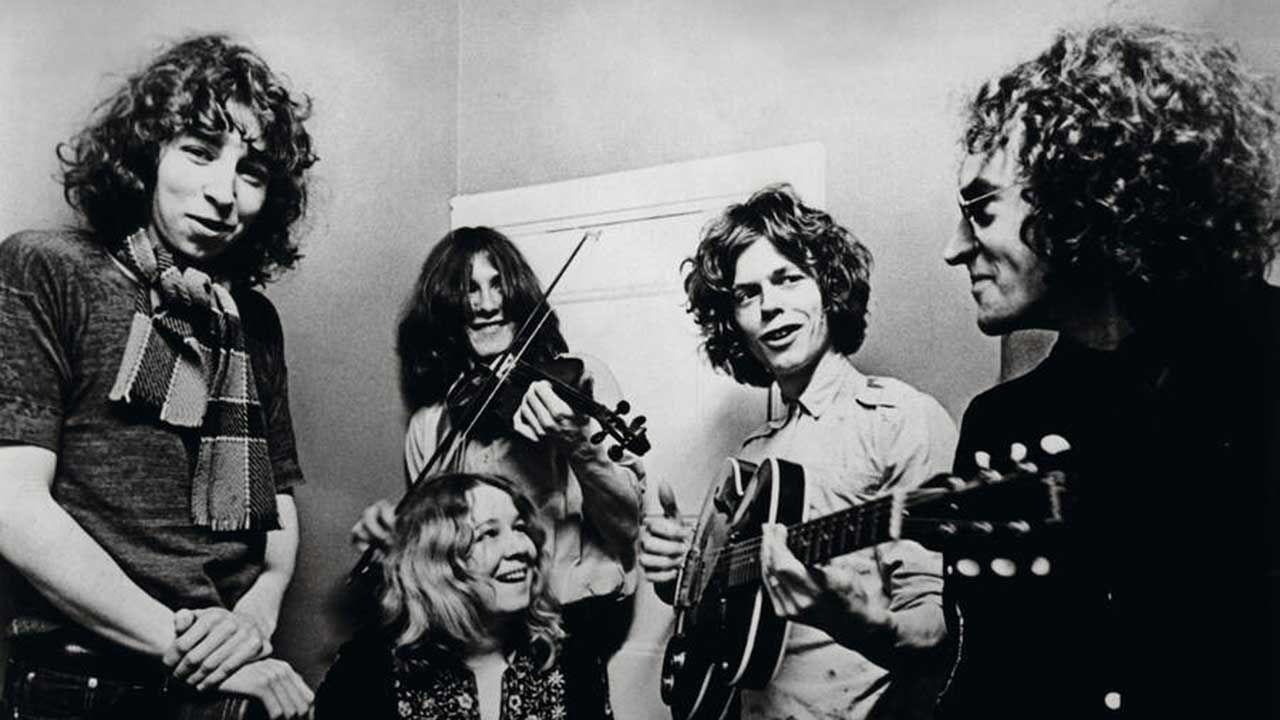
For him it was another stepping stone on the swift ascent of the London folk-rock group that he, at 17, had co-founded with 21-year-old bandleader and bassist Ashley Hutchings and 16-year-old guitarist Simon Nicol in 1967. Drummer Martin Lamble (also 16) and co-vocalists Judy Dyble and Iain Matthews would complete the group.
They were quickly signed to Island Records by producer and UFO club co-founder Joe Boyd, and their self-titled debut, recorded in late ’67, captured their raw youthfulness through West Coast folk and blues covers and original co-writes.
“We hadn’t long been professional as a group at this point,” Richard Thompson tells CR. “In terms of style, Fairport Convention was all over the place. We were young and experimenting, seeing if we could keep time, trying to figure out if we could write songs. We could, but most were collaborations because we didn’t have the nerve to say: ‘I wrote that.’”
After the album was released in May ’68, musical differences led to Dyble leaving and rising singer-songwriter Sandy Denny joining. Denny had gone from solo folk sets around the capital to search for a band where she could challenge herself vocally. Initially that was Strawbs, but Fairport were a better fit. Denny had kudos and excellent compositional skills.
Under her influence “[Fairport’s] songwriting definitely got better,” Thompson affirms. “You’ve got Sandy, me and Iain writing. Other collaborations [in the group] are going on, and we’re starting to play some traditional British music as well. Our playing was improving because we played live all the time, and we now had a really forceful vocal department with Iain and Sandy together.”
When Fairport weren’t out gigging, they were encouraged to build up a song pile. “I was getting a lot of instrumental ideas, but in terms of lyrics I was still quite shy,” Thompson says. “In the great spirit of sixties songwriting obfuscation, like Bob Dylan I buried the meaning of my songs under a superficial layer, and Sandy did the same.”
When Thompson was a kid, he and his school friends would climb the Pothole Tree on Hampstead Heath. Its lowest hanging branch was called The Ledge. According to childhood pal Brian Wyvill – who’d introduced Thompson to Hutchings and Nicol – Thompson had thought of reuniting his school friends there in adulthood.
“I shared a flat with Simon and Iain, and I remember sitting on my little single bed, strumming something in the key of A, and a kind of melodic idea came first,” Thompson recalls of the genesis of Meet On The Ledge. “Then I wrote the lyrics almost without thinking what they mean except: What’s this? A song about the future? What we owe to each other, how we need each other, how we love each other? I don’t know.”
Thompson then took the tune to Ashley Hutchings. “Meet On The Ledge immediately stood out as a very special song, and quite moving,” Hutchings tells Classic Rock. “However, Richard wouldn’t divulge the meaning. But that was fine.”
“To my knowledge, this was Richard’s very first song he’d written on his own,” says Simon Nicol. “It was a door to a whole new world for him, and he must have had a lot of confidence to bring it forward.”
Meet On The Ledge was recorded at Fairport’s regular studio hangout, Sound Techniques in Chelsea. The lyrics suggest missed opportunities, solitude and struggle, but eventually have an optimistic upswing, implied as the afterlife.
“I remember hearing it come together in the studio,” Nicol says, “and it really took its full shape as a big-chorus song. Up to that point we’d not attempted anything like that.”
Denny and Matthews sang alternate parts, tender and tremulous at first, then rousing and powerful as the chorus repeats: ‘Meet on the ledge, we’re gonna meet on the ledge/When my time is up, I’m gonna see all my friends.’ For those who hadn’t caught Fairport live, Denny’s vocal light and shade would be showcased on the track, which became their second single release, in December ’68.
Critics were supportive, and Matthews thought that this could be their first hit record. It wasn’t. However, its inclusion on the popular Island Records sampler You Can All Join In helped get the song beyond the Christmas charts and into hippie-kid homes from ’69 onwards.
Thompson left Fairport in ’71 to go solo. He was living with grief and trauma following the dreadful van accident in ’69 that killed his girlfriend Jeannie Franklyn and the band’s drummer Martin Lamble. In 1978, Denny died after a fall at home. At some point, Meet On The Ledge became imbued with the poignancy of these events, and a point of reflection and emotion for anyone experiencing loss. By the time of the first Cropredy Convention proper, in 1980, the song was a traditional curtain closer.
“I don’t know how this happened,” Nicol says. “It was incremental. One day you realise you’ve got this big song.”
“It’s such a privilege to perform Meet On The Ledge and see people respond to it. Every year it gets better for me, and it’s the tip of Cropredy’s pyramid,” he continues. “Fairport has somehow reached into people’s lives, and for a weekend we’re this community that really comes into focus when we’re singing this song.”
Thompson has often expressed embarrassment about the song. “I used to think it was immature, juvenile,” he explains. “As a songwriter you have to revisit your past work all the time. I’m glad I wrote it when I was eighteen, I respect that person. The music evokes the past in an extraordinary way. The public own it now, and it has a kind of magic to it. I’m not ashamed of it.”
“When the rest of us heard it, we didn’t think it was juvenile at all,” Hutchings says. “It was lovely to play, easy to sing, but a heavyweight composition. It deserves its stature.”