
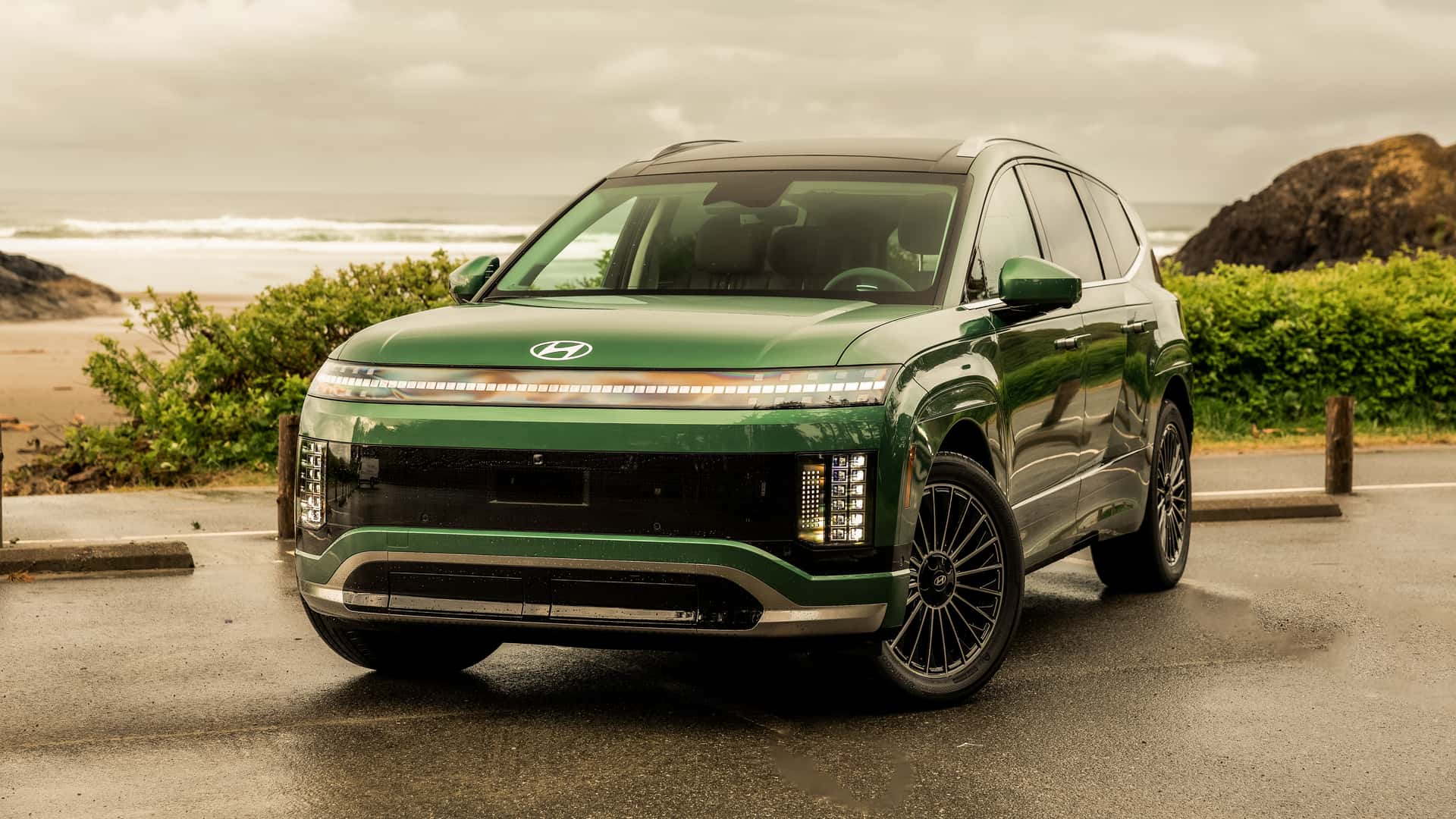
- The Hyundai Ioniq 9 and Kia EV9 electric crossovers will gain vehicle-to-home functionality in the U.S.
- Parent company Hyundai Motor Group said the two EVs will gain the feature “in the near term.”
- Stateside, the Kia EV9, which is based on the same E-GMP architecture, is already compatible with V2H.
American owners of the Kia EV6 and Hyundai Ioniq 9 will soon be able to use their electric cars as generators, enabling them to keep the lights on during grid outages or take advantage of peak and off-peak energy periods, saving some money along the way.
Hyundai Motor Group, the company that owns Hyundai, Kia and Genesis, said it will expand its vehicle-to-home (V2H) services in the United States “in the near term,” enabling the two electric crossovers to export power from their high-voltage batteries to the main electrical panel of the owners’ houses. That's in addition to the vehicle-to-load (V2L) functionality, which is already present on the E-GMP-based EVs.

The Kia EV9 three-row SUV already has V2H capability in the U.S., although it’s worth noting that only a handful of installations have been made so far in California. To benefit from the feature, owners need additional hardware installed at their homes, and there’s only one approved system so far, the Quasar 2 from Wallbox.
Kia and Hyundai didn’t say what hardware will be needed to get vehicle-to-home up and running for Kia EV6 and Hyundai Ioniq 9 owners, but seeing how all three EVs share the same E-GMP 800-volt electrical platform, it’s likely that the same Quasar 2 combo will be part of the conversation. We know the Ioniq 9 will be the first in line, before the Kia EV6, but there’s no timeline yet.

In the Kia EV9’s case, the Quasar 2 from Wallbox can do double duty as a home charger and a gateway to send electricity from the car’s battery to the home. It can handle up to 12.48 kilowatts on alternating current (AC) and 12.8 kW on direct current (DC), but an additional box called a Power Recovery Unit is needed to make the whole thing work.
Besides keeping the lights on during power outages, vehicle-to-home can also help owners lower their energy bills by charging the car’s battery when energy prices are low, and then using the stored energy to power the house when electricity is more expensive. That’s a big promise, and it works, but it takes a bit of scheduling to make it viable, as the car needs to be connected to the charger for these things to happen.
The feature also makes stationary energy storage systems pretty much irrelevant. With modern EV batteries having well over 50 kilowatt-hours of energy, it makes little sense to pay thousands or even tens of thousands of dollars on a home battery system.