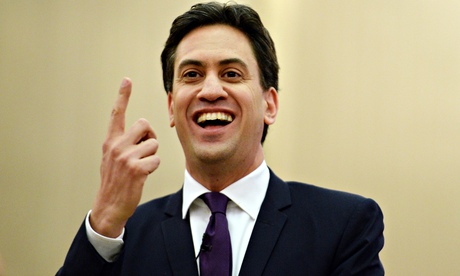
Had another Labour leader in happier times delivered the speech that Ed Miliband gave on Thursday, it would have been viewed as a mightily important moment. Just imagine, for instance, if Gordon Brown – during that fleeting honeymoon in 2007 – had explained, as Mr Miliband did yesterday, that reducing runaway inequality was his whole purpose in politics, and laid the blame for it squarely on a view “I abhor”, the presumption that “the success of the country depends on a few at the top”. A stark line under the Blair years would have been drawn and people would – whether with excitement or dread – have looked forward to redistributive budgets and radical policy papers.
As it is, the speech was not given on the glad, confident morning of a prime minister in his first flush of power, but by an opposition politician clambering out of a very deep hole. As such, the ultimate significance of Mr Miliband’s words is not a given, but entirely depends on whether or not he finally succeeds in beginning to reset the electoral weather. There are, of course, many risks in attempting such clarity of definition. The mood is world-weary, people having grown justifiably cynical about transformative talk, and there is a post-collectivist culture, where the failure of class to translate into solidarity as it once did is posing problems for social democrats across the west. And these dangers only arise after a great prior obstacle is cleared: persuading a country, overwhelmingly consumed by things other than politics, to pay any attention at all.
People stopped listening to Mr Brown after early hopes of clear purpose gave way to the sort of nip-and-tuck manoeuvres that abolished the 10p tax rate to fund a middle-class giveaway. This suggests that – in grabbing attention, at least – there might be an advantage in being as emphatic as Mr Miliband was on Thursday. His unapologetic statement of values may help motivate a bewildered party, but he is deluded if he imagines that one ringing speech will cut through beyond it. Too often, he has come up with an idea, expressed it and then ticked it off his to-do list. If he has now settled on the unarguably timely twin themes of inequality and insecurity as his focus, he must work tirelessly to knit the raft of largely unknown micro-measures he has developed, on everything from employment to housing, into a story about them both. He must encourage his team to do the same, including those semi-detached colleagues who can reach those parts of the country that are disinclined to listen to him. And he must be utterly shameless about repeating himself. It is only at that point where the Westminster village is yawning because it has heard the phrases so often before, that anyone else will start taking them in.
Even now, at this frighteningly late stage in the game, there is also a need for further substantive thinking on several aspects of policy which could ultimately determine whether or not the electorate believes that the promise of a more equal country stands up. Does Labour have a distinct agenda on macroeconomics, or is it content to pick up where the coalition and the Bank of England leave off? How far, or not, is it willing to countenance public borrowing to invest? And what does it mean when Mr Miliband talks, as he did yesterday, of closing the deficit, but somehow doing so more fairly than the coalition?
For all the unanswered questions, the Labour leader did more than he has in a long while to give a sense of the sort of campaign he plans to lead. It was particularly heartening to hear him take Ukip’s reactionary programme to task without compromising, but also without insulting the intelligence of voters whose grim contemporary experiences lend genuine appeal to that party’s nostalgic promise to restore old certainties. The delicate balance Mr Miliband struck is one that has eluded all the Westminster parties, as they veer between aping Nigel Farage’s latest outburst and branding his supporters as fruitcakes.
Taking David Cameron to task will require even more delicate footwork and the Labour leader has more to do to prove himself equal to the task. But in his most confident performance in months, he confronted adversity, and did a good deal to hearten the diminished ranks of his supporters.