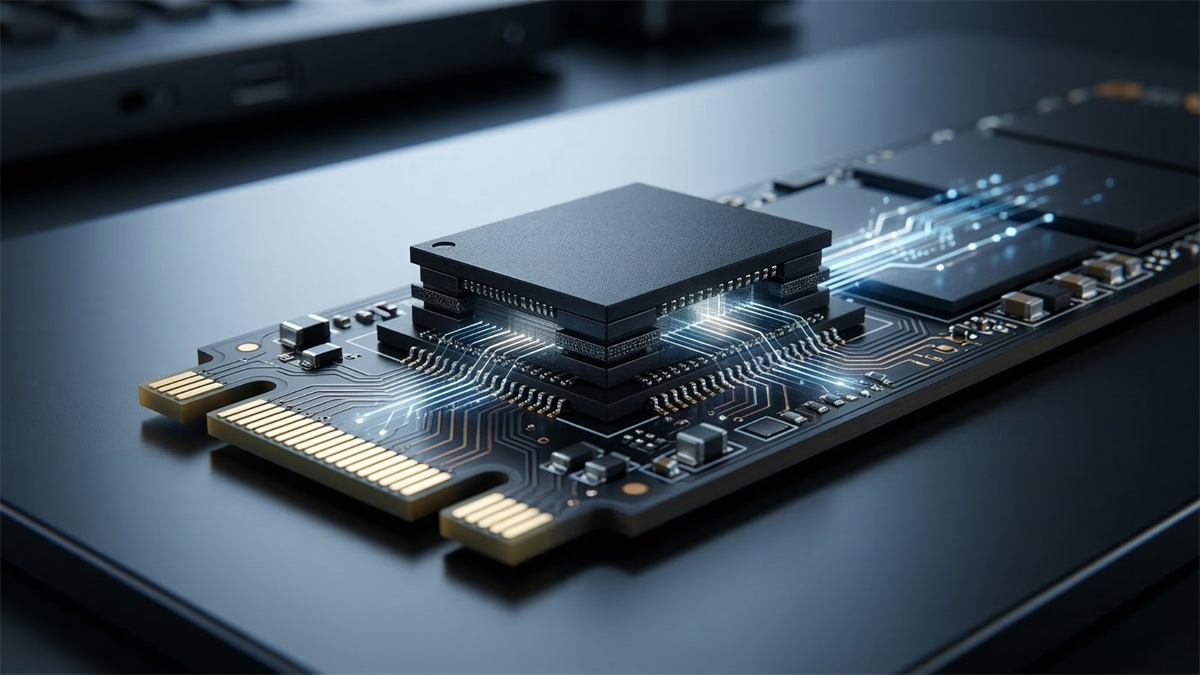
The artificial intelligence hardware trade, which for years has been a straightforward bet on GPU manufacturers, is undergoing a foundational shift. As the initial frenzy of building out AI training models matures, the market is waking up to a new, more persistent bottleneck: data storage.
The data access demands of enterprise-level AI inference are forcing a massive capital expenditure rotation from compute to memory, catching many off guard and igniting a supercycle in the NAND flash market. Heavy AI workloads are fundamentally re-architecting the data center, and legacy storage infrastructure is proving inadequate. This has triggered an imbalance between supply and demand, with global NAND fabrication capacity unable to keep pace. For investors, the narrative has pivoted. The primary beneficiaries are no longer just the companies that train the models, but the ones that feed them.
From Compute to Cache
The economics of artificial intelligence are being rewritten. For the first time, one of the primary constraints on performance is not processing speed, but data accessibility. Enterprise-grade AI requires constant, high-throughput access to vast datasets, a task for which older storage architectures are fundamentally ill-suited.
This reality has ignited a structural repricing across the memory sector. The most direct evidence appears in the enterprise SSD market, where contract prices have soared by as much as 80% over the last three quarters. This has moved past the hopes of a temporary spike and has set a new pricing floor established by hyperscalers aggressively hoarding capacity to prevent performance throttling in their AI platforms. This intense demand creates a powerful long-term tailwind for revenue and margin expansion, poised to continue for the foreseeable future.
Starving the Consumer to Feed the Cloud
In response to this surge in high-margin enterprise demand, memory fabricators are making a calculated strategic pivot. Production capacity is being ruthlessly funneled away from lower-margin consumer electronics and legacy nodes to serve the lucrative, high-performance needs of AI data centers.
This deliberate market squeeze is cementing unprecedented pricing power for the industry's leaders. By controlling the supply of the most advanced NAND flash memory, these suppliers are effectively setting the terms for the entire AI hardware ecosystem. They are no longer just component providers; they are gatekeepers to the performance and scalability of modern AI, a position that allows them to capture an outsized portion of the value being created in this technological revolution.
Read / Write: Hard Numbers Behind the Supercycle
This structural shift is translating directly into strong financial performance. The recent earnings reports from key industry players provide unequivocal proof of the supercycle's momentum. SanDisk (NASDAQ: SNDK), now a pure-play in the NAND flash market following its spin-off, posted a stunning 251% year-over-year revenue surge in its third quarter 2026 financial results.
This top-line growth is not just a function of volume; it reflects the immense margin expansion driven by pricing power, with SanDisk's third-quarter earnings per share crushing consensus estimates by over 63%.
Similarly, market behemoth Micron Technology (NASDAQ: MU) saw revenue grow 56.7% year over year, while the more diversified Western Digital (NASDAQ: WDC) reported a 45.5% increase in quarterly revenue.
These coordinated data points confirm a sector-wide updraft, further validated by competitor Samsung (OTCMKTS: SSNLF), which recently crossed the $1 trillion market capitalization threshold.
Whale Watching: Betting the Farm on Flash
Sophisticated market participants are acting with conviction. Micron Technology frequently trades at volumes exceeding 50 million shares, a significant jump from its daily average, indicating heavy institutional accumulation. High-profile investors have been actively building positions, lending credibility to the trade's durability.
This institutional confidence is mirrored by corporate action. Western Digital's board recently authorized a massive $2 billion open-market share repurchase program, giving it the ability to retire nearly 12% of its outstanding stock.
A buyback of this magnitude is one of the strongest signals management can send, telegraphing a deep belief that Western Digital's shares are undervalued and that the current data storage cycle has significant longevity. When institutional whales and corporate insiders are aligned, investors should take notice.
Supercycle or Super-Risky—Should You Invest or Forget About It?
Investors should still consider potential headwinds. Insider selling has been noted across the sector, though this activity appears to be routine profit-taking in line with the significant year-to-date gains rather than a signal of weakening fundamentals.
The semiconductor industry also remains cyclical and highly sensitive to broader macroeconomic pressures. A significant economic downturn could lead to a pullback in enterprise IT spending, potentially slowing the pace of data center upgrades. However, the demand driven by AI integration appears to be a powerful counterbalancing force that could insulate the sector from typical cyclicality. The evidence overwhelmingly suggests that the AI hardware landscape has fundamentally shifted. The transition to data-intensive workloads has ignited a durable pricing cycle in enterprise storage, positioning the memory sector as the next great frontier for growth.
The article "The Great AI Rotation: Cashing In on Data" first appeared on MarketBeat.