
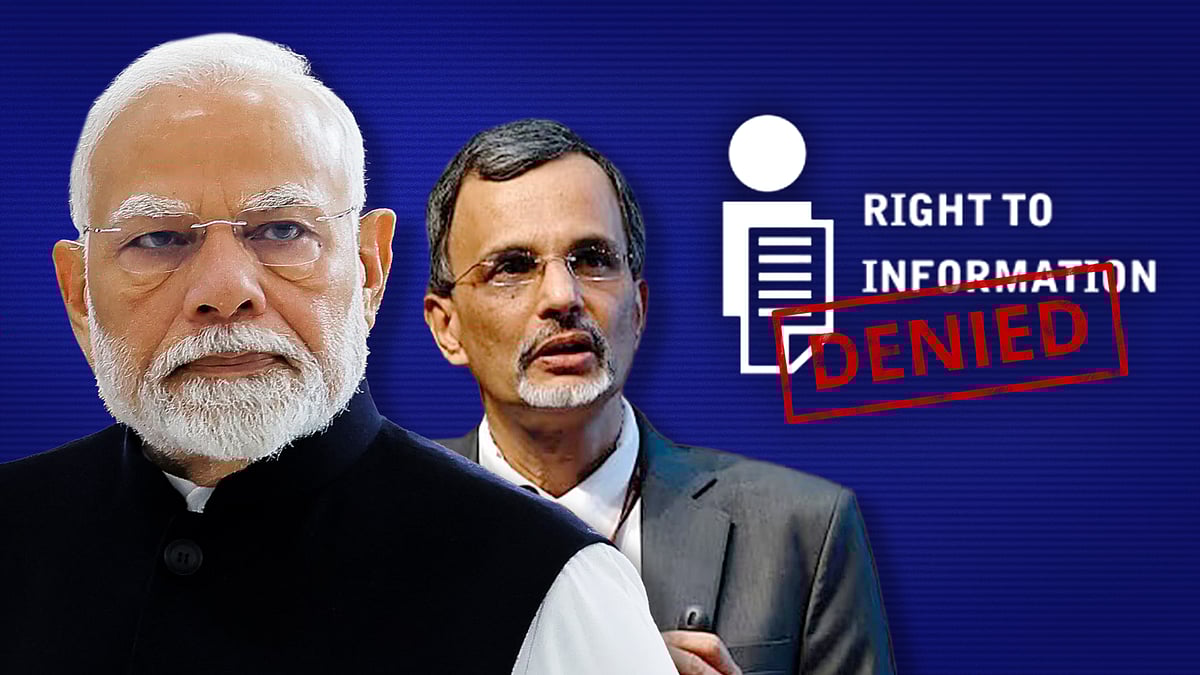
In the recent Economic Survey, a document meant to discuss the state of the economy, the Chief Economic Advisor (CEA) has decided to hold forth on the need to amend the Right to Information Act, 2005.
On page 660 of the Economic Survey, it complains that, “Draft notes, internal correspondence, and even personal records of officials often enter the public domain, sometimes even where the link to public interest is weak” and that such disclosures may constrain officials from deliberating freely and being held accountable for every “half-formed thought along the way”. The survey complains that “if every draft or remark might be disclosed, officials may hold back, resorting instead to cautious language and fewer bold ideas.”
This is not the first time the Delhi durbar has whined about the RTI Act blunting “bold thinking” by the bureaucracy.
This argument misses the fundamental point that the RTI Act is meant to make the bureaucracy worry about the consequence of their “bold ideas” on the citizens of this country who have to pay the price for bureaucratic incompetence.
It would aid, not hurt, Indian governance if Indian bureaucrats were to think more carefully before putting down their hare-brained ideas on the public record. We could do with fewer “half formed” ideas like the sovereign gold bond scheme or demonetisation or the special intensive revision of electoral rolls.
If greater transparency leads to our bureaucracy refusing to express their “bold ideas” on the public record, so be it – that is a worthwhile trade off in a country like India where the bureaucracy is rarely held accountable for its deeds of misgovernance.
But to return to the Economic Survey, the CEA after holding forth on all the ills and none of the positives of greater transparency, propose three reforms to the RTI Act: (i) A deliberative process exemption which would exclude brainstorming notes, working papers and draft comments until the record is final (ii) To exclude service records and staff records of civil servants and (iii) A narrowly defined ministerial veto to deny records that would constrain governance.
It takes a certain degree of chutzpah to suggest these reforms in an era where this government, with the assistance of a servile Central Information Commission (CIC), has already throttled the RTI Act with an enthusiasm it normally reserves for its bashing of religious minorities. More so when the bureaucracy has gone one step ahead of its political masters by ceasing to create public records which can be requested under the RTI Act.
As reported by journalists, an increasing number of bureaucrats are communicating through personal messaging services to avoid creating a public record. But nevertheless, let’s dig in deeper into the Economic Survey’s recommendations.
A deliberative process exemption
The first amendment sought by the Economic Survey is a “deliberative process exemption” for “brainstorming notes, working papers, and draft comments until they form part of the final record of decision-making”.
There already exists such an exemption for decisions being taken by the Council of Ministers, as acknowledged by the Economy Survey, until such time that a final decision is taken. This exemption in Section 8(i) is very wide and includes not just “cabinet papers” but records of deliberations of Secretaries and other bureaucrats. The courts have already interpreted the phrase quite broadly to “cover not only the deliberations of the secretaries and other officers, which form a part of the ‘cabinet papers’ but also any other information or material taken into account by the Council of Ministers in arriving at its decision”. Access to these documents is crucial to understand how decisions are taken within the government.
If I may illustrate this point with the help of the records pertaining to the Jan Vishwas Act, 2023, which decriminalised amongst other offences, the manufacture of substandard drugs. Here is a Cabinet Note prepared by the bureaucracy for the Jan Vishwas Act and which was provided to me under the RTI Act after the legislation was enacted by Parliament. As I explain in this piece, a perusal of the Cabinet Note demonstrates quite clearly that the bureaucracy did not disclose major implications of this bill to its political masters in the Cabinet – in essence the Cabinet had no clue on the implications of the legislation they were approving for introduction in Parliament.
The Economic Survey presumably wants to expand this exemption to cover decisions beyond those taken by Cabinet but is not clear on the exact contours of its demand. It is presumably targeting ministerial decisions which do not require Cabinet approval and can be taken by individual ministers and are currently not covered by Section 8(i). These include significant powers delegated to the government by Parliament. For example, making rules under a legislation is a task left to individual ministries and does not require Cabinet approval.
The remit of ministerial decision making is generally limited to implementation of policy and could range from making new rules or regulation or deciding on an “Environmental Impact Assessment”. These decisions can have consequences for how legislative policy is translated into action on the ground. The existing process for several ministerial decisions is actually participative with citizens having room to object and provide suggestions.
For example, it is a routine practice for all ministries to publish draft rules or regulations for comment before finalising the same – except these rules or regulations are never accompanied by a white paper or policy paper to explain the intent or policy of the rules in question.
I would argue that as citizens we actually need not just more transparency but more consultation at this stage. If the government is not going to make any background material on these decisions publicly available until a decision is taken it is not possible for citizens or stakeholders to understand the true intent of the government and participate in the decision-making process as fully informed citizens. In other words, the consequence of the Economic Survey’s suggestion would be to further distance citizens from governance in a country that likes to boast of being the mother of all democracies.
To exclude service records and staff records of civil servants
The second recommendation of the CEA is to exclude service records and staff records of civil servants. As already noted in the Economy Survey, these records have already been excluded from the purview of the RTI Act by the Supreme Court in the Girish Deshpande case on the grounds that it would violate the privacy of the public servant.
Post the Puttaswamy case, where privacy was declared to be a fundamental right by the Supreme Court, the privacy clause in the RTI Act has been further amended by Parliament via the Personal Data Protection Act. This was done by deleting the “public interest” exemption, wherein privacy could be over-ridden in the larger “public interest”.
That exemption no longer exists in the RTI Act and privacy has become an unqualified ground to refuse sharing personal information. It is therefore not clear what exactly the Economic Survey is demanding here – the law already provides the exemption it seeks.
The larger question here for citizens is why exactly should service records of public servants be considered private?
If a bureaucrat has a poor service record with several adverse entries, that deserves to be public knowledge. If complaints against a bureaucrat for misbehaviour or corruption or harassment have been recorded on his service record, that too should be public information. Similar information about our elected legislators, along with their wealth and assets (which is arguably private information) is already public. Why should bureaucrats who wield more power on the daily lives of citizens when compared to the individual elected legislator, be exempted from similar transparency requirements?
A narrowly defined ministerial veto to deny records that would constrain governance
The third and final recommendation by the Economic Survey is to introduce a “narrowly defined ministerial veto to deny records that would constrain governance”. The RTI Act already contains a long list of 10 exemptions in Section 8 of the RTI Act under which the government can deny information to citizens. These grounds cover national security to pending investigations to privacy etc. These grounds already offer the government a wide number of options to deny information. The Economic Survey wants to introduce a “ministerial power” over and above these exemptions.
This idea for a ministerial veto has been lifted by this nationalist government from the law in the United Kingdom where such an exemption does exist. That our nationalistic bureaucrats long for the worst that our former colonial masters have to offer should be of no surprise. But it takes a degree of malicious naivete to make such a recommendation in a country like India where the government is infamous for abusing its discretion to the hilt and where the RTI Act is already suffocated by the government through a variety of measures ranging from not staffing information commissions to stuffing information commissions with party loyalists. These measures have acted as a de facto veto. Though such strangulation of the transparency law does not take place in the UK.
Perhaps the Chief Economic Advisor who is in charge of the Economic Survey should first recommend British levels of transparency to our government before borrowing the worst of exemptions in English law. That he has little to say on the appalling levels of transparency within the Indian government is telling.
As an endnote, I should mention that these suggestions to further throttle the RTI Act would not have been surprising if they had been made by the bureaucracy. That these recommendations have come from the Chief Economic Advisor is surprising. Transparency in government is not within his mandate. Why did he feel compelled to make this awful recommendation at a time when the RTI Act is already floundering? Perhaps his next posting will give us the answer.
The writer was once a user of the RTI Act.
If you’re reading this piece, you’re not seeing a single advertisement. That’s because Newslaundry powers ad-free journalism that’s truly in public interest. Support our work and subscribe today.
Newslaundry is a reader-supported, ad-free, independent news outlet based out of New Delhi. Support their journalism, here.