
You came because the famous ones didn't answer you
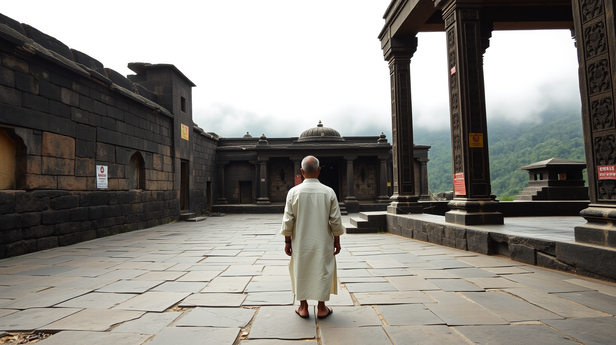
The priest at Katarmal doesn't ask where you've come from. He asks what you're carrying.Not your bag. Not your offering. He means the thing you brought without meaning to, the grief you've been rationalising, the decision you've been postponing, the version of yourself you're still pretending is fine. Katarmal is a 9th-century sun temple in the Almora district of Kumaon, dedicated to Burhadiya Aditya, a form of the sun god older and less ceremonial than the one worshipped at Konark. It sits on a ridge above a village that barely registers on maps. The stone is dark. The courtyard is small. There are sixty-odd subsidiary shrines arranged around the main one, and the whole complex feels less like a monument than like a conversation that has been going on for twelve centuries without you.You probably went to Kedarnath or Badrinath first. Or you planned to. And somewhere in the logistics, the helicopter bookings, the crowd-management systems, the WhatsApp groups for pilgrimage packages, something felt wrong. Not wrong like a bad sign. Wrong like a costume that doesn't fit. The Char Dham circuit is real and sacred and it carries the weight of millions of sincere prayers. But it is also an infrastructure now. The ancient temples of Kumaon are not infrastructure. They are still just temples.
The temple doesn't perform for you
Baijnath, on the banks of the Gomti river near Bageshwar, is an 13th-century Shiva temple complex that archaeologists and the Archaeological Survey of India have documented carefully and that almost nobody outside the region visits with any real intention. The carvings on its outer walls show apsaras, river goddesses, erotic couples, and scenes of daily medieval life, not because the builders were irreverent, but because they understood that the sacred and the ordinary were the same material. You stand in front of those walls and you realise the temple is not trying to impress you. It is not arranged for your arrival. The lamps are lit on a schedule that has nothing to do with tourist hours. The priest will finish his work whether you are watching or not.This is the thing that discomforts people who arrive from the Char Dham mindset. On the major circuits, the pilgrimage has a shape: you go, you queue, you receive darshan, you return. The transaction is legible. At Baijnath, at Katarmal, at the Golu Devata shrine in Chitai near Almora, the transaction is not legible. The Golu Devata temple is famous among Kumaonis as a court of justice. Devotees write letters to the deity on stamp paper, petitioning him to resolve disputes, deliver verdicts, right wrongs. The temple walls and trees are covered in thousands of these letters and the bells that devotees hang as thanks when their petitions are answered. It looks chaotic to an outsider. It is in fact extremely precise. The god here is not a symbol. He is an authority.And you, arriving with your incense and your rehearsed prayer, have to decide whether you actually believe that, or whether you've been treating worship as atmosphere.
What the hills ask that the circuit doesn't
The climb to most of these shrines is not dramatic by Himalayan standards. The Patal Bhuvaneshwar cave temple in Pithoragarh district requires a descent rather than an ascent, you go down into the earth through a narrow limestone passage to reach a series of natural cave chambers that contain rock formations the priests identify as Shiva, Brahma, Vishnu, and the four yugas. The experience is physically claustrophobic and theologically vertiginous. You are inside the mountain. The stone around you is not carved by human hands. Whatever you brought in with you, your assumptions about what a temple should feel like, your comfortable relationship with the divine as something you visit and then leave, none of it fits in the passage.The hills ask this of every person who comes: can you be in a place that is not arranged for your comfort, and still be present? The Char Dham circuit, for all its genuine sanctity, now has the infrastructure of comfort. Resting points, route markers, emergency services, phone signal. The Kumaon temples outside the circuit have some of this, and none of the rest. The trek to Nanda Devi temples in the upper reaches of Kumaon involves passes where weather turns without announcement. The ancient shrines at Jageshwar, a cluster of over a hundred temples in a deodar forest in Almora district, some dating to the 7th century, receive visitors who sometimes arrive to find the forest so quiet that they can hear their own breathing. That silence is the question.
The answer you bring back isn't the one you expected
People who make this circuit, if you can call it a circuit, since it has no official name and no governing body and no app, tend to describe the experience in similar terms afterward. Not peace, exactly. Not revelation. Something more like clarity about what they'd been avoiding. One woman from Lucknow who had done Jageshwar three times told a fellow traveller that the first time she came looking for a sign, the second time she came because she liked the deodar smell, and the third time she came because she finally had a real question. The third visit was the only one that changed anything.The ancient temples of Kumaon have been asking that question since before the pilgrimage industry existed. They will be asking it after. The stone at Katarmal has weathered a thousand monsoons. The letters at Chitai have been accumulating for generations. The cave at Patal Bhuvaneshwar was old before anyone thought to give it a name.What all these shrines share is not a deity or a dynasty or an architectural school. They share the assumption that you arrived with something unresolved, and that the point of coming was not the darshan but the honesty required to ask for it. The Char Dham gives you the route. These temples give you the question. And the question, it turns out, was always the same one the priest at Katarmal asked at the beginning: what are you carrying?