

At the heart of today’s car industry, there is a contradiction. Ordinary car shoppers, our readers, and even friends of mine tell me they want cheaper cars. But send them into a showroom, and they’ll demand all-wheel-drive, a 65-inch infotainment screen, a thousand horsepower and room for 11 people. Making a great affordable car, then, is about squaring this circle.
With the new Leaf, Nissan did it. The company created a car that’s packed with modern tech, practical and cheap enough to solve your electric driving needs
The company created a car that’s packed with modern tech, cheap enough for average Americans and charming enough to make you want it. That’s why the 2026 Nissan Leaf is our Breakthrough EV Of The Year.
(This story is part of the Breakthrough Awards, our series on 2025's best EVs. Only one will be our Breakthrough EV of the Year. Read the other stories here.)
Gallery: 2026 InsideEVs Breakthrough EV Of The Year: The 2026 Nissan Leaf
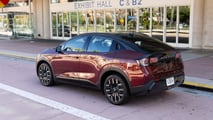



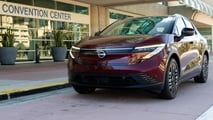

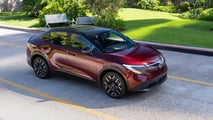
The Art Of Subtraction
Any car company can weave desire out of excess. Add enough power or space, and you’ll win your share of maximalist customers. But here lies the dilemma: When every automaker chases size, power and profit margins, we end up with a new car market where the average car costs over $50,000.
The Nissan Leaf does not cost $50,000. It costs $30,000 to start, though realistically, you will see most of them trading for $35,000-$40,000. That’s no small sum by compact Nissan standards, but for the EV world, it’s a deal that usurps our last Breakthrough EV award winner, the Chevy Equinox EV.
The Equinox EV offered 319 miles of range for $35,000. When I spoke to a Nissan product planning executive after the Leaf reveal in April, he said it’d be hard to beat Chevy’s base price. But the company managed: The Leaf is now the most affordable way to get a long-range EV. So how did Nissan do it?
The art of subtraction. The Leaf is a size class below cars like the Equinox EV, competing more with things like the Hyundai Kona EV and still-to-come 2027 Chevy Bolt. It is available exclusively with front-wheel drive, and there’s only one motor option: A 214-horsepower synchronous motor making 261 lb-ft of torque. Nothing here is fancy. But that means Nissan can offer it at a price point that competitors can’t really match. And the range is right on target for an everyday, livable EV in 2025: up to 303 miles on the base S+ trim level.
2026 Nissan Leaf: This Is The One We'd Buy
2026 Nissan Leaf SV+
You can get more range on an S+ and more gadgets on a Platinum, but the mid-range SV+ offers the best value, with all of the tech features you need, leatherette seats, available two-tone paint and 288 miles of range. Pricing for the SV+ starts at $35,725.
Yet while other manufacturers penalize you for taking the cheap route with drabby looks, cut corners and ho-hum driving experience, the Leaf charmed all five of our judges with its cute design, expansive feature set and refined ride. For its mid-$30,000 price tag, the SV+ model, with Google Built-In for excellent navigation and voice controls, vehicle-to-load functionality, leatherette seats and 288 miles of range, really stands above.
“This is perfectly priced,” staff writer Suvrat Kothari said.

A Friendly Face
But while pricing is important, it’s not the only reason that the Leaf won. So far, affordable EVs have typically been either severely limited in the real world, spartan inside or charmless outside.
This car’s predecessor, the last Leaf, was like that for a long time. It wasn’t alone. The Chevy Bolt was charming to drive and attainable, but it charged too slowly for road trips. The Hyundai Kona EV charges better, but feels more like a compliance car. It’s also one of the only Leaf competitors left standing.
Unable to launch compelling products at this price, most manufacturers focus exclusively on the “compact” segment, with cars like the Ford Mustang Mach-E, Chevrolet Equinox EV, Hyundai Ioniq 5 and Volkswagen ID.4.
But there are EV buyers who either want a smaller car or can’t afford a larger one. And by building the Leaf on the bones of its recently departed Ariya, itself a larger model, Nissan gave the Leaf the same sort of quiet, composed ride you’d get in a larger crossover, but in a cheaper, friendlier package.
That’s clear from first approach, as a two-tone blue-and-black Leaf commands gazes like few sub-$50,000 cars. It’s amazing what a great color can do. It looks classy inside, too, with an expansive infotainment display, great materials for the class and excellent seats. The only real miss is the “shifter,” a collection of flat, cheap-looking square buttons arrayed underneath the infotainment screen.
“I think the drive selector is hilarious,” senior editor Tim Levin said. It looked as though Nissan just “pulled some air conditioning buttons out of the parts bin and threw them on the dash,” he added.
Levin also noted the other major drawback of the Leaf’s interior: Despite Nissan calling the new model a “crossover,” the back seat is actually smaller than the one in the outgoing hatchback. If you have more than one kid, you’ll probably still want to go for a larger car.
Every Feature You’d Want
If you can accept the Leaf’s size and front-wheel-drive motivation as necessary drawbacks, the rest is upside. The Leaf feels well-appointed and thoughtfully designed. The LED taillights, available two-tone interior, Bose audio system and electronically dimmable panoramic moonroof make the top-trim Platinum far more luxurious than anything else in its class. In fact, I’d say the SV+ is far nicer than that base model Chevy Equinox EV.
Nissan’s ProPilot driver assistance suite is also solid, able to comfortably handle stop-and-go traffic and keep you centered most of the time. Combined with the excellent ride quality and airy cabin layout, this makes the Leaf a pleasant place for long highway slogs.
When you get to the destination, you’ll also benefit from thoughtful touches Nissan included for the EV ownership experience. The Leaf SV+ gets standard vehicle-to-load capability, allowing you to export power to your campsite, power tools or home. And thanks to the thoughtfully designed software, you can leave your V2L functions running overnight, or sleep in the car with the climate control enabled. These are simple touches, but things that rivals often miss.
As a whole, I can’t say there’s any must-have feature the Leaf is missing. Despite being the cheapest new EV you can buy, you can load it up with every option and still only spend as much as the cheapest, most cut-rate Model Y Standard costs.
“This feels like an EV made by people who have done this before, because they have,” Editor-in-Chief Patrick George said. “Nissan was as much an early EV pioneer as Tesla, but then it dropped the ball. We’ve been waiting for this company to get back in the game, and now it finally has, to show everyone else how it’s done.”
A Joyful Car
There lies the rationalist case for the Leaf. But frankly, I’m not sure that would have clinched this award on its own. While the Leaf is thoughtfully designed and well-priced, that alone isn’t enough to outflank tough competition from the Hyundai Ioniq 5 and Tesla Model Y.
The Leaf won because it has something most competitors lack: Personality. From the retro design flourishes—the taillights are a callback to the Nissan 300ZX of the 1990s—and the bold paint colors to the tire-spinning, torque-steering front-wheel-drive flickability, the Leaf is one of the few EVs out there that doesn’t take itself too seriously.
That’s aided by its relatively tidy 4,200-ish-pound curb weight, which makes it feel livelier than most of the bloated electric SUVs on sale today. Staff writer Kevin Williams noted that the steering in the Leaf is numb, and a few judges bemoaned a mushy brake pedal, but everyone seemed to walk away from the Leaf smiling.
That, then, is the real breakthrough: The Leaf has the feature set and maturity of a large car, with the playful personality and affordable price of a small car.
The Right Car, The Right Time
It couldn’t have come at a better moment. The Leaf arrived right as the tax credit went away, causing the real-world price of may EVs to skyrocket. Americans may have snapped up $50,000 compact electric crossovers in droves last year, but as the economy tightens and prices climb, cheap cars are more important than ever.
Will that make the Leaf a smash hit? Probably not. Nissan has said that it doesn’t plan to sell a ton of Leafs here, likely due to the tight margins in the EV business, and the import tariff President Trump imposed on Japanese-built vehicles like the Leaf. If the climate in America were different, it probably could’ve been a huge volume-seller, but now Nissan’s in more of a “wait and see” moment with this EV.
But the other reason is more obvious to those who follow the new car market: Small vehicles usually struggle in America.
The Leaf may not be able to change that. Yet electric cars stand to benefit the most from downsizing. A larger vehicle requires a larger battery for the same range, increasing weight, which decreases efficiency and range. That problem scales exponentially, which is why large EVs are so absurdly expensive and heavy. They can’t compete with gasoline.
But at the lower end of the market, the payoff is huge. Small EVs offer better driving dynamics, lower running costs and far more range for your dollar. And with electric motors, going small means you no longer give up power or speed. That means every small EV is fun to drive and cheap to own.
Yet no other affordable EV is as luxurious, feature-packed and refined as the Leaf. It captures all of the charm of a cheap car with the maturity of a flagship EV, making it the first model in the segment to feel genuinely aspirational. I have always respected the Bolt, and the Kona. But I actually want the Nissan.
Among our field of five exceptional cars, the Nissan is the one I enjoyed driving the most—even against options that cost anywhere from $20,000 to $100,000 more. It is not just the best value on the EV market; it is a renewed attempt to show car buyers that small cars don’t have to feel like a compromise.
While we end 2025 on a down note as U.S. EV sales trail off without incentives, we are very excited for what’s next: more electric models with lower prices, longer range, better batteries and improved charging tech. The era of the 220-mile expensive spaceship is over. After years of investments, R&D and learning what works and what doesn’t, the electric field is shifting to have more choices with less compromise than ever before.
The Leaf sets the tone for where everything else should go next. That makes it a glimmer of hope for the EV market, and our 2026 Breakthrough EV of the Year.
Nissan LEAF
Contact the author: Mack.hogan@insideevs.com.