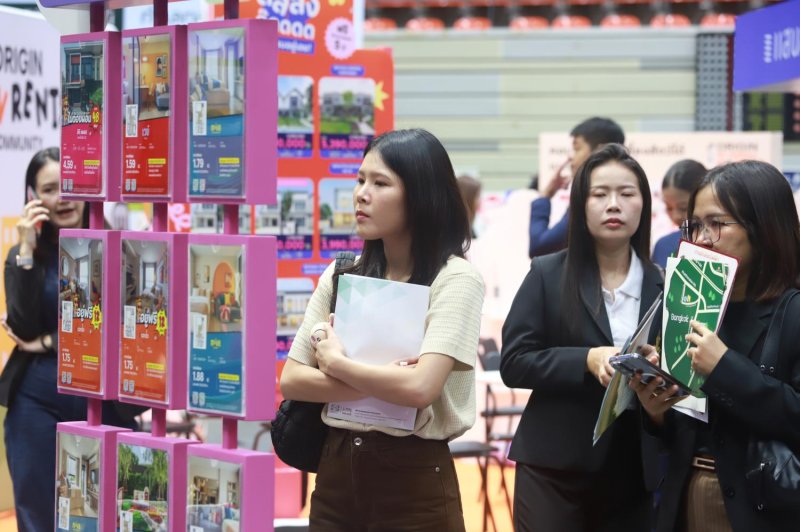
The proportion of consumers with no plans to buy a home within five years has risen sharply to 56%, from 47% a year earlier, marking the highest level in four years as concerns about the economy weigh on purchasing decisions.
According to Siam Commercial Bank Economic Intelligence Center (EIC), worries about the economy was the most common reason among Thais with no plans to purchase a home, accounting for 15% of respondents, up from 7% a year earlier.
Income levels and household expenses that made homeownership less affordable was another key factor, cited by 15% of respondents, down from 19% last year.
Meanwhile, the proportion of respondents who viewed housing prices as too high more than doubled to 9%, from 4% a year earlier.
Concerns about household debt and limited access to mortgage financing remained unchanged at 7% and 1%, respectively.
EIC noted some prospective buyers were reluctant to proceed with mortgage applications or chose not to apply at all because they believed their loan applications would be rejected.
Others decided against applying from the outset after assessing that their financial position was not strong enough to qualify for a housing loan.
The research centre conducted residential real estate surveys in March the last four years, and the share of consumers with no plans to buy a home within five years rose to 56% this year, up from 50% in 2023, 44% in 2024 and 47% in 2025.
The 2026 survey covered 1,528 respondents and found 38% of those with no plans to purchase a home cited already owning a home or paying off a mortgage as the main reason, down from 44% a year earlier.
MAJOR CONCERNS
Among the key issues respondents wanted the government to address to improve access to homeownership was the rising cost of living outpacing income growth, which has reduced affordability and borrowers' ability to service housing loans. This issue was cited by 32% of respondents, followed by household debt burdens, which affect both access to new mortgage financing and the ability to repay existing housing loans, at 29%.
Other major concerns were the high prices of new homes, cited by 16% of respondents, and stricter mortgage lending criteria imposed by financial institutions, at 15%.
Meanwhile, 8% of respondents highlighted economic volatility, which has led many people to postpone or cancel their home purchase plans.
Respondents also called for short-term government measures to improve housing affordability, with 44% seeking support for people to become homeowners, such as soft loan schemes and affordable housing programmes for low-income earners.
Roughly one-fifth of respondents sought assistance for borrowers facing difficulties with mortgage repayments, including more flexible repayment terms for borrowers with good credit records, debt restructuring programmes, debt moratoriums and credit record rehabilitation.
Another 18% of respondents called for measures to reduce homebuying costs and tax incentives for homeowners, such as extending the transfer and mortgage registration fee cut to 0.01%, due to expire at the end of this month, as well as extending the temporary easing of loan-to-value rules, expiring on June 30, 2027.
Regarding tax incentives, respondents suggested expanding tax deductions for homebuyers as well as reducing land and building taxes for homeowners.
RESIDENTIAL OUTLOOK
According to EIC, Thailand's residential property market is expected to contract this year, with a gradual recovery anticipated over the medium term amid persistent economic headwinds.
Key challenges include the slow pace of Thailand's economic recovery, elevated household debt, and tighter mortgage lending criteria imposed by financial institutions.
Demand remains lukewarm as consumers postpone home purchases and property investments due to economic uncertainty, exacerbated by the war in the Middle East, which weighs on domestic and foreign purchasing power.