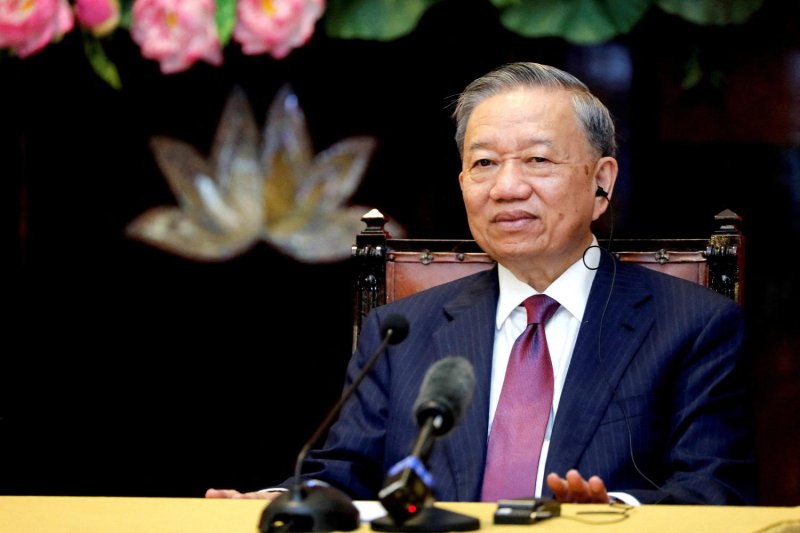
When To Lam -- Vietnam's President and General Secretary of the Communist Party -- arrives in Bangkok tomorrow, he will find a different Thailand, one increasingly prepared to align itself with Vietnam's strategic and economic trajectory. Over the past two decades, bilateral relations have grown increasingly dynamic. It is no exaggeration to say that Vietnam has become one of Thailand's closest neighbours despite the absence of a shared border. This state visit will further reinforce the two countries' commitment as comprehensive strategic partners.
Mr To's three-day trip is historic, as he simultaneously holds the posts of President and General Secretary of the Communist Party of Vietnam. His visit comes at a time of profound geopolitical flux. Amid shifting global dynamics, Vietnam has emerged as one of the region's key economic drivers. With projected GDP growth of 8% this year -- the highest in Southeast Asia -- Vietnam is eager to raise its regional and international profile and play a larger role in shaping the regional order. To achieve its ambition of becoming a high-income country by 2045, Vietnam will need a stable region anchored in a rules-based international order.
Thailand and Vietnam, the two largest economies in mainland Southeast Asia, are well-positioned to help shape the region's future together. After establishing a strategic partnership in 2013 and upgrading ties to an enhanced strategic partnership in 2015, both countries have steadily deepened cooperation over the past decade. In May last year, Thailand and Vietnam elevated relations again to the level of a comprehensive strategic partnership.
The visit, which runs until Friday, also coincides with the 50th anniversary of diplomatic relations between Bangkok and Hanoi. Over the past two decades, the modern Thai-Vietnamese relationship has evolved into a sophisticated and deeply integrated partnership that extends far beyond conventional diplomacy. Both countries are now seeking to expand cooperation into more diversified and strategic areas.
Notably, attitudes in Thailand towards Vietnam have also changed significantly. In the past, many Thais viewed Vietnam as a competitor. Today, Vietnam is increasingly seen as a trusted partner, with whom cooperation is both valuable and productive. This shift in perception has encouraged leaders on both sides to deepen high-level cooperation.
Indeed, the Thai-Vietnamese partnership has become an increasingly important anchor for regional stability as intensifying US-China rivalry forces Southeast Asian nations to navigate a more fractured Indo-Pacific landscape.
Dang Trung Dung of the Diplomatic Academy of Vietnam has argued that Thailand and Vietnam have developed a "high level of political trust", while Bangkok also plays an important geopolitical role to Vietnam's west. Both countries are key players in the Mekong subregion. From Thailand's perspective, closer strategic alignment with Vietnam is also important in guarding against hegemonic ambitions by outside powers.
In many respects, Bangkok and Hanoi complement each other diplomatically through their shared "bamboo diplomacy" approach. By coordinating their flexible and pragmatic foreign policies more closely, both countries can leverage their respective diplomatic strengths and networks to strengthen Asean centrality and reinforce the foundations of good neighbourly relations.
Vietnam maintains a complex, deeply rooted and often fraternal relationship with China, enabling Hanoi to manage Beijing's actions with seasoned pragmatism. Thailand, meanwhile, remains one of Washington's five treaty allies in the Indo-Pacific and continues to maintain longstanding security ties with the United States. Rather than allowing these differing relationships to divide them, Bangkok and Hanoi have adopted similar balancing strategies towards the major powers.
As geopolitical fragmentation intensifies, the two countries should consider upgrading their Defence Policy Dialogue to the ministerial level, potentially with participation from their foreign ministries. Thailand should also broaden Vietnam's participation in the annual Cobra Gold exercises. At present, Vietnam participates in selected joint naval exercises only as an observer.
Importantly, this strategic vision is underpinned by strong economic ties. Vietnam is Thailand's sixth-largest trading partner globally and the second-largest within Asean.
Thailand, meanwhile, is Vietnam's largest trading partner within Asean and one of its leading global partners. Bilateral trade has expanded steadily in recent years into the tens of billions of US dollars, although Vietnam has consistently recorded a trade deficit with Thailand. Both governments aim to raise bilateral trade to US$25 billion (812 billion baht) in the coming years.
Thai investment in Vietnam is also growing steadily. Thailand currently ranks as Vietnam's eighth-largest foreign investor, with more than 700 Thai companies involved in 792 projects worth a combined US$15.4 billion since 1987. This economic interdependence runs deep: more than 55% of Thai exports to Vietnam consist of intermediate goods -- including auto parts, petroleum products, chemicals, plastics and electronic components -- that support Vietnam's export-oriented manufacturing sector.
However, to better withstand challenges such as global energy shocks, both countries must further integrate their economic strengths through existing frameworks. One such initiative is the "Three Connects" strategy.
The first pillar focuses on strengthening supply chains in key sectors such as electronics, food processing, petrochemicals and auto parts to improve efficiency, lower production costs and reduce trade barriers.
The second seeks to connect local economies in northeastern Thailand with Vietnamese provinces by supporting SMEs, expanding business ties and distributing income more broadly at the community level. At present, there are 20 sister-city partnerships between the two countries.
Mr To's first stop will be in Udon Thani, home to around 60% of the 100,000 overseas Vietnamese living in Thailand. The Vietnamese community there plays an important role in the local economy. The world's first "Vietnam Town" is also located in Udon Thani.
Finally, both countries are working together to promote sustainable economic development. Thailand's Bio-Circular-Green (BCG) economic model aligns well with Vietnam's Green Growth Strategy. However, structural obstacles hindering investors and implementation under the Three Connects framework must still be addressed.
Maritime security cooperation will also require greater attention in the years ahead. Both countries must comply fully with international standards on illegal, unreported and unregulated (IUU) fishing to prevent encroachment and illegal fishing in each other's waters. Fortunately, institutional mechanisms to address these issues are already in place. The signing of a memorandum of understanding between the Thai Maritime Enforcement Command Centre and the Vietnam Coast Guard in August 2024 demonstrated a shared commitment to tackling illegal fishing through institutionalised law enforcement cooperation.
Labour mobility and people-to-people exchanges also offer considerable untapped potential. Vietnam's population of 102.3 million is significantly younger than Thailand's and could help meet growing demand for skilled labour in the digital economy. Both countries should move quickly to revise and update their labour agreement. At present, only 12,389 Vietnamese nationals hold work permits in Thailand.
Tourism is another area showing positive momentum. Airlines are planning to expand the current 250 direct flights per week linking Thailand with six Vietnamese destinations. Last year, more than one million travellers moved between the two countries. Thailand is also home to three memorial sites -- in Phichit, Udon Thani and Nakhon Phanom -- dedicated to the life and legacy of Ho Chi Minh, who lived in Thailand during Vietnam's struggle for independence from France.
Mr To's visit presents an opportunity for Thailand and Vietnam to deepen cooperation further in pursuit of shared interests, while promoting peace, prosperity and stability across the region.
Kavi Chongkittavorn is a veteran journalist covering regional affairs.