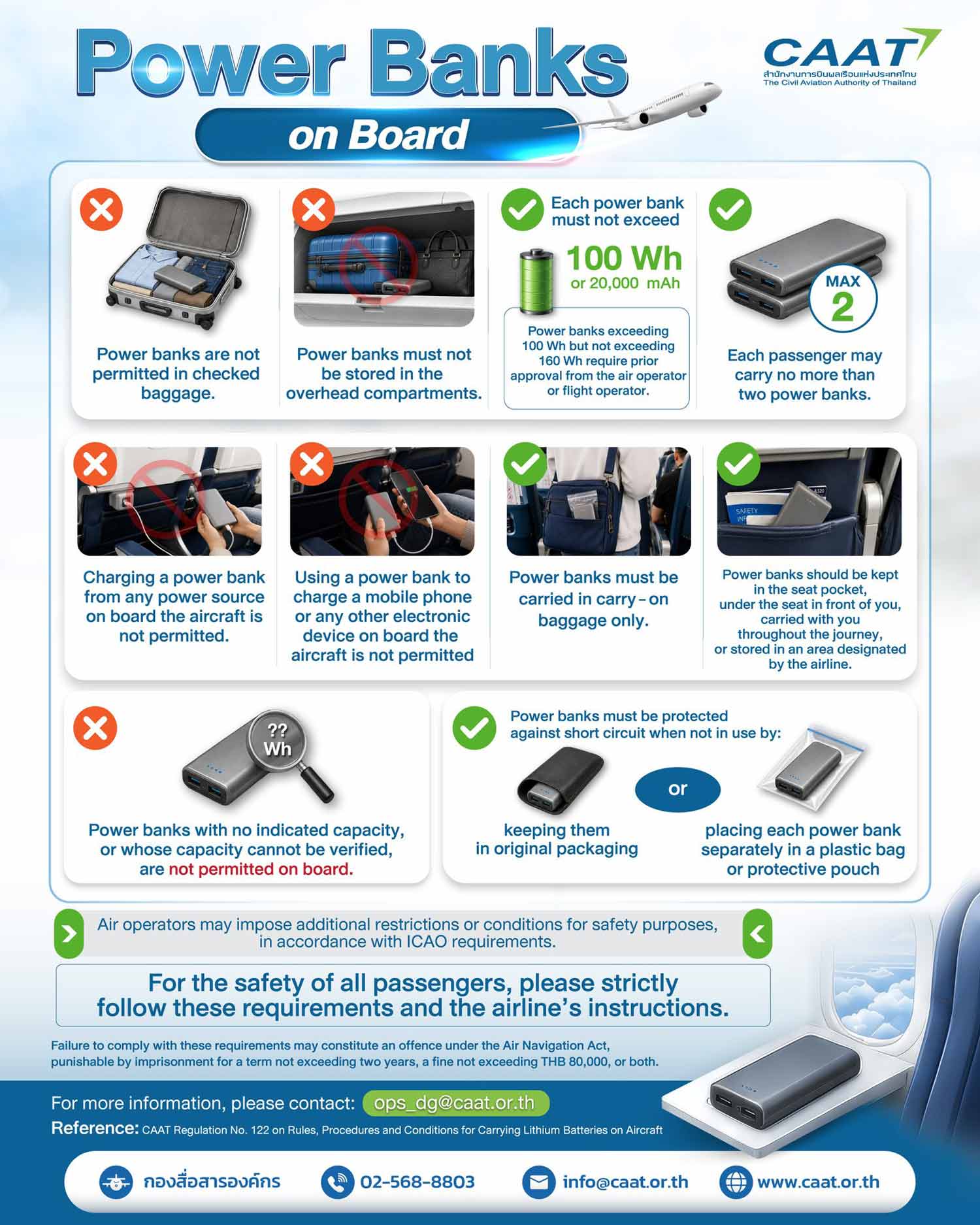
The Civil Aviation Authority of Thailand has announced new regulations on air travellers with power banks, setting device capacity limits and banning them in checked baggage, among other restrictions.
The rules (see graphic below) are largely in line with International Civil Aviation Organization guidelines and are already being enforced by many airlines worldwide, including Thai Airways International.
The crackdown followed a fire on an Air Busan plane before takeoff in South Korea in January 2025, which raised alarm bells after an initial investigations suggested a power bank might have been responsible.
Locally, a Bangkok Airways flight from Samui to Hong Kong had to divert to Bangkok after a power bank caught fire in July 2025. A similar incident took place onboard a Thai AirAsia flight in January 2024.
Staff in both cases brought the fires under control swiftly but the incidents underlined the need for tighter controls.
“This reflects that lithium batteries significantly threaten the safety of passengers, crews and overall air transport operations,” the CAAT said.
Under the new regulations, power banks must be in carry-on baggage only and they cannot be put in checked baggage.
The capacities of carried power banks must not exceed 100 watt-hours (Wh) or 20,000 milliampere-hours (mAh). Batteries with capacities between 101 and 160 Wh need approval from airlines before being brought aboard aircraft.
Power banks with unclear labels or no visible capacity rating are not permitted on board, it said.
Each air traveller cannot carry more than two lithium batteries.
The CAAT prohibits power banks from being charged or being used to charge any mobile phone or electronic device during flights.
Travellers cannot put power banks inside overhead compartments but must keep them in easily reachable locations such as seat pockets, space under seats in front of them, and their pockets. This is to allow cabin crew to quickly deal with any situation including unusual heat, smoke or fire.
Passengers are required to prevent short circuits of power banks by, for example, keeping the devices in their original bags or protective pouches to prevent power banks from contacting other metal objects or other batteries during their flights.
CAAT director-general ACM Manat Chavanaprayoon said many air passengers carried lithium batteries and power banks but such devices could overheat, give off smoke or cause fire if they were broken, knocked or used improperly.
“The regulations are not aimed at restricting passengers but at ensuring safety in line with the guidelines of the International Civil Aviation Organization and many other countries to maximise air transport safety in Thailand,” he said.