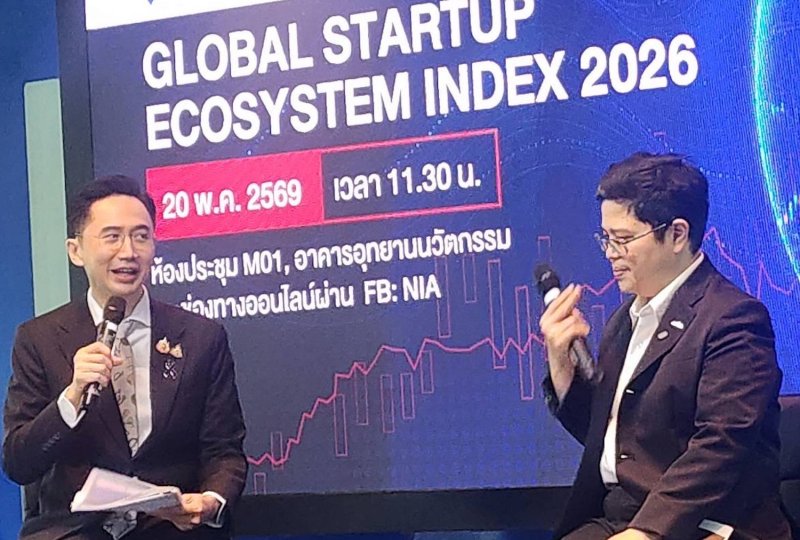
Thailand has entered the top 50 in global startup rankings for the first time in six years, while cementing its position as Southeast Asia’s leading medical technology hub, according to the 2026 Global Startup Ecosystem Index released by StartupBlink.
The ranking, compiled by the global startup research and analytics platform, covers 120 countries and more than 1,500 cities worldwide, placing Thailand 49th globally for its highest position in six years, following Singapore, Indonesia and Malaysia in Southeast Asia.
Yodchanan Wongsawat, the minister of higher education, science, research and innovation, said Thailand posted one of the fastest growth rates among the world’s top 50 nations, expanding by 62.6%. Thailand secured the top ranking in Southeast Asia for medtech startups and eighth globally in the sector.
The rankings underscore the country’s growing appeal as a regional innovation and technology hub, he noted.
Bangkok, Chiang Mai and Phuket emerged as key magnets for startups, investors and digital nomads. Bangkok climbed five spots to rank 76th globally and fourth in Southeast Asia, while also being recognised as the leading robotics city in the region and 17th worldwide.
Meanwhile, Chiang Mai and Phuket recorded growth of 91.6% and 85.9% respectively, reflecting rising momentum in regional innovation clusters beyond the capital.
Pattaya, Samut Prakan, Pathum Thani and Nakhon Pathom were new entrants in the rankings, placing Thailand third for most ranked startup cities in Southeast Asia.
New growth engine
Mr Yodchanan said the government views startups as a critical new growth engine capable of accelerating the digital economy, strengthening targeted industries, creating high-skilled jobs and enhancing the country’s global competitiveness.
“Thailand entering the top 50 and becoming the leading medtech hub in the region signals growing confidence from investors, entrepreneurs and international innovation networks,” he said.
The Ministry of Higher Education and the National Innovation Agency (NIA) are accelerating efforts to strengthen the country’s innovation systems through initiatives such as matching fund schemes, university holding companies and the expansion of Startup Thailand League.
Mr Yodchanan said Thailand’s rise in medtech highlighted the country’s readiness to tap into the rapidly expanding global wellness economy, which is seen as a future growth driver.
Despite the progress, he acknowledged startups still face challenges such as limited access to funding, insufficient testing opportunities for innovations and fragmented support networks.
Krithpaka Boonfueng, executive director of the NIA, said the agency plans to develop Bangkok’s Ari district into a dedicated innovation and startup community hub aimed at connecting entrepreneurs with global investment, technology and innovation networks.
Eli David Rokah, chief executive and co-founder of StartupBlink, told the Bangkok Post that Thailand’s improvement reflects a gradual stabilisation of its startup landscape after years of sluggish momentum, although structural weaknesses continue to limit the country’s regional competitiveness.
Global outlook lacking
Thailand still faces major structural obstacles if it hopes to become a leading regional startup hub, he noted.
One of the most urgent challenges is the country’s limited global orientation. Many Thai startups continue focusing primarily on the domestic market rather than building products and services for regional or international expansion.
“Startup founders need to adopt a broader mindset if Thailand wants to compete more effectively within Southeast Asia and globally,” said Mr Rokah.
Compared with regional rivals, Thailand still faces weaknesses in taxation, investment incentives, banking systems and regulatory clarity, making it less attractive for entrepreneurs seeking to establish scalable global businesses.
As a result, some high-potential founders are choosing to register companies in more business-friendly jurisdictions overseas, a trend analysts described as a serious long-term risk for Thailand’s innovation economy, he said.